
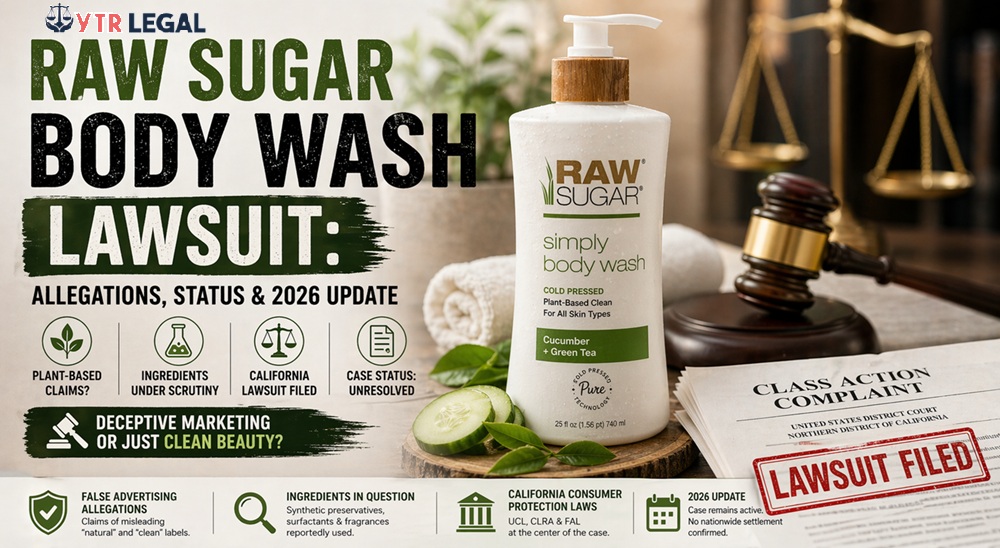

The Raw Sugar Body Wash lawsuit is a consumer false-advertising case alleging that Raw Sugar Living marketed its body wash as “natural,” “clean,” and “plant-based” while formulations contain synthetic preservatives, surfactants, and fragrance agents. The complaint invokes California consumer protection laws, and as of 2026, the matter remains unresolved.
Filed in California federal court, the Raw Sugar Body Wash lawsuit accuses Raw Sugar Living of deceptive labeling under California’s Unfair Competition Law (UCL), Consumers Legal Remedies Act (CLRA), and False Advertising Law (FAL). Plaintiffs claim the brand’s “plant-based” and “chemical-free” marketing misled buyers paying a premium for clean beauty. Raw Sugar denies wrongdoing, maintaining its products meet FDA labeling standards. No nationwide class settlement has been confirmed as of early 2026, and discovery continues.
“Clean beauty” has exploded into a multi-billion-dollar category — and so has the legal scrutiny around its marketing claims. The Raw Sugar Body Wash lawsuit is one of the most-searched cases in this space, raising a simple but powerful question: when a brand labels its product “natural” and “plant-based,” does that label actually mean anything under the law? This article explains what the lawsuit alleges, which laws are involved, where the case stands in 2026, how the company has responded, and what the case means for consumers in the US and for Indian buyers purchasing imported clean-beauty brands online. The goal is to cut through TikTok speculation and give you verified, current facts.
What Is Raw Sugar Living?
Raw Sugar Living is a US-based personal care brand founded on a “plant-powered clean” positioning. The company sells:
- Body washes
- Shampoos and conditioners
- Hand soaps
- Lotions and lip care
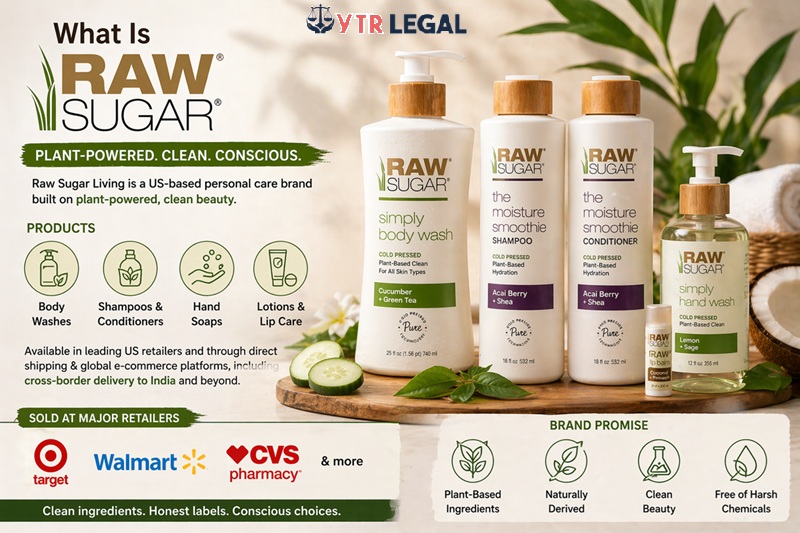
Its products are stocked in major US retailers such as Target, Walmart, and CVS, and are also available through direct shipping and international e-commerce platforms — including to Indian buyers via cross-border marketplaces.
The brand’s core marketing identity leans on terms like “plant-based,” “clean,” “naturally derived,” and “free of harsh chemicals.” That branding is exactly what the lawsuit challenges.
What the Raw Sugar Body Wash Lawsuit Alleges
The core allegation is false and misleading advertising — not that the products are physically dangerous, but that the labeling does not match the actual formulation.
Key Claims by Plaintiffs
- “Plant-based” labels misrepresent the formula — laboratory analyses allegedly identified synthetic preservatives, surfactants, and fragrance agents
- “Clean” and “chemical-free” terms mislead consumers — these terms are not regulated by the FDA, allowing wide marketing flexibility
- Price premium paid on false assumptions — consumers paid more believing they were buying a genuinely natural product
- Violation of consumer protection statutes — including both state and federal truth-in-advertising laws
Ingredients Reportedly at Issue
Sources covering the case have flagged ingredients such as:
- Cocamidopropyl Betaine (plant-derived origin, heavily chemically processed)
- Phenoxyethanol (synthetic preservative)
- Behentrimonium Chloride (synthetic conditioning agent)
- Synthetic fragrance and PEG compounds
These ingredients are legal and common in cosmetics — the legal dispute is whether marketing a product containing them as “plant-based” or “clean” misleads a reasonable consumer.
Which Laws Are Being Invoked?
The complaint leans primarily on California consumer protection statutes, which are among the most plaintiff-friendly in the US.
| Law | What It Covers |
|---|---|
| California Unfair Competition Law (UCL) — Bus. & Prof. Code § 17200 | Prohibits unlawful, unfair, or fraudulent business acts |
| California False Advertising Law (FAL) — Bus. & Prof. Code § 17500 | Prohibits false or misleading advertising statements |
| Consumers Legal Remedies Act (CLRA) — Civil Code § 1750 | Provides damages and injunctive relief for deceptive practices |
| Federal Trade Commission Act — Section 5 | Prohibits deceptive acts or practices in commerce |
| Fair Packaging and Labeling Act (FPLA) | Requires accurate ingredient listings |
Timeline of the Raw Sugar Body Wash Lawsuit
Based on reporting from consumer-law sources, the case has moved through these broad phases:
- 2024 (late) — Consumer watchdogs and social media flag alleged mislabeling
- Early 2025 — Counsel sends demand letters citing California UCL, CLRA, and FAL
- Mid-2025 — Complaint filed in California federal court; case assigned to a district judge
- Mid-to-late 2025 — Defense motion to dismiss partially denied; core California claims allowed to proceed
- Late 2025 — Discovery opens on labeling, ingredient sourcing, and marketing channels
- Early 2026 — Plaintiffs move to compel supplemental ingredient and supplier data
- As of 2026 — Case remains active; no nationwide class settlement confirmed
Raw Sugar Living’s Response
Raw Sugar has publicly denied the allegations. Key points of the brand’s defense include:
- All ingredient lists appear clearly on packaging in compliance with FDA labeling rules
- “Plant-derived” refers to the origin of ingredients, not their final chemical state
- Products undergo safety and quality testing
- Marketing “aligns with industry standards” for the personal care sector
The company continues to sell and market its body wash line during the litigation.
Why This Case Matters (Beyond Raw Sugar)
This lawsuit sits at the center of a much larger regulatory gap.
The “Natural” Loophole
Under current US cosmetic regulations, the FDA does not define or regulate terms like “natural,” “clean,” or “plant-based” for personal care products. Any brand can use these terms with wide marketing flexibility.
The Reasonable Consumer Test
Because the terms aren’t legally defined, plaintiffs must show that a reasonable consumer would be misled by the marketing — a fact-intensive standard that turns on surveys, label context, and advertising history.
The “Clean Beauty” Cascade Effect
If plaintiffs succeed, similar lawsuits could accelerate against:
- Other “clean” personal care brands
- “Natural” food and beverage products
- “Eco-friendly” household products
A 2021 Tresemmé settlement set an early precedent for cosmetics false-marketing class actions.
What This Means for Indian Consumers
Indian buyers purchase Raw Sugar products through cross-border platforms and personal imports. Key practical notes:
- India’s Bureau of Indian Standards (BIS) and Legal Metrology Act, 2009 govern cosmetic labeling locally
- The Consumer Protection Act, 2019 empowers Indian consumers to file complaints for “misleading advertisement” via the Central Consumer Protection Authority (CCPA)
- A US class action typically covers US purchases only — Indian buyers usually cannot claim directly
- Indian buyers paying premium prices for imported “clean” products should verify ingredients using tools like EWG Skin Deep or the INCI Decoder
If you bought Raw Sugar in India and experienced adverse effects, your remedy falls under Indian consumer law — not the US class action.
How to Join a Class Action (If Certified)
If a US class action is certified and you purchased Raw Sugar body wash in the United States, here’s the typical process:
- Watch for notice — by email, mail, or publication in major media
- Confirm eligibility — usually based on purchase date and location
- Gather proof — receipts, order confirmations, photos of the product
- Submit a claim form — via the official settlement website (never third-party pages)
- Choose a claim option — often a cash payment or product voucher
- Meet deadlines — claims typically expire within months of notice
Warning: Scam sites often mimic class-action claim pages. Only use URLs confirmed in official court filings or notice mailings.
What You Should Do If You Used the Product
Whether or not the lawsuit results in a settlement:
- Keep receipts and packaging if you suspect false advertising influenced your purchase
- Document reactions with photos and dated notes if you experienced skin irritation
- Consult a dermatologist for any persistent reactions
- Report adverse events to the FDA’s MedWatch (US) or the CDSCO (India)
- Patch test new products on a small skin area for 24–48 hours
FAQs
1. Is there an active class action settlement for Raw Sugar body wash?
As of early 2026, no nationwide class action settlement has been publicly confirmed. The case remains active in California federal court, with discovery ongoing. Consumers should verify current status through official court filings rather than social media posts, which frequently misrepresent the legal status of pending cases.
2. Is Raw Sugar body wash safe to use?
No product recall has been issued, and the FDA has not flagged Raw Sugar products as unsafe. The lawsuit focuses on marketing claims, not safety hazards. Some users report irritation from specific ingredients, which can happen with any personal care product. A patch test is recommended, especially for sensitive skin types.
3. Can I still buy Raw Sugar body wash during the lawsuit?
Yes. The products remain available in retail stores and online. A lawsuit alone does not trigger a recall or sales ban. Raw Sugar continues to manufacture, distribute, and sell its products while defending the claims in court. Purchase decisions are a matter of personal judgment based on current information.
4. What does “plant-based” legally mean in cosmetics?
Almost nothing, legally. The FDA does not define or regulate “plant-based,” “natural,” or “clean” for cosmetic products in the US. Brands can use these terms broadly, even for ingredients that undergo heavy chemical processing. This regulatory gap is precisely what the Raw Sugar lawsuit seeks to challenge through the courts.
5. Can Indian consumers join the Raw Sugar lawsuit?
Generally, no. US class actions typically cover purchases made in the United States. Indian consumers who purchased the product abroad or via cross-border platforms would need to pursue remedies under India’s Consumer Protection Act, 2019, through the District Consumer Commission or the Central Consumer Protection Authority (CCPA).
6. Has Raw Sugar shampoo faced similar lawsuits?
Yes. Raw Sugar’s shampoo and conditioner lines face related consumer complaints centered on identical “natural” and “plant-based” marketing claims. Some complaints also reference scalp irritation and hair shedding, though current scientific evidence has not established a direct causal link between named ingredients and hair loss at permitted concentrations.
7. How long do consumer class actions like this take?
Consumer false-advertising class actions typically take 2–5 years from filing to resolution. Key phases include pleadings, discovery, class certification motions, summary judgment, and either trial or settlement. Most cases settle before trial. The Raw Sugar case is still in discovery as of 2026, suggesting a resolution is likely still months or years away.
Key Takeaways
- The Raw Sugar Body Wash lawsuit alleges false advertising under California UCL, CLRA, and FAL
- Core dispute: “plant-based” and “clean” marketing vs. presence of synthetic ingredients
- No nationwide class settlement has been confirmed as of early 2026
- The FDA does not regulate terms like “natural” or “clean” in cosmetics
- Raw Sugar denies wrongdoing and continues to sell its products
- Indian consumers have separate rights under the Consumer Protection Act, 2019
- Keep receipts, photos, and packaging if you believe you were misled
