
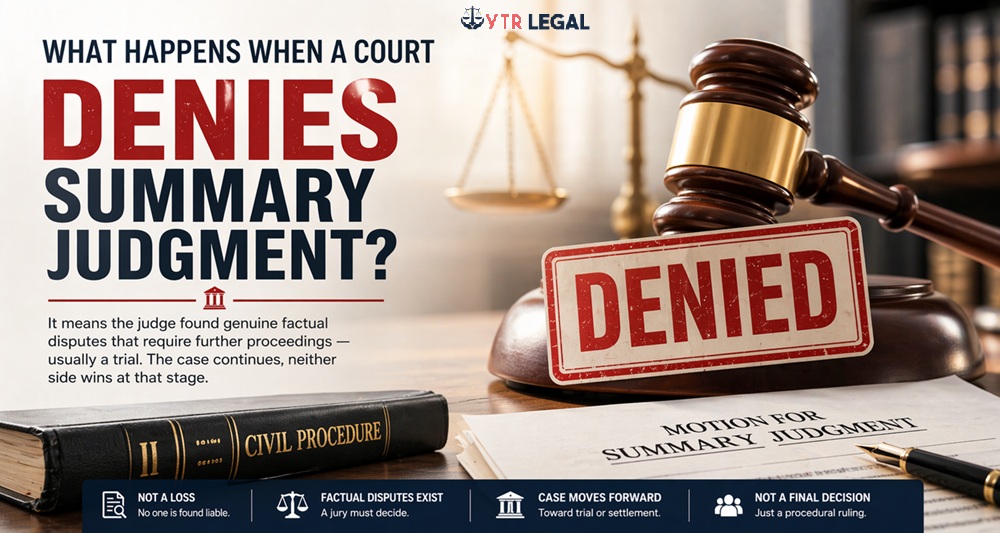

When a court denies summary judgment, it means the judge found genuine factual disputes that require further proceedings — usually a trial. The case continues, neither side wins at that stage, and the parties move toward trial, settlement negotiations, or additional pre-trial motions. It is not a loss on the merits.
A denied summary judgment motion means the judge reviewed the evidence and concluded that reasonable minds could disagree about material facts. The case is not dismissed, and no party is found liable. Instead, the lawsuit proceeds toward trial. In practice, denial often accelerates settlement talks because both sides now face the cost, time, and uncertainty of a jury verdict. Denial is a procedural ruling — not a final judgment on who is right or wrong.
Introduction
You’ve just read that a court “denied summary judgment” in a case you’re following, and suddenly the reporting gets confusing. Does that mean someone lost? Is the case over? Who won? The short answer: nothing is over, and no one has won. Summary judgment is one of the most misunderstood stages of a civil lawsuit. This guide explains, in plain English, what summary judgment actually is, what happens when a court grants or denies it, what it signals about the strength of a case, and what comes next. Whether you’re tracking a medical malpractice case, a business dispute, or just trying to understand legal news, this breakdown clears up the confusion.
What Is Summary Judgment?
Summary judgment is a procedural request made before trial. One party asks the judge to decide the case — or part of it — without a full trial, on the grounds that the essential facts aren’t really in dispute.
The Core Legal Standard
Under Federal Rule of Civil Procedure 56 (and parallel state rules), a court grants summary judgment only when:
- There is no genuine dispute as to any material fact, AND
- The moving party is entitled to judgment as a matter of law
Translation: if the judge can decide the case based solely on undisputed facts and legal principles — without needing a jury to sort out who’s telling the truth — summary judgment is appropriate.
Who Files It and When
- Filed by either the plaintiff or defendant (defendants file more often)
- Typically comes after discovery is complete
- Must be supported by evidence: depositions, documents, expert declarations, affidavits
Granted vs. Denied: What’s the Difference?
| Outcome | What It Means | What Happens Next |
|---|---|---|
| Granted (in full) | Case ends at that stage; moving party wins without trial | Judgment entered; losing side may appeal |
| Granted (in part) | Some claims dismissed; others survive | Case proceeds on surviving claims only |
| Denied | Triable factual disputes exist | Case moves toward trial or settlement |
What “Denied Summary Judgment” Really Means
This is where most news coverage loses people. A denial is not a ruling that the moving party is wrong on the merits. It’s a ruling that the factual disputes are real enough that a jury must decide them.
What Denial Does NOT Mean
- The moving party has been found liable
- The other side “won” the case
- The allegations have been proven true
- Damages have been awarded
- Anything final has been decided
What Denial DOES Mean
- The judge found at least one genuine factual dispute
- A reasonable jury could potentially side with either party
- The case survives to the next phase
- Trial, settlement, or additional motions will follow
- The moving party failed to meet the high burden for early dismissal
Key insight: Summary judgment has a deliberately high bar. Courts resolve doubts in favor of the non-moving party. A denial just means the moving party couldn’t clear that high bar — not that they’re wrong.
Why Courts Deny Summary Judgment
Judges typically deny these motions for a few recurring reasons.
1. Conflicting Witness Testimony
When witnesses — including expert witnesses — offer contradictory accounts, a jury must weigh credibility. Judges don’t resolve credibility disputes on paper.
2. Competing Expert Opinions
In medical malpractice, product liability, or technical cases, opposing experts often reach different conclusions from the same records. Expert disagreement alone usually defeats summary judgment.
3. Disputed Timelines
When the parties disagree about when an event occurred, who acted first, or the sequence of communications, those disputes go to the jury.
4. Intent or State of Mind at Issue
Fraud, malice, discrimination, and negligence often turn on what someone knew or intended. These mental states are notoriously hard to resolve without live testimony.
5. Incomplete or Disputed Evidence
If key documents are missing, authentication is contested, or the evidentiary record has gaps, the judge typically lets the case proceed.
Step-by-Step: What Happens After Summary Judgment Is Denied
Here’s the typical progression once the ruling comes down.
- The written ruling is issued — sometimes after a tentative ruling phase where parties can argue orally
- Pre-trial scheduling continues — trial date confirmed or set
- Settlement discussions often intensify — both sides now face trial risk
- Motions in limine are filed — requests to exclude certain evidence at trial
- Jury selection is scheduled — typically voir dire begins shortly before trial
- Trial proceeds — unless the case settles first
Most civil cases that survive summary judgment settle before trial. Denial frequently shifts negotiating leverage toward the plaintiff.
Can You Appeal a Denial of Summary Judgment?
Generally, no — not immediately. Summary judgment denials are considered interlocutory orders, meaning they’re not final judgments. In federal court and most state courts:
- You cannot appeal a denial right away
- You must wait until the case reaches final judgment
- Only then can the denial be challenged on appeal
- Rare exceptions exist (e.g., qualified immunity in civil rights cases)
By contrast, a granted summary judgment is typically immediately appealable because it ends the case or a major portion of it.
Summary Judgment in Medical Malpractice Cases
Medical malpractice is one of the most common areas where summary judgment is contested.
Why Defendants File
Defending doctors often move for summary judgment armed with an expert declaration stating the defendant met the standard of care. If the plaintiff can’t produce a qualified expert contradicting that opinion, the defense usually wins.
Why Plaintiffs Defeat It
Plaintiffs defeat these motions by producing their own expert declaration identifying specific breaches of the standard of care. When dueling experts disagree on timeline, causation, or treatment decisions, courts routinely deny summary judgment and send the case to a jury.
Real-World Pattern
The Jean Shir v. Kevin Sadati medical malpractice case (Orange County Superior Court, Case No. 30-2018-01006528) illustrates the pattern. In November 2022, the court denied the defense’s summary judgment motion after concluding that the plaintiff’s expert testimony and the defense expert’s position highlighted triable issues of material fact — particularly the timeline and cause of an alleged facial nerve injury. The denial didn’t decide who was right; it simply confirmed that a jury would need to resolve those disputes.
Common Misconceptions
“The doctor/defendant lost the case”
No. A denied motion doesn’t determine liability.
“The judge thinks the plaintiff is right”
Not necessarily. The judge only concluded that reasonable people could disagree.
“This means the case will definitely go to trial”
Not necessarily. Many cases settle shortly after denial.
“Summary judgment denials show the case is strong”
Somewhat. It shows the case has enough evidence to proceed — but strength and outcome are different things.
“A denied motion can be immediately appealed”
Usually not. You typically must wait until final judgment.
How Summary Judgment Differs From Other Pre-Trial Motions
| Motion | Purpose | Timing |
|---|---|---|
| Motion to Dismiss | Challenges the legal sufficiency of the complaint | Early, before discovery |
| Motion for Summary Judgment | Challenges whether facts support a trial | After discovery |
| Motion in Limine | Seeks to exclude specific evidence at trial | Close to trial |
| Motion for Directed Verdict | Ends the case mid-trial | During trial |
| Motion for Judgment Notwithstanding the Verdict (JNOV) | Challenges a jury verdict | After trial |
Summary judgment sits between discovery and trial — the moment when the record is most complete before the jury gets involved.
FAQs
1. Does denying summary judgment mean the case is weak or strong?
It means the case has enough disputed facts to require a jury. That’s a procedural finding, not a strength rating. Some cases that survive summary judgment still lose at trial, while others settle favorably. Denial simply confirms the plaintiff cleared a threshold — not that they will ultimately prevail on the merits.
2. Can a judge reverse their own denial of summary judgment?
Yes, in limited circumstances. The moving party can file a motion for reconsideration if new evidence emerges or if there’s a clear legal error. Courts rarely grant these. Some parties also file renewed summary judgment motions after additional discovery, though this requires the judge’s permission in most jurisdictions.
3. How long after denial does a case typically go to trial?
It varies widely. In federal court, trial often follows denial by three to nine months. In busy state court systems, the wait can stretch twelve to eighteen months or longer. California Superior Courts, for example, regularly schedule civil trials twelve or more months after dispositive motions due to calendar congestion.
4. Who has the burden of proof at the summary judgment stage?
The moving party — whoever filed the motion — carries the initial burden of showing no genuine dispute exists. Once they meet that burden with evidence, the burden shifts to the opposing party to produce specific facts showing a triable issue. Neither side has to prove their entire case; they just address whether a trial is necessary.
5. Does denial of summary judgment increase the chance of settlement?
Usually yes. Denial confirms the case is going to a jury, which is expensive and unpredictable for both sides. Defendants who hoped to end the case cheaply must now weigh trial costs, verdict risk, and publicity. Plaintiffs gain leverage, and settlement negotiations often intensify within weeks of the ruling.
6. What is a “tentative ruling” on summary judgment?
In many California courts and some other jurisdictions, judges issue tentative rulings before oral argument. The tentative signals how the judge is leaning, giving both sides a chance to argue before the ruling becomes final. Tentatives are often adopted with little change, but skilled oral advocacy can occasionally shift outcomes.
7. Can only one part of a summary judgment motion be denied?
Yes. This is called partial summary judgment or summary adjudication. A judge may dismiss some claims while allowing others to proceed. For example, in a case with multiple causes of action, the court might grant summary judgment on fraud claims but deny it on negligence claims. The surviving claims then proceed to trial.
Key Takeaways
- Summary judgment is a pre-trial request to decide a case without a full trial
- A denial means genuine factual disputes exist — not that the moving party is wrong
- Denial keeps the case alive and typically pushes it toward trial or settlement
- Courts deny motions when there are conflicting witnesses, competing experts, or disputed timelines
- Denials are usually not immediately appealable; you must wait for final judgment
- In medical malpractice cases, denials often follow dueling expert declarations
- Most cases that survive summary judgment settle before trial
