
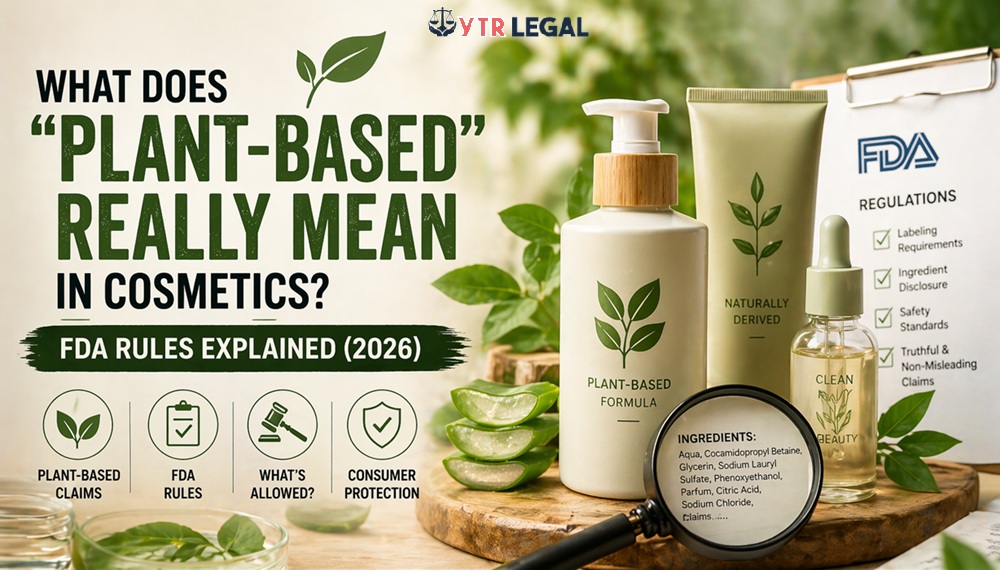

“Plant-based” has no legal definition in US cosmetics. The FDA does not regulate terms like “natural,” “plant-based,” or “clean” for skincare, hair care, or personal care products. Any brand can use these terms even when formulations contain synthetic, chemically-processed, or petroleum-derived ingredients — as long as the ingredient list itself is accurate.
In the United States, the FDA regulates cosmetics under the FD&C Act and the Fair Packaging and Labeling Act, but it has never established a regulatory definition for “natural” or “plant-based.” Labels must be truthful and not misleading, but marketing terms remain largely self-policed. Only “organic” is regulated — by the USDA under the National Organic Program. This regulatory gap fuels consumer lawsuits, which increasingly rely on the “reasonable consumer” standard to challenge plant-based claims in court.
Walk down any beauty aisle and you’ll see the words “plant-based,” “natural,” and “clean” splashed across bottles — often on products containing ingredients you can’t pronounce. That contradiction isn’t illegal. It’s the result of a decades-old regulatory gap in the United States, where cosmetic marketing terms are almost entirely unregulated. This article explains exactly what “plant-based” means under current FDA rules, why the term has no legal definition, how new laws like MoCRA change the picture, how US rules compare to EU and Indian standards, and what consumers can actually verify before buying. By the end, you’ll know how to read a cosmetic label like a regulator does.
The Short Version: “Plant-Based” Is a Marketing Term, Not a Legal Term
Let’s clear up the most important fact first.
Under current US law:
- The FDA does not define “plant-based” for cosmetics
- The FDA does not define “natural” for cosmetics
- The FDA does not define “clean” for cosmetics
- The FDA does not define “green” or “eco-friendly” for cosmetics
The only cosmetic marketing term with any regulatory backing is “organic” — and even that is regulated by the USDA (not the FDA), under the National Organic Program.
Key insight: A product labeled “plant-based” can contain heavily synthetic ingredients and still be perfectly legal — as long as the full ingredient list is accurate and not misleading on its face.
How the FDA Actually Regulates Cosmetics
The FDA’s authority over cosmetics comes from two federal laws.
The Two Foundational Laws
| Law | What It Does |
|---|---|
| Federal Food, Drug, and Cosmetic Act (FD&C Act) | Prohibits misbranded or adulterated cosmetics in interstate commerce |
| Fair Packaging and Labeling Act (FPLA) | Requires accurate ingredient declarations and quantity statements |
What the FDA DOES Require
- Accurate ingredient list in descending order of predominance (using INCI names)
- An identity statement (what the product is)
- Net quantity of contents
- Name and address of manufacturer, packer, or distributor
- Warnings when applicable
- Labeling must be truthful and not misleading
What the FDA Does NOT Require
- Pre-market approval (cosmetics are not “FDA-approved”)
- Pre-market safety testing
- Standardized definitions for marketing terms
- Expiration dates (for most cosmetics)
- Disclosure of “fragrance” sub-ingredients
MoCRA 2022: What Changed and What Didn’t
The Modernization of Cosmetics Regulation Act (MoCRA) of 2022 was the biggest update to US cosmetic law in over 80 years. As of 2026, its provisions are fully in effect.
What MoCRA Added
- Mandatory facility registration with the FDA
- Product listing requirements (every product, every ingredient)
- Good Manufacturing Practice (GMP) requirements
- Mandatory adverse event reporting to the FDA
- Safety substantiation files that brands must maintain
- Recall authority for the FDA
What MoCRA Did NOT Change
- The FDA still does not define “natural,” “plant-based,” or “clean”
- There is no pre-market approval for cosmetics
- Marketing claims remain largely self-policed by brands
- “Fragrance” can still be listed without disclosing sub-ingredients
The regulatory gap for marketing terms persists, even under the modernized framework.
Why “Plant-Based” Is Ambiguous
Here’s where the science gets messy. Many common cosmetic ingredients start as plant material but undergo heavy chemical processing.
Examples of “Plant-Derived” Yet Synthetic Ingredients
| Ingredient | Plant Origin | Processing |
|---|---|---|
| Cocamidopropyl Betaine | Coconut oil | Synthesized surfactant |
| Behentrimonium Chloride | Rapeseed oil | Chemically quaternized |
| Sodium Lauryl Sulfate | Coconut or palm | Sulfated, synthetic |
| PEG compounds | Petroleum or plant | Ethoxylated |
| Stearic Acid | Vegetable oils | Hydrogenated/purified |
Under current rules, a brand can legally call a product “plant-derived” when these ingredients are present, because the starting material was a plant — even if the final molecule bears no chemical resemblance to the source.
The FTC’s Role: Where Enforcement Happens
When consumers are misled, action usually comes from the Federal Trade Commission (FTC) — not the FDA.
FTC Standards for “Natural” Claims
The FTC has informally adopted the FDA’s food definition, meaning “all-natural” or “100% natural” claims should not apply to products with artificial ingredients or significant chemical processing. Enforcement comes through:
- Section 5 of the FTC Act — prohibits deceptive acts or practices
- Green Guides — guidance on environmental marketing claims
- Consumer class actions — often cite FTC standards even when the FTC itself hasn’t acted
The “Reasonable Consumer” Test
In most false-advertising cases, courts apply the reasonable consumer standard: would an ordinary shopper, acting reasonably, be misled by the claim? Several federal courts have held that consumers can reasonably expect a product labeled “natural” to contain only natural ingredients — even when fine-print qualifications or synthetic ingredients appear on the packaging.
The Proposed Natural Cosmetics Act
In 2019, legislation was introduced in Congress to define “natural” for cosmetics. The bill proposed:
- “Natural” — a product containing at least 70% natural substances (unprocessed ingredients)
- “Naturally-derived ingredient” — an ingredient whose starting material is of mineral, plant, microbe, or animal origin
The bill has not passed, and no federal definition currently applies. Several versions have been reintroduced over the years, reflecting continued congressional interest — but brands remain free to use the term as they wish.
How Different Countries Regulate “Natural” Cosmetics
The US lags significantly behind other major markets. Here’s how the rules stack up:
| Region | “Natural” Definition | “Organic” Definition | Enforcement Body |
|---|---|---|---|
| United States | None | USDA NOP (agricultural only) | FDA, FTC, state AGs |
| European Union | ISO 16128 standard (voluntary) | COSMOS & Ecocert | CPNP, national authorities |
| India | Partial (BIS IS 4707) | NPOP (agricultural) | CDSCO, BIS |
| Canada | No formal definition | COR (agricultural) | Health Canada |
| Australia | Voluntary ACO standard | ACO certified | TGA, ACCC |
The ISO 16128 Standard
The international ISO 16128 standard defines natural and organic cosmetic ingredients using specific calculation methods. Compliance is voluntary, but many global brands use it to support marketing claims with measurable backing.
India’s Cosmetic Labeling Rules: A Closer Look
For Indian consumers buying imported “plant-based” products, local rules add another layer.
Key Indian Regulations
- Drugs and Cosmetics Act, 1940 and Cosmetics Rules, 2020 govern cosmetics
- Bureau of Indian Standards (BIS) IS 4707 specifies requirements for certain cosmetic categories
- Central Drugs Standard Control Organisation (CDSCO) registers imported cosmetics
- Legal Metrology (Packaged Commodities) Rules, 2011 require MRP, manufacturer details, and batch numbers
- Consumer Protection Act, 2019 addresses misleading advertisements via the CCPA
What India Does NOT Define
Like the US, India has no statutory definition for “natural,” “plant-based,” or “clean” in cosmetics. Indian consumers relying on these claims when buying imported products face the same marketing ambiguity as US buyers.
How to Verify a “Plant-Based” Claim Yourself
Since regulators won’t do it for you, here’s a practical verification routine.
- Read the full INCI list on the back of the package — ignore the front
- Cross-check ingredients on EWG Skin Deep or INCI Decoder (both free)
- Look for certifications: USDA Organic, COSMOS, Ecocert, NATRUE
- Check the position of water — if it’s listed first, the “plant extracts” further down are often under 1%
- Search for the brand’s ingredient sourcing disclosures — legitimate brands publish supplier info
- Watch for fragrance/parfum — undisclosed sub-ingredients can include synthetic compounds
- Compare INCI names — “Cocos Nucifera Oil” is coconut oil; “Cocamidopropyl Betaine” is a processed surfactant
Red Flags on Cosmetic Labels
Stop and reconsider when you see:
- No certifications despite “natural” or “organic” claims
- Ingredient lists longer than 30 items on a “clean” product
- “Fragrance” or “Parfum” without sub-ingredient disclosure
- Numbered or coded color names (e.g., CI 77491) on “all-natural” products
- “Free-from” marketing without disclosing what the product actually contains
- Leaf icons and green packaging with no substantive claims
FAQs
1. Is “plant-based” the same as “natural” in cosmetics?
Legally, neither term is defined by the FDA for cosmetics. Most brands use “plant-based” to mean some ingredients are plant-derived at origin, while “natural” suggests minimal processing. Because neither term has regulatory backing in the US, they’re essentially marketing labels interpreted differently by every brand, retailer, and consumer.
2. Does the FDA approve cosmetic products?
No. The FDA does not approve cosmetics before they go to market. Brands are responsible for ensuring their own products are safe and properly labeled. FDA approval applies only to color additives and products classified as drugs. Any cosmetic labeled “FDA Approved” is actually violating FDA rules against misleading claims.
3. What’s the difference between “natural” and “organic” in cosmetics?
“Natural” has no legal definition for cosmetics. “Organic” is regulated by the USDA under the National Organic Program for agricultural ingredients. A cosmetic labeled “100% Organic” or “Organic” (at least 95% organic content) must comply with USDA standards and can display the USDA Organic seal.
4. Can a “plant-based” product contain synthetic ingredients?
Yes, legally. Under current US rules, “plant-based” is unregulated. A product can contain synthetic preservatives, surfactants, fragrances, and colorants while still being marketed as plant-based — as long as the full ingredient list appears accurately on the label. This is the gap most false-advertising lawsuits target.
5. What is the Modernization of Cosmetics Regulation Act (MoCRA)?
MoCRA, passed in 2022, is the most significant update to US cosmetic law in over 80 years. It added facility registration, product listing, GMP standards, adverse event reporting, safety substantiation files, and FDA recall authority. However, MoCRA did not define marketing terms like “natural” or “plant-based,” leaving that gap intact.
6. How do I know if a cosmetic claim is really truthful?
Check third-party certifications (USDA Organic, COSMOS, Ecocert, NATRUE), review the full INCI ingredient list, cross-reference on EWG Skin Deep or INCI Decoder, and look for brand transparency about sourcing. Certifications require independent audits and provide far more reliability than unverified marketing language on the front of the package.
7. Does India regulate “natural” cosmetic claims differently?
India follows a similar pattern to the US. The Drugs and Cosmetics Act and CDSCO oversee cosmetic safety and registration, but no formal definition exists for “natural” or “plant-based.” Indian consumers can file complaints about misleading advertisements under the Consumer Protection Act, 2019, through the CCPA — regardless of whether the product is domestic or imported.
Key Takeaways
- “Plant-based” has no legal definition in US cosmetics — it’s a marketing term
- The FDA regulates labeling accuracy and safety, not marketing claims
- MoCRA (2022) modernized US cosmetic regulation but didn’t define “natural”
- Only “organic” is regulated — by the USDA, not the FDA
- Courts apply the “reasonable consumer” test in false-advertising lawsuits
- The EU, India, and Canada all have similar gaps, with some regions moving toward ISO 16128
- Verify with INCI lists and third-party certifications — not front-of-package claims
