
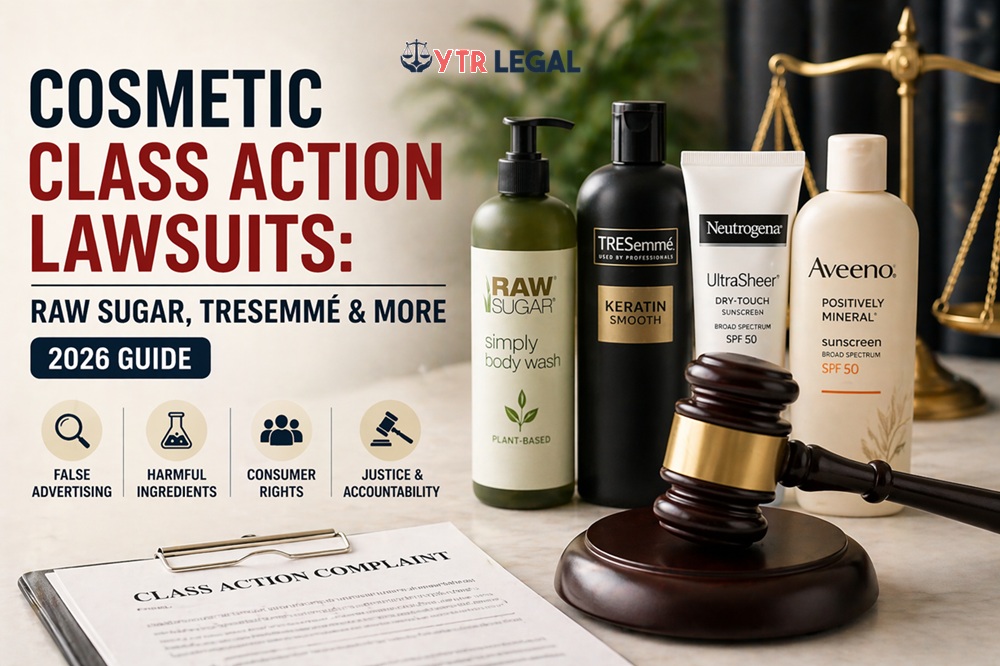

Cosmetic class action lawsuits target beauty brands for false advertising, contaminated products, or hidden health risks. Major cases include Tresemmé ($10.2M Suave settlement, ongoing TRESemmé claims), Neutrogena/Aveeno ($1.75M benzene settlement), WEN by Chaz Dean ($26M hair loss settlement), and the active Raw Sugar “plant-based” labeling case in California.
smetic class actions have reshaped the beauty industry over the past decade. The most significant settled cases include Unilever’s $10.2 million Suave Keratin settlement, WEN by Chaz Dean’s $26 million settlement, and Johnson & Johnson’s $1.75 million Neutrogena/Aveeno benzene settlement. Active cases in 2026 include Raw Sugar Living’s false-advertising lawsuit over “plant-based” claims and ongoing TRESemmé DMDM hydantoin litigation. Most cases invoke California’s UCL, CLRA, and FAL alongside state consumer protection laws.
Cosmetic class actions are no longer fringe legal news — they’re shaping how beauty brands formulate, market, and label their products. Over the past decade, consumers have secured multi-million-dollar settlements against some of the biggest names in personal care, from Unilever to Johnson & Johnson. This article breaks down the most significant cosmetic class actions, including verified settlement amounts, key allegations, outcomes, and ongoing cases like Raw Sugar. You’ll also learn the common legal theories behind these suits, how to check if you qualify for a settlement, and what the growing volume of cases means for the “clean beauty” industry in 2026.
What Is a Cosmetic Class Action Lawsuit?
A cosmetic class action is a civil lawsuit where one or a few consumers sue a beauty or personal care brand on behalf of a large group of similarly affected buyers.
Common Types of Cosmetic Class Actions
- False advertising — “natural,” “clean,” or “plant-based” claims contradicted by ingredients
- Product contamination — benzene in sunscreens, asbestos in talc
- Injury or adverse reaction — hair loss, scalp irritation, skin damage
- Failure to warn — risks not disclosed on packaging
- Greenwashing — “eco-friendly” or “sustainable” claims without substantiation
Legal Theories Commonly Used
Most cosmetic class actions invoke a combination of:
- California Unfair Competition Law (UCL) — Bus. & Prof. Code § 17200
- California Consumers Legal Remedies Act (CLRA) — Civil Code § 1750
- California False Advertising Law (FAL) — Bus. & Prof. Code § 17500
- FTC Act Section 5 — prohibits deceptive acts in commerce
- State consumer protection statutes — similar rules in NY, IL, NJ, FL, and others
California’s laws are the most plaintiff-friendly, making it the most common venue for these cases.
Landmark Cosmetic Class Actions at a Glance
| Case | Brand / Company | Year | Outcome | Key Issue |
|---|---|---|---|---|
| Suave Keratin Infusion | Unilever | 2014–2016 | $10.2M settlement | Hair loss, scalp irritation (DMDM hydantoin) |
| WEN by Chaz Dean | Guthy-Renker | 2016 | $26M settlement | Hair loss, scalp irritation |
| TRESemmé Keratin Smooth | Unilever | 2020–active | Mixed; some dismissals | DMDM hydantoin, hair loss claims |
| Neutrogena & Aveeno sunscreens | Johnson & Johnson | 2021–2023 | $1.75M voucher settlement + refunds | Benzene contamination |
| Coppertone sunscreens | Bayer | 2022 | $2.3M settlement fund | Benzene in aerosol sprays |
| Banana Boat Hair & Scalp | Edgewell | 2022–2023 | Recall + refunds | Benzene from propellant |
| Raw Sugar Body Wash | Raw Sugar Living | 2025–active | Pending | “Plant-based” labeling |
| OGX Shampoo | Johnson & Johnson | Ongoing | Pending | DMDM hydantoin claims |
Case Deep Dive: Unilever’s Suave and TRESemmé Saga
This is the most-cited reference point in modern cosmetic class actions — and it directly connects to the ongoing TRESemmé case.
The Suave Keratin Settlement (2012–2016)
In 2012, Unilever recalled its Suave Professionals Keratin Infusion product after consumers reported hair loss and scalp irritation. The class action that followed resulted in a $10.2 million settlement, upheld on appeal in 2016. The ingredient at the center of the dispute: DMDM hydantoin, a formaldehyde-releasing preservative.
The TRESemmé Keratin Lawsuits (2020–Present)
Starting in 2020, multiple class actions were filed against Unilever over TRESemmé Keratin Smooth shampoos. Key cases:
- Lipetz v. Unilever (E.D. Pa., 2020) — hair loss and scalp burns
- Castillo v. Unilever (N.D. Ill., 2020) — mislabeling claims
- Additional cases in New Jersey, Illinois, and Canada
Allegations: Plaintiffs argued Unilever knowingly continued using DMDM hydantoin despite the Suave precedent. One case was later dismissed after the court ruled that ingredient disclosure on the label defeated the deception claim. Other cases remain active.
Key Takeaway
Ingredient disclosure alone can sometimes defeat false-advertising claims. But when marketing claims directly contradict ingredient behavior (e.g., “safe” vs. known irritant), cases often survive.
Case Deep Dive: WEN by Chaz Dean ($26 Million)
The WEN cleansing conditioner case is one of the largest cosmetic class action settlements in US history.
- Year finalized: 2016
- Settlement amount: $26 million
- Claims: Thousands of consumers reported hair loss, balding patches, and scalp irritation
- Unique aspect: The specific ingredient causing the alleged reactions was never conclusively identified in court
The WEN case set a benchmark for hair care class actions and is frequently cited in later shampoo litigation.
Case Deep Dive: Neutrogena & Aveeno Benzene Settlement
The 2021 sunscreen benzene scandal triggered one of the most significant personal-care settlements of the decade.
The Recall
In July 2021, Johnson & Johnson recalled five Neutrogena and Aveeno aerosol sunscreens after independent testing by online pharmacy Valisure detected benzene — a classified human carcinogen.
The Settlement
- Preliminary approval: March 2022
- Final approval: March 2023
- Structure: Full cash refunds for recalled aerosol products + up to $1.75 million in vouchers for purchases of non-recalled Neutrogena and Aveeno products
- Coverage period: Purchases between May 26, 2015, and April 8, 2022
- Voucher value: $10.58 each; up to 2 per household ($21.16 max)
- Additional relief: J&J agreed to test raw materials for benzene
Why It Matters
This case expanded cosmetic class action liability beyond marketing claims into contamination — proving that even approved ingredients can trigger lawsuits if adulterated versions reach consumers.
Case Deep Dive: The Raw Sugar Body Wash Case (Ongoing)
The Raw Sugar case is the most-followed active cosmetic class action of 2025–2026.
- Filed: California federal court, 2025
- Defendant: Raw Sugar Living
- Core allegation: “Plant-based,” “natural,” and “clean” marketing claims allegedly contradicted by synthetic ingredients
- Laws cited: California UCL, CLRA, FAL, and FTC Act Section 5
- Status (early 2026): Active; core California claims allowed to proceed; discovery ongoing
- Settlement status: None finalized
The case is seen as a potential landmark for the “clean beauty” category — similar in scope to how the Tresemmé/Suave cases shaped hair care disclosure.
The Benzene Wave: Sunscreens, Deodorants, and Sprays
Between 2021 and 2023, Valisure testing triggered a cascade of benzene-related class actions:
- Johnson & Johnson — Neutrogena, Aveeno ($1.75M + refunds)
- Bayer — Coppertone ($2.3M settlement fund)
- Edgewell — Banana Boat Hair & Scalp (recall and refunds)
- Procter & Gamble — Old Spice, Secret aerosol deodorant recalls
The common thread: benzene appearing as a contaminant from propellants or manufacturing processes, not as an intentional ingredient. This shifted industry focus toward raw material testing and propellant purity.
Common Plaintiff Arguments in Cosmetic Class Actions
- Reasonable consumer expectations — would an ordinary buyer be misled by the claim?
- Price premium paid — consumers paid more based on false beliefs
- Failure to warn — known risks not disclosed on packaging
- Material misrepresentation — claims directly contradicted by formulation
- Ongoing harm — continued sale despite known issues
Common Brand Defenses
- Full ingredient disclosure on packaging
- Compliance with FDA labeling rules
- Scientific evidence supporting safety
- Lack of causation between product and alleged harm
- Preemption by federal law
Step-by-Step: How to Check If You Qualify for a Settlement
- Search the settlement database — ClassAction.org, TopClassActions.com, and official court sites
- Verify the case name and number — scam sites are rampant
- Check the class period — purchase dates must fall within the defined window
- Confirm eligible products — specific SKUs and variants only
- Gather proof of purchase — receipts, loyalty card history, bank statements, photos
- File before the deadline — typically 60–180 days from notice
- Choose your payment method — cash, voucher, or product replacement
- Track the claim status — follow up via the official administrator
Warning: Never pay a fee to join a class action settlement. Legitimate claims are always free.
What This All Means for Indian Consumers
Indian buyers increasingly purchase US-labeled cosmetics via cross-border e-commerce (Amazon Global, iHerb, Nykaa Luxe, Tira). Important points:
- US class actions cover US purchases only — you typically cannot claim
- India’s Consumer Protection Act, 2019 offers a parallel path through the CCPA
- The CDSCO regulates imported cosmetics under the Drugs and Cosmetics Act, 1940
- Indian consumers can file misleading advertisement complaints even for imported brands
- The Bureau of Indian Standards (BIS) oversees labeling compliance for many categories
If you experienced harm or believe you were misled in India, remedies exist — but they operate under Indian law, not through the US settlement.
Why Cosmetic Class Actions Are Increasing
Several trends are driving the surge in cosmetic litigation:
- Independent testing labs (like Valisure) detecting contamination
- Social media amplification of adverse reactions (especially TikTok)
- The “clean beauty” marketing boom creating false-advertising vulnerabilities
- MoCRA 2022 adding mandatory adverse event reporting to the FDA
- Plaintiff-friendly California statutes inviting nationwide filings
- Consumer demand for transparency at an all-time high
Expect more cases through 2026 and beyond, particularly in the “natural” and “organic” segments.
FAQs
1. What’s the biggest cosmetic class action settlement ever?
The WEN by Chaz Dean hair loss settlement at $26 million (2016) is one of the largest. Unilever’s Suave Keratin settlement reached $10.2 million (2014). Larger individual recoveries exist in personal injury cases, but for pure consumer class action settlements, WEN remains a benchmark in the cosmetics category.
2. Can I join a cosmetic class action if I threw away the product?
Often yes, but with limitations. Many settlements allow claims without receipts, up to a maximum number of products (typically 2–6). Without proof, you’ll usually receive the minimum tier payout. Photos, credit card statements, loyalty card data, or retailer purchase histories can also substitute for physical receipts.
3. Is Raw Sugar body wash still being sold during the lawsuit?
Yes. A pending class action does not force a recall or sales ban. Raw Sugar continues to manufacture and sell its body wash, shampoo, and related products while defending the allegations in California federal court. Only an FDA-mandated recall or a court injunction would halt sales.
4. What’s the difference between a recall and a class action?
A recall is a regulatory action (usually FDA-driven) to remove unsafe products from the market. A class action is a civil lawsuit filed by consumers seeking compensation. They often happen together — like the Neutrogena sunscreen case — but they operate independently. Recalls address safety; class actions address economic or physical harm.
5. How long do cosmetic class actions typically take?
Most cosmetic class actions take 2–5 years from filing to settlement. Complex cases like WEN and TRESemmé have lasted longer due to appeals and multi-district consolidation. The Suave Keratin case filed in 2012 wasn’t fully resolved until 2016. Expect the Raw Sugar case to follow a similar multi-year timeline.
6. Can Indian consumers sue US cosmetic brands?
Generally not through US class actions, which require US purchase jurisdiction. However, Indian consumers can file complaints under the Consumer Protection Act, 2019, through District Consumer Commissions or the Central Consumer Protection Authority. The CCPA has authority over misleading advertisements of imported products sold in India.
7. Which cosmetic ingredients most often trigger class actions?
DMDM hydantoin (formaldehyde-releasing preservative), benzene (contaminant from propellants), talc (asbestos contamination concerns), and synthetic fragrance compounds are the most frequent triggers. Marketing terms like “natural,” “clean,” “plant-based,” and “eco-friendly” have also become major litigation targets in the last five years.
Key Takeaways
- Major cosmetic class actions include Unilever’s Suave ($10.2M), WEN ($26M), Neutrogena/Aveeno ($1.75M), and Coppertone ($2.3M)
- The Raw Sugar case is the most-watched active lawsuit, targeting “plant-based” marketing claims
- Most cases invoke California consumer protection laws (UCL, CLRA, FAL)
- DMDM hydantoin and benzene remain the most litigated ingredient/contaminant concerns
- Settlements often include cash refunds, vouchers, and labeling reforms
- Indian consumers have parallel remedies via the Consumer Protection Act, 2019
- Always verify settlement details through official court-approved administrators — never pay a fee
