
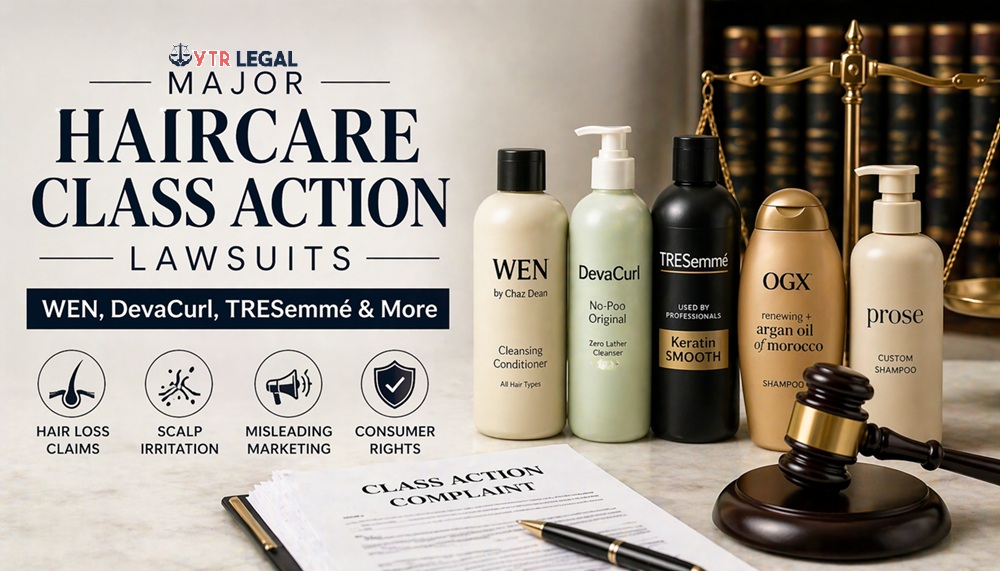

Major haircare class action lawsuits include WEN by Chaz Dean ($26.25 million settlement, 2017), DevaCurl ($5.2 million settlement, 2022), Unilever’s Suave Keratin ($10.2 million settlement, 2014), and ongoing cases against TRESemmé (Unilever) and OGX (Johnson & Johnson) involving DMDM hydantoin and alleged hair loss.
The largest haircare class actions in US history target hair loss, scalp irritation, and misleading “sulfate-free” or “keratin” marketing claims. WEN’s 2017 settlement ($26.25 million) remains the largest, followed by Suave Keratin Infusion ($10.2 million, 2014) and DevaCurl ($5.2 million, 2022). TRESemmé, OGX, and Prose currently face ongoing litigation or consumer investigations. The common thread across these cases: the gap between “clean” marketing claims and ingredients that caused documented adverse reactions.
Haircare class actions have reshaped how the beauty industry markets, formulates, and labels its products. Over the past decade, consumers have secured hundreds of millions in settlements against brands that promised clean, gentle hair care while allegedly causing hair loss, scalp burns, and permanent thinning. This article breaks down the most significant haircare lawsuits — verified settlement amounts, product-specific claims, outcomes, and ongoing cases. You’ll also learn the common legal theories behind these cases, which ingredients keep triggering litigation, how to check if you qualify for a settlement, and what to do if a haircare product has harmed you.
What Counts as a Haircare Class Action?
A haircare class action is a civil lawsuit where one or more consumers sue a shampoo, conditioner, or styling brand on behalf of a larger group of affected buyers.
Common Allegations
- Hair loss and breakage — shedding beyond normal amounts
- Scalp irritation and burns — itching, rash, chemical reactions
- False advertising — “natural,” “sulfate-free,” or “chemical-free” claims that don’t match formulations
- Failure to warn — known risks not disclosed on labels
- Misleading keratin, botanical, or “clean” marketing
Legal Theories Typically Used
- California Unfair Competition Law (UCL) — Bus. & Prof. Code § 17200
- California Consumers Legal Remedies Act (CLRA) — Civil Code § 1750
- California False Advertising Law (FAL) — Bus. & Prof. Code § 17500
- FTC Act Section 5 — prohibits deceptive acts in commerce
- State consumer protection statutes in NY, IL, FL, NJ, and others
- Negligence and failure-to-warn claims for personal injury
California remains the most common venue because of plaintiff-friendly consumer protection laws.
Major Haircare Class Actions at a Glance
| Brand | Parent Company | Settlement / Status | Year Finalized | Key Issue |
|---|---|---|---|---|
| WEN by Chaz Dean | Guthy-Renker | $26.25 million | 2017 | Hair loss, scalp irritation |
| Suave Professionals Keratin Infusion | Unilever | $10.2 million | 2014 (upheld 2016) | Hair loss, scalp burns (DMDM hydantoin) |
| DevaCurl | Deva Concepts | $5.2 million | 2022 | Hair loss, scalp irritation |
| TRESemmé Keratin Smooth | Unilever | Ongoing / mixed | 2020–present | DMDM hydantoin |
| OGX Shampoo | Johnson & Johnson | Ongoing | 2021–present | DMDM hydantoin |
| Prose Haircare | Persé Beauty | No lawsuit filed | Under investigation | Online complaints only |
Deep Dive: WEN by Chaz Dean ($26.25 Million)
The WEN case is the largest haircare class action settlement in US history — and it set the template for every case that followed.
Background
- Brand: WEN by Chaz Dean
- Manufacturer: Guthy-Renker LLC
- Case name: Amy Friedman v. Guthy-Renker LLC (Case No. 2:14-cv-MRP-AGR)
- Venue: US District Court, Central District of California
Key Allegations
- Consumers reported losing up to one-third of their hair after using WEN Cleansing Conditioner
- Scalp pain, balding, and persistent hair loss even after stopping product use
- WEN marketing promoted “no harsh chemicals” despite causing documented reactions
- Failure to include warning labels
The Settlement
- Preliminary approval: October 2016 (Judge Otis D. Wright II)
- Final approval: August 21, 2017
- Total fund: $26.25 million
- Tier structure:
- Flat $25 refund for purchasers (no proof of injury required)
- Up to $20,000 for those with documented hair loss or scalp injury
- Injunctive relief: WEN agreed to add warning labels to Cleansing Conditioner
- Class size: Roughly 6 million potential claimants
Why It Matters
WEN established that “natural” or “gentle” marketing claims could trigger both economic-injury and personal-injury class claims in the same case — a framework used in every haircare lawsuit since.
Deep Dive: Unilever’s Suave Keratin Infusion ($10.2 Million)
The Suave case predated WEN and is still cited in every current Unilever lawsuit.
Background
- Brand: Suave Professionals Keratin Infusion
- Manufacturer: Unilever (via Conopco)
- Year: Product recalled in 2012
Key Allegations
- Consumers reported hair loss, scalp burns, and significant breakage after using the “formaldehyde-free” product
- The product contained DMDM hydantoin, a formaldehyde-releasing preservative
- Failure to warn consumers about the formaldehyde-release chemistry
- Ingredient disclosure allegedly misrepresented the product as safe
The Settlement
- Initial settlement: 2014
- Amount: $10.2 million
- Appeal outcome: Upheld by appeals court in 2016
- Product recall: Issued 2012
The Legacy
Despite the Suave outcome, Unilever continued using DMDM hydantoin in its TRESemmé line — which later became the basis for the ongoing TRESemmé lawsuits. Plaintiffs in those cases argue Unilever had “known knowledge” of the risks since at least 2012.
Deep Dive: DevaCurl ($5.2 Million)
The DevaCurl settlement is the most recent major haircare class action to reach final approval.
Background
- Brand: DevaCurl (curly hair specialty products)
- Manufacturer: Deva Concepts, LLC
- Case name: In re Deva Concepts Products Liability Litigation
- Venue: US District Court, Southern District of New York
- Judge: Gregory H. Woods
Key Allegations
- 13 consolidated class actions filed starting in February 2020
- Plaintiffs reported excessive shedding, scalp irritation, hair loss, and dullness
- DevaCurl marketed products as “sulfate-free, paraben-free, silicone-free” and ideal for curly hair
- Alleged failure to warn consumers of adverse reactions
- Emotional damage claims from visible hair loss and thinning
The Settlement
- Preliminary approval: July 30, 2021
- Final approval: January 3, 2022
- Total fund: $5.2 million
- Class period: Purchases from February 8, 2008 to August 29, 2021
- Tier structure:
- Tier 1: Up to $20 without proof of purchase (minor reactions)
- Tier 2: Up to $19,000 with medical documentation (severe reactions)
- Out-of-pocket costs: Additional $1,000 available
- Average payouts: Tier 1 averaged ~$14.40; Tier 2 averaged ~$5,500
Products Covered
The settlement covered a massive product list including:
- No-Poo Original and Low-Poo Delight
- One Condition (Original, Delight, Decadence)
- Super Cream
- Arc AnGEL, Light Defining Gel
- Buildup Buster
- And dozens more styling and treatment products
Injunctive Relief
DevaCurl agreed to:
- Add QR codes to product labels linking to safety and usage information
- Form a Professional Curl Care Council
- Update consumer educational materials
Deva Concepts denied all allegations of wrongdoing as part of the settlement.
Ongoing: TRESemmé Keratin Smooth (Unilever)
The TRESemmé lawsuits are the most active hair loss class actions as of 2026.
Key Cases
- Lipetz v. Unilever (E.D. Pa., 2020) — hair loss and scalp burns
- Castillo v. Unilever (N.D. Ill., 2020) — mislabeling claims
- Additional cases in New Jersey, Illinois, and Canada
Central Allegation
TRESemmé Keratin Smooth shampoos and conditioners contain DMDM hydantoin, the same formaldehyde-releasing preservative at the heart of the Suave case. Plaintiffs argue Unilever knew of the risks since at least 2012 but continued using the ingredient.
Mixed Outcomes
Some cases have been dismissed on the grounds that DMDM hydantoin was properly disclosed on ingredient labels, defeating the deception claim. Other cases remain active, particularly those focused on personal injury rather than pure false advertising.
FDA Context
On March 2, 2021, the FDA updated its notice about formaldehyde and hair-smoothing products, adding pressure on manufacturers to reconsider DMDM hydantoin use. Some competitors (CVS, Johnson & Johnson in parts of its lineup) have since removed the ingredient.
Ongoing: OGX (Johnson & Johnson)
OGX shampoos faced class actions starting in 2021 over similar DMDM hydantoin claims.
Background
- Brand: OGX (formerly Organix)
- Parent: Johnson & Johnson (acquired Vogue International in 2016)
- Product examples: OGX Coconut Milk, Argan Oil of Morocco, Biotin & Collagen, others
Allegations
- DMDM hydantoin causing hair loss, scalp irritation
- False or misleading “natural ingredient” marketing
- Failure to warn despite industry knowledge
Current Status
Cases remain active in 2026. J&J has denied wrongdoing and defended its formulations as safe and properly labeled. Some variants have since been reformulated to remove DMDM hydantoin.
Under Investigation: Prose Haircare
Unlike the brands above, no class action has actually been filed against Prose as of early 2026 — despite heavy online speculation.
What’s True
- No class action filed in federal or state courts
- Multiple law firms are monitoring consumer complaints
- TikTok-driven narrative has created search spikes
- BBB has logged consumer complaints about hair loss and subscription billing
What’s Not True
- Claims of “active lawsuits” circulating online
- PDFs asserting settlements or class certifications
- Social media posts describing “ongoing class action investigations” as filed cases
For a complete breakdown of what is and isn’t verified, see our detailed analysis: Prose Hair Lawsuit: Facts, Status & 2026 Update.
The DMDM Hydantoin Connection
If you’ve noticed a pattern across these cases, you’re right. Many major haircare lawsuits trace back to one ingredient.
What Is DMDM Hydantoin?
DMDM hydantoin is a preservative that releases small amounts of formaldehyde over time to prevent microbial growth in shampoos and conditioners. The FDA has classified formaldehyde as a known human carcinogen based on long-term inhalation exposure.
Why It’s in Lawsuits
- Plaintiffs allege formaldehyde release causes scalp irritation, burns, and hair loss
- “Formaldehyde-free” marketing contradicts actual formulation chemistry
- Safer preservatives exist (phenoxyethanol, benzoic acid, sodium benzoate)
- Continued use after industry knowledge of risks forms a key plaintiff argument
Brands That Have Used DMDM Hydantoin
- Suave Keratin Infusion (recalled 2012)
- TRESemmé Keratin Smooth
- OGX Shampoo (certain products)
- Several others now reformulated
Legal Theories Across Haircare Cases
These cases all share a common playbook.
Economic Injury Theories
- Price premium paid based on misleading labels
- No refund for products that didn’t perform as marketed
- Class-wide damages regardless of individual physical harm
Personal Injury Theories
- Hair loss documented by before/after photos
- Scalp injuries diagnosed by dermatologists
- Emotional distress from visible hair damage
- Medical treatment costs for remediation
Common Plaintiff Arguments
- Reasonable consumer standard — would an ordinary buyer be misled?
- Ingredient disclosure isn’t enough — labels don’t warn of actual risks
- Industry knowledge — manufacturers knew of the risks
- Continued sale despite complaints shows bad faith
Common Defense Arguments
- Full ingredient disclosure on packaging
- Compliance with FDA labeling rules
- Lack of scientific evidence of causation
- Individual sensitivity, not product defect
- Preemption by federal law
How to Check if You Qualify for a Haircare Settlement
If you used a product named in a class action, here’s the process.
Step-by-Step
- Identify the case — use ClassAction.org or TopClassActions.com
- Verify case name and court — settle through official administrator only
- Confirm class period — purchase dates must fall within the defined window
- Check eligible products — specific SKUs and variants only
- Gather documentation — receipts, loyalty card history, photos, medical records
- Submit the claim form — via the official settlement website
- Choose a tier — cash refund, vouchers, or medical-documented claim
- Meet deadlines — typically 60–180 days from notice
- Track your claim — through the settlement administrator’s site
Documentation That Strengthens Claims
- Receipts and order confirmations
- Photos of affected scalp or hair
- Dermatologist records
- Emergency room or urgent care visits
- Prescription records
- Before/after comparison photos
Warning: Never pay a fee to join a legitimate class action settlement. If a site asks for payment to “file your claim,” it’s a scam.
What to Do If a Haircare Product Harmed You (No Lawsuit Filed)
Even without an active class action, you have options.
Immediate Steps
- Stop using the product immediately
- Take photos of scalp and hair conditions with dates
- Save the product including packaging and batch numbers
- Consult a dermatologist — get professional documentation
- Save receipts and order records
Report to Authorities
- FDA MedWatch — cosmetic adverse events at fda.gov/safety/medwatch
- FTC — deceptive marketing at reportfraud.ftc.gov
- BBB — businesses with unresolved complaints at bbb.org
- State attorney general — consumer protection division
Individual Legal Action
Consumer protection lawsuits don’t require a class action to proceed. Options include:
- Small claims court for refund disputes (under state limits)
- Individual state UCL, CLRA, or FAL claims
- Personal injury suits with medical documentation
- State-specific consumer protection statutes
Consult a product liability attorney for case evaluation.
FAQs
1. What’s the largest haircare class action settlement ever?
The WEN by Chaz Dean settlement at $26.25 million (finalized August 2017) remains the largest haircare class action in US history. It covered purchases of WEN Cleansing Conditioner and offered up to $20,000 per class member with documented hair loss or scalp injury, plus $25 flat refunds for general purchasers without injury claims.
2. Can I still file a claim in the DevaCurl settlement?
The DevaCurl settlement claim deadline has passed — the settlement was finalized January 3, 2022. Payments have been distributed. If you used DevaCurl and have a new adverse reaction, individual legal action may still be possible under state consumer protection laws, but the class action itself is closed to new claims.
3. Is DMDM hydantoin banned in the US?
No, DMDM hydantoin is not banned. It remains a legal cosmetic preservative under FDA rules when used within permitted concentrations. However, multiple class actions target its use due to alleged hair loss and scalp irritation. Some brands have voluntarily removed it, but regulatory action at the federal level has not occurred as of 2026.
4. How long do haircare class actions typically take?
Most haircare class actions take 3 to 6 years from filing to final settlement. The DevaCurl case filed in 2020 reached final approval in 2022 (faster than average). WEN took roughly 3 years. The Suave case took 2–3 years. Active cases like TRESemmé have been pending since 2020 and remain unresolved in 2026.
5. What’s the difference between a class action and a personal injury lawsuit?
A class action groups many consumers together for efficiency and typically pays smaller individual amounts. A personal injury lawsuit is brought by one person for specific harm and can result in larger individual recoveries. You can sometimes pursue both — opting out of a class action to pursue individual claims is allowed in many settlements.
6. Do I need receipts to join a haircare class action?
Not always. Most recent settlements (DevaCurl, WEN) allow “no receipt” claims at the lowest tier, typically capped at $20–$25. Higher-tier claims requiring proof of injury usually need medical documentation and often receipts. Credit card statements, loyalty card records, and photos can substitute for physical receipts.
7. Why does California host so many haircare class actions?
California’s Unfair Competition Law (UCL), Consumers Legal Remedies Act (CLRA), and False Advertising Law (FAL) are the most plaintiff-friendly consumer protection laws in the country. Classes certified in California often cover nationwide purchases, making it the preferred venue. California courts also have extensive class action experience, supporting efficient litigation.
Key Takeaways
- WEN by Chaz Dean ($26.25 million, 2017) remains the largest haircare class action settlement
- DevaCurl ($5.2 million, 2022) is the most recent major case to reach final approval
- Unilever’s Suave Keratin Infusion ($10.2 million, 2014) set the precedent for DMDM hydantoin cases
- TRESemmé and OGX face ongoing lawsuits over DMDM hydantoin
- Prose Haircare has no filed class action despite widespread online speculation
- California consumer laws (UCL, CLRA, FAL) drive most filings
- Consumers harmed by haircare products can file FDA, FTC, and BBB reports even without an active class action
