
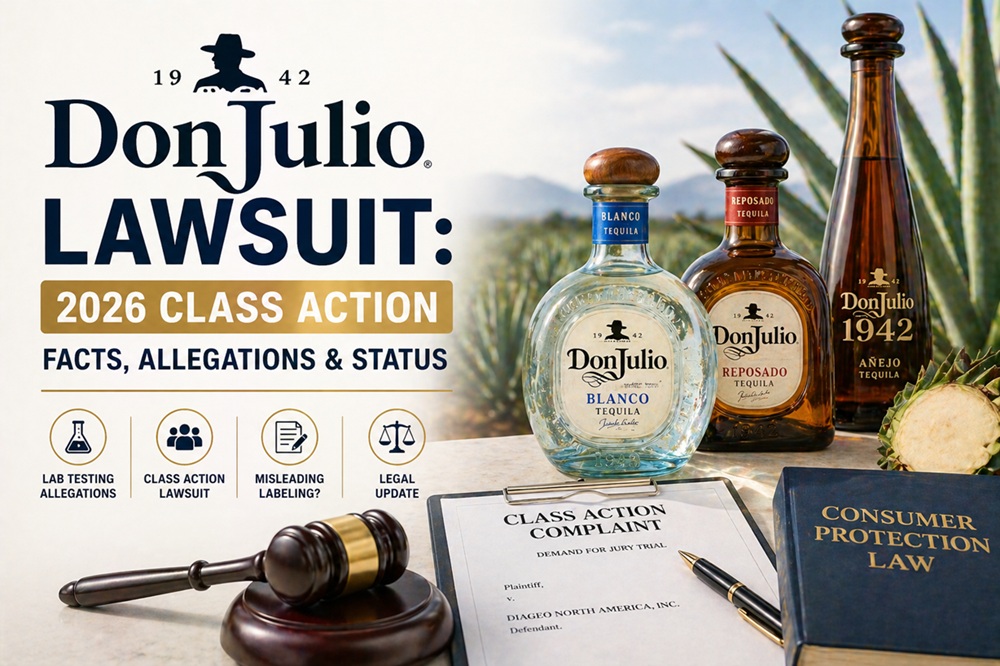

The Don Julio lawsuit is a 2025 class action filed against Diageo North America alleging that Don Julio and Casamigos tequilas contain non-agave alcohol despite “100% agave” labeling. Filed May 5, 2025 in the Eastern District of New York, it seeks over $5 million in damages. Diageo denies all allegations.
The Don Julio lawsuit is a class action filed by law firm Hagens Berman against Diageo North America in May 2025. Plaintiffs allege independent isotope testing found significant cane alcohol or non-agave sources in tequilas labeled “100% agave.” Similar lawsuits followed in California and Florida. A California RICO case alleges Don Julio Blanco contains only ~42% agave-derived alcohol. Diageo has filed motions to dismiss, calling the allegations “implausible” and the testing “scientifically unvalidated.”
If you’ve paid premium prices for Don Julio tequila believing it was made from 100% blue agave, the 2025 class action lawsuit might affect you. This case is one of the most-watched consumer fraud lawsuits in the spirits industry — alleging that Diageo, the parent company of Don Julio and Casamigos, sold tequila that wasn’t actually 100% agave. This article breaks down what the lawsuit alleges, who filed it, what the lab tests reportedly found, Diageo’s defense, current case status, and whether you may qualify for compensation. Every fact here is verified against court filings and reputable industry reporting.
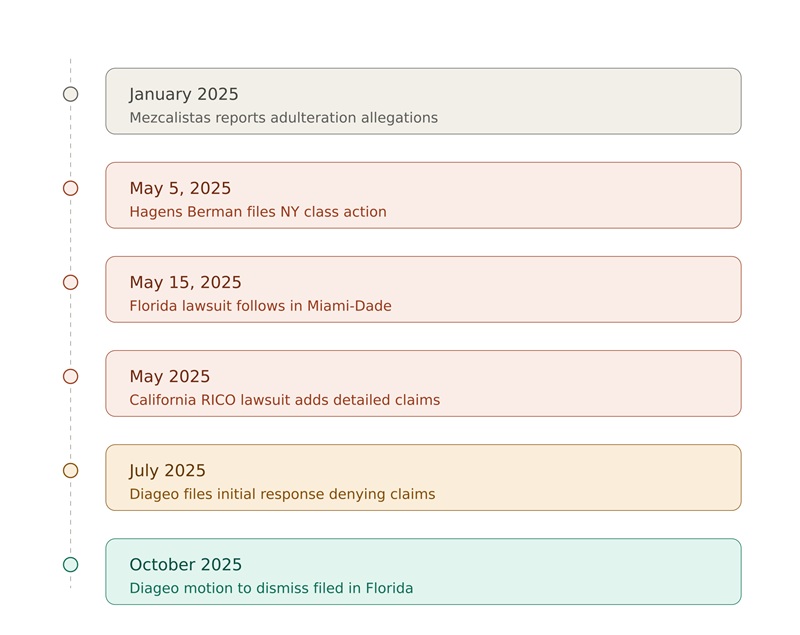
Visual Timeline of the Don Julio Lawsuit
What Is the Don Julio Lawsuit?
The Don Julio lawsuit is a consumer class action filed against Diageo North America, the parent company of Don Julio and Casamigos tequila brands. Plaintiffs allege the tequilas are mislabeled as “100% agave” when independent laboratory testing reportedly found significant amounts of non-agave alcohol — particularly cane-derived ethanol.
Why “100% Agave” Matters
Under both U.S. and Mexican regulations, tequila labeled “100% agave” must be:
- Made entirely from blue weber agave (Agave tequilana Weber blue variety)
- Distilled and bottled in Mexico
- Compliant with Norma Oficial Mexicana (NOM-006-SCFI) standards
- Certified by Mexico’s Tequila Regulatory Council (CRT)
If a tequila labeled “100% agave” actually contains other alcohol sources, it would violate consumer protection laws and U.S. labeling regulations.
The Premium Price Question
Don Julio and Casamigos sit firmly in the super-premium tequila category, with bottles ranging from $50 to over $1,000 (Don Julio 1942). Consumers pay these prices specifically because of the “100% agave” promise. The lawsuit argues consumers were defrauded by paying premium prices for an allegedly non-premium product.
Who Filed the Lawsuit?
The lawsuit was filed by the consumer rights firm Hagens Berman Sobol Shapiro LLP, a major plaintiffs’ firm with a track record in class actions against large corporations.
Named Plaintiffs
| Plaintiff | Type | State |
|---|---|---|
| Avi Pusateri | Consumer | New York |
| Chaim Mishulovin | Consumer | New York |
| Sushi Tokyo | Restaurant | New York |
| Nabil Haschemie | Consumer | Florida |
| Jacqueline Jackson | Consumer | California |
Where the Cases Were Filed
- Eastern District of New York (May 5, 2025) — original filing
- California (San Francisco) — May 2025
- Miami-Dade County, Florida (May 15, 2025) — described by Diageo as “copycat”
- California RICO case — filed by Jacqueline Jackson with detailed lab data
The Florida case has since moved to the U.S. District Court for the Southern District of Florida.
What the Lawsuit Alleges
The core allegations are detailed across the multiple class action complaints.
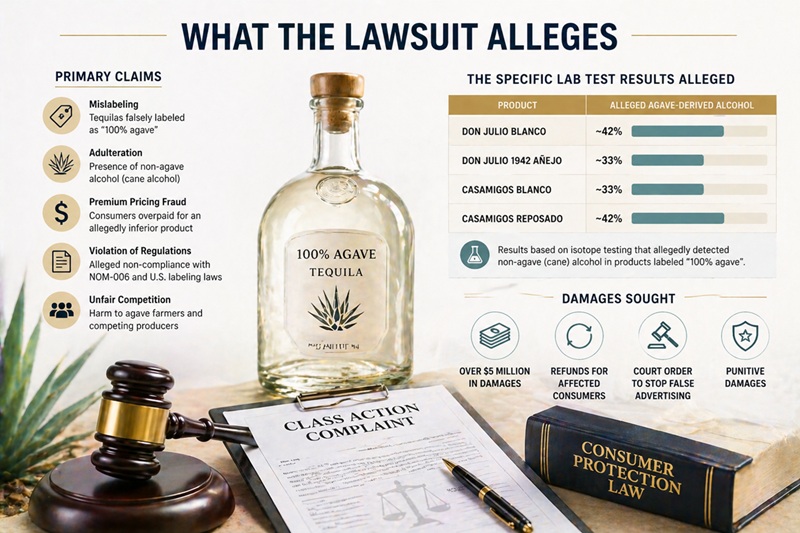
Primary Claims
- Mislabeling — Don Julio and Casamigos tequilas falsely marketed as “100% agave”
- Adulteration — Significant amounts of non-agave alcohol allegedly present
- Premium pricing fraud — Consumers paid super-premium prices for an allegedly inferior product
- Violation of regulations — Alleged non-compliance with NOM-006 and U.S. labeling rules
- Unfair competition — Alleged harm to agave farmers and competing producers
The Specific Lab Test Results Alleged
According to the California RICO complaint, isotope testing reportedly found:
| Product | Alleged Agave-Derived Alcohol |
|---|---|
| Don Julio Blanco | ~42% |
| Don Julio 1942 Añejo | ~33% |
| Casamigos Blanco | ~33% |
| Casamigos Reposado | ~42% |
Important context: These numbers come from the plaintiffs’ filings. Diageo has called the testing “scientifically unvalidated” and the allegations “implausible.” No court has ruled on the accuracy of these results.
Damages Sought
- New York case: Over $5 million in damages
- Court ruling prohibiting future false advertising
- Refunds for affected consumers
- Punitive damages in the California RICO case
How the Allegations Were Discovered
The story didn’t start with the lawsuit. According to Mezcalistas, an industry publication, the allegations have a longer history.
The Reporting Trail
- January 13, 2025: Mezcalistas published an investigation citing claims by agave farmers that large tequila companies were illegally mixing tequila with cane alcohol
- Lab tests allegedly existed supporting the allegations even before lawsuits were filed
- May 5, 2025: Hagens Berman filed the first formal class action
The European Lab Testing
Plaintiffs reportedly relied on isotope testing performed by a European laboratory to support their claims. The technique attempts to distinguish:
- C3 plant alcohols (agave, beets, wheat)
- C4 plant alcohols (cane sugar, corn)
By measuring ratios of carbon isotopes (¹²C vs. ¹³C), labs claim they can identify whether ethanol came from agave or cane.
Diageo has challenged the validity and applicability of this testing method to their tequila.
Diageo’s Defense
Diageo has firmly denied the allegations and is defending the case aggressively. Their position has been consistent across multiple statements and court filings.
Key Points of Diageo’s Response
- “Implausible” allegations — Diageo’s filings describe the claims as lacking legal and logical merit
- Test methodology challenged — Diageo says the European lab test is “scientifically unvalidated”
- No plaintiff samples — Diageo notes the test was based on “one sample of each brand, neither of which plaintiffs themselves purchased”
- NOM compliance — Diageo states all bottles labeled “100% agave” comply with Mexican regulatory standards
- Multiple oversight layers — Production is overseen by distillers, the Tequila Regulatory Council (CRT), and other independent parties
- “Copycat” allegations — Diageo describes Florida and other follow-up suits as “me too” filings
Diageo’s Public Statement
The company has stated through its spokespersons: bottled Casamigos and Don Julio tequilas labeled as “100% agave” are made from 100% blue weber agave, and Diageo is confident in its defense.
The Motion to Dismiss
In October 2025, Diageo filed a motion to dismiss the lawsuits. Their filing argued plaintiffs attempted to “alchemize rumor into fraud” and compared the testing theory to unscientific claims. As of early 2026, the court has not yet ruled on the motion.
What Is NOM-006 and Why It Matters
Understanding the lawsuit requires understanding the regulatory framework.
Norma Oficial Mexicana NOM-006-SCFI
NOM-006 is Mexico’s official tequila standard. Key requirements:
- Tequila must come from specific designated regions (mainly Jalisco)
- “100% agave” tequila must be made entirely from blue weber agave
- Mixed tequila (“mixto”) must contain at least 51% agave sugars
- Production must be bottled in Mexico
- All production is overseen by the Tequila Regulatory Council (CRT)
U.S. TTB Labeling Rules
In the U.S., the Alcohol and Tobacco Tax and Trade Bureau (TTB) governs alcohol labeling. Tequila imported into the U.S. must:
- Match Mexican production standards
- Carry accurate labels
- Comply with TTB regulations on alcohol content claims
False “100% agave” claims would potentially violate both Mexican and U.S. consumer protection law.
Diffuser vs. Traditional Tequila Production
The lawsuit also touches on a broader industry debate.
Traditional Production
Traditional tequila is made by:
- Roasting agave hearts (piñas) in stone ovens
- Crushing the cooked agave to extract sugars
- Fermenting the agave juice
- Distilling twice in copper pot stills
This process preserves agave character and is what consumers associate with premium tequila.
Diffuser Production
The diffuser method:
- Shreds raw, uncooked agave
- Uses pressurized hot water to extract sugars
- Often uses high-volume column distillation
- Can produce more efficient yields at lower cost
Diffuser production is legal under NOM-006 but is criticized for stripping out traditional agave character. Many craft producers prohibit it.
Note: Some lawsuit coverage conflates “diffuser tequila” with “non-agave alcohol.” These are different concerns. The lawsuit focuses on alleged non-agave alcohol content, not production methodology alone.
What This Means for Consumers
The case has implications regardless of how it’s resolved.
If You Bought Don Julio or Casamigos
You may be a potential class member if you purchased Don Julio or Casamigos tequila in the United States within the relevant statute of limitations. Specifics depend on:
- The state where you purchased
- The dates of your purchases
- Whether class certification is granted
- The eventual settlement (if any) terms
Documentation to Save
If you think you may qualify:
- Receipts showing tequila purchases
- Credit card statements with bar/restaurant tequila tabs
- Photos of bottles you purchased
- Loyalty card records from liquor stores
How Class Actions Typically Pay Out
If a settlement is reached:
- Tier 1 (no proof of purchase): typically $5–$25 flat refund
- Tier 2 (with receipts): higher amounts based on documented purchases
- Maximum claim: typically capped per household
These figures are typical for consumer class actions and are not guarantees in this specific case.
How the Spirits Industry Is Responding
The lawsuit has triggered industry-wide attention.
Reactions
- Agave farmers in Mexico have voiced support for the claims
- Craft tequila producers have noted competitive concerns about diffuser methods
- The CRT (Tequila Regulatory Council) maintains its certification processes are robust
- Other large producers are watching for how the court evaluates isotope testing as evidence
What’s at Stake
If plaintiffs succeed:
- Other tequila brands could face similar lawsuits
- Labeling standards may face stricter scrutiny
- Isotope testing could become a standard quality verification tool
- Premium pricing for “100% agave” tequila could face legal challenge if claims aren’t accurate
If Diageo prevails:
- The “scientifically unvalidated” defense could deter similar lawsuits
- Industry self-regulation through the CRT is strengthened
- Premium pricing models remain protected
Similar Lawsuits in the Beverage Industry
The Don Julio case fits a broader pattern of false-advertising lawsuits in alcohol and beverages.
Notable Recent Cases
| Brand | Allegation | Status |
|---|---|---|
| Tito’s Handmade Vodka | “Handmade” claims (2014–2016) | Settled |
| Maker’s Mark | “Handmade” bourbon claims | Dismissed |
| Templeton Rye | Source/age misrepresentation | Settled, ~$2.5M |
| Heineken Light | Calorie/carb claims | Settled |
| Bumble Bee Tuna | “Sustainable” labeling | Various outcomes |
These cases show that labeling and marketing claims are a recurring class action target, especially for premium-priced products.
What to Watch Next
Several developments will shape this case in 2026.
Key Milestones to Watch
- Court ruling on motion to dismiss (Florida)
- Class certification decisions (whether the case can proceed as a class action)
- Discovery phase (production records, testing protocols, internal documents)
- Expert witness depositions (validity of isotope testing methodology)
- Mediation or settlement discussions
- Possible related lawsuits against other tequila brands
How Long This May Take
Consumer class actions in federal court typically take 2–5 years to resolve. Active discovery, motions, and potential appeals can extend timelines further. Settlement is often more likely than trial.
FAQs
1. Is the Don Julio lawsuit real?
Yes. A class action lawsuit was filed May 5, 2025 by Hagens Berman law firm in the U.S. District Court for the Eastern District of New York against Diageo North America. Additional lawsuits have been filed in California and Florida. The cases allege that Don Julio and Casamigos tequilas contain non-agave alcohol despite “100% agave” labeling.
2. What does the lawsuit specifically allege?
The lawsuit alleges that independent laboratory testing using isotope analysis found significant amounts of non-agave alcohol — particularly cane-derived ethanol — in Don Julio and Casamigos tequilas labeled “100% agave.” The California RICO complaint alleges Don Julio Blanco contains only about 42% agave-derived alcohol and Don Julio 1942 only about 33%.
3. Has Diageo admitted any wrongdoing?
No. Diageo has firmly denied all allegations. The company filed a motion to dismiss in October 2025, calling the claims “implausible” and the testing “scientifically unvalidated.” Diageo states its tequilas comply with Mexican NOM-006 regulations and are made from 100% blue weber agave as labeled.
4. Can I join the Don Julio lawsuit?
If you purchased Don Julio or Casamigos tequila in the U.S. within the statute of limitations, you may be a potential class member if the class is certified. You don’t need to formally “join” — class actions automatically include qualifying purchasers unless they opt out. Hagens Berman maintains a case page for affected consumers.
5. How much could the lawsuit pay if successful?
The New York case seeks more than $5 million in damages. If a class is certified and settlement reached, individual payouts typically range from $5–$25 for purchasers without receipts, with higher amounts for documented purchases. Final amounts depend on class size, settlement structure, and court approval.
6. What is “100% agave” tequila?
“100% agave” tequila must be made entirely from blue weber agave (Agave tequilana Weber blue variety) under Mexican NOM-006 standards. Mixed tequila (mixto) requires only 51% agave content with the rest from other sugars. The “100% agave” label commands premium prices because of the higher production cost and traditional methods involved.
7. Should I stop drinking Don Julio while the lawsuit is pending?
That’s a personal choice. The FDA has not issued any safety warnings, and Diageo continues to sell its tequilas. The lawsuit concerns labeling accuracy and alleged consumer fraud — not health or safety. You can keep drinking, switch brands, or wait for case resolution. No recall has been issued.
Key Takeaways
- The Don Julio lawsuit is a 2025 class action filed by Hagens Berman against Diageo North America
- Plaintiffs allege the tequilas contain non-agave alcohol despite “100% agave” labeling
- The first case was filed May 5, 2025 in the Eastern District of New York, seeking over $5 million
- A California RICO case alleges specific test results — Don Julio Blanco at ~42% agave alcohol
- Diageo denies all allegations and has filed a motion to dismiss
- The court has not ruled on the motion as of early 2026; discovery may continue
- Consumers who bought Don Julio or Casamigos may be potential class members if certification is granted
