
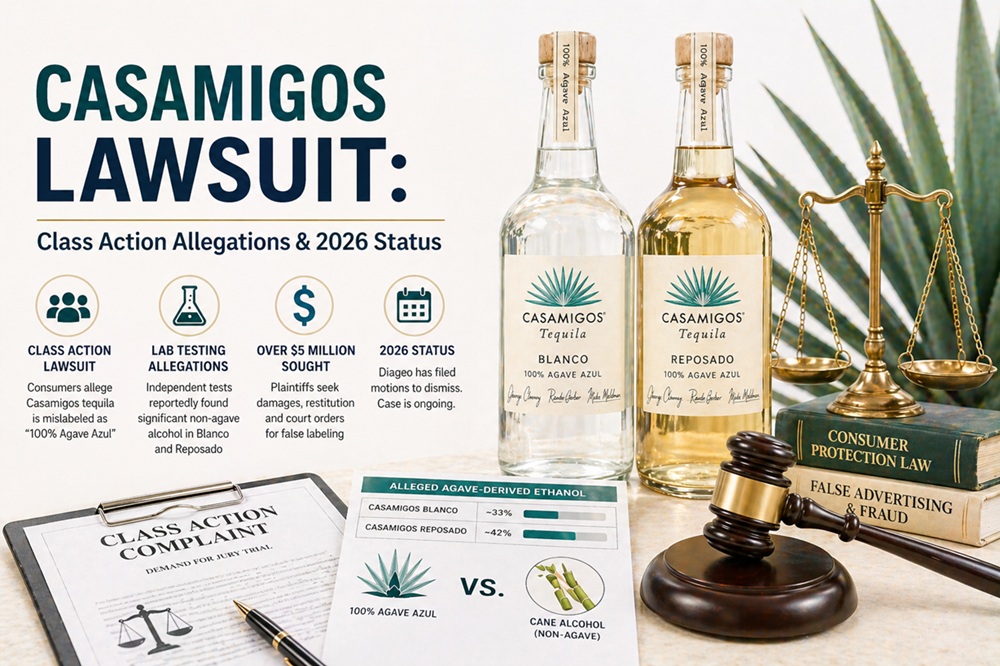

The Casamigos lawsuit is a 2025 class action filed against Diageo North America alleging the George Clooney-founded tequila is mislabeled as “100% agave” while containing significant non-agave alcohol. Filed May 5, 2025 in the Eastern District of New York, it seeks over $5 million in damages. Diageo denies all allegations.
The Casamigos lawsuit alleges that the tequila brand co-founded by George Clooney, Rande Gerber, and Mike Meldman — and acquired by Diageo for up to $1 billion in 2017 — is mislabeled as “100% Agave Azul.” Independent lab testing reportedly found Casamigos Blanco contains only ~33% agave-derived ethanol and Casamigos Reposado ~42% — both below the 51% minimum for even mixto tequila. Diageo has filed motions to dismiss, calling the allegations “implausible” and the testing methodology “scientifically unvalidated.”
Casamigos became one of the world’s fastest-growing tequila brands in part because of its celebrity origin story — George Clooney, Rande Gerber, and Mike Meldman built it before selling to Diageo for up to $1 billion in 2017. Today, that same brand is the subject of one of the most-watched consumer fraud lawsuits in the spirits industry. This article breaks down what the Casamigos lawsuit alleges, the specific lab test results cited in court filings, Diageo’s defense strategy, current case status, and what consumers should know if they purchased the brand. Every fact is sourced from court filings and verified industry reporting.
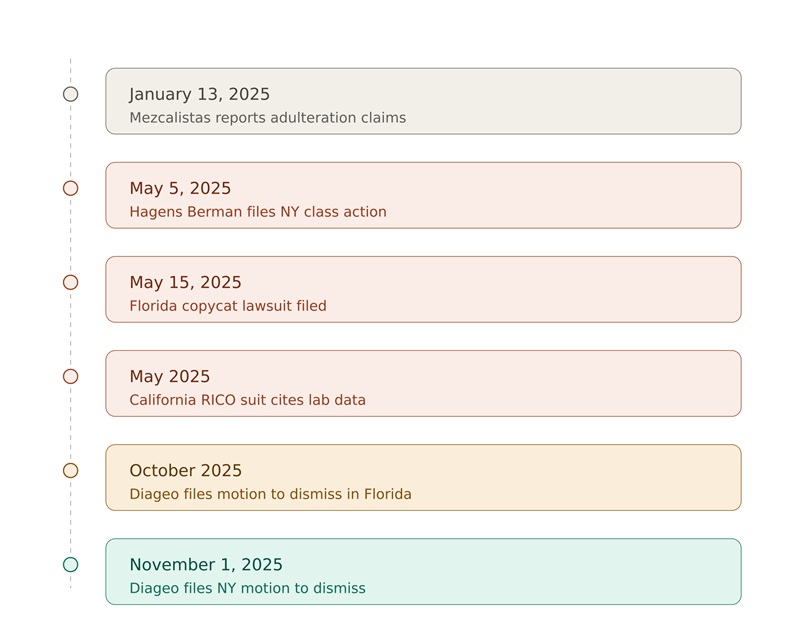
Visual Timeline of the Casamigos Lawsuit
What Is the Casamigos Lawsuit?
The Casamigos lawsuit is a consumer class action filed against Diageo North America Inc., the parent company that acquired Casamigos in 2017. Plaintiffs allege the tequila is mislabeled as “100% Agave Azul” when independent laboratory testing reportedly found significant non-agave alcohol — particularly cane-derived ethanol.
The Official Case
- Case name: Pusateri, et al. v. Diageo North America Inc.
- Case number: 1:25-cv-02482
- Court: U.S. District Court, Eastern District of New York
- Filed: May 5, 2025
- Plaintiff law firm: Hagens Berman Sobol Shapiro LLP
- Damages sought: Over $5 million
Why “100% Agave Azul” Matters
Every Casamigos bottle is reportedly labeled “Tequila 100% Agave Azul” — meaning made entirely from blue weber agave. Under Mexican and U.S. regulations:
- “100% agave” tequila must be made only from blue weber agave
- “Mixto” tequila requires at least 51% agave sugars
- The Tequila Regulatory Council (CRT) in Mexico oversees compliance
- The U.S. TTB (Alcohol and Tobacco Tax and Trade Bureau) enforces label accuracy in the U.S.
The lawsuit alleges Casamigos doesn’t even meet the lower 51% threshold required for mixto tequila.
Casamigos: From Friends’ Project to $1 Billion Brand
The Casamigos backstory is part of why this lawsuit has captured public attention.
The Founding Story
- Founded: 2013
- Founders: George Clooney, Rande Gerber, Mike Meldman
- Origin: The trio reportedly developed the brand for personal use before commercializing
- Marketing angle: Premium, smooth, “small-batch” tequila with celebrity credibility
The Diageo Acquisition
- Year: 2017
- Total deal value: Up to $1 billion (including performance-based payouts)
- Structure: Staggered payments over approximately 10 years
- Founders’ role post-acquisition: Clooney, Gerber, and Meldman reportedly stayed on as brand ambassadors
- Strategic significance: One of the largest celebrity brand acquisitions in spirits history
Casamigos’ Market Position
- 2023 ranking: 4th-largest tequila brand globally
- 2023 nine-litre case sales: ~3 million
- Price tier: Super-premium ($45–$120 per bottle for standard expressions)
- Distribution: Sold in 50+ countries through Diageo’s global network
The premium positioning — and the price consumers pay for it — is central to the lawsuit’s claims of consumer fraud.
What the Lawsuit Alleges
The complaint is built on consumer fraud and false advertising claims.
Primary Allegations
- False labeling — Casamigos marketed as “Tequila 100% Agave Azul” allegedly contains non-agave alcohol
- Adulteration — Significant amounts of cane-derived alcohol allegedly present
- Premium pricing fraud — Consumers paid super-premium prices for an allegedly inferior product
- Below-mixto thresholds — Tested samples allegedly fell below even the 51% minimum for mixto tequila
- Violation of consumer protection laws — New York and New Jersey statutes cited
- Unjust enrichment — Diageo allegedly profited from misleading marketing
The Specific Lab Test Results Alleged
According to the California RICO complaint (filed by Jacqueline Jackson) and other lawsuit filings:
| Casamigos Product | Alleged Agave-Derived Ethanol |
|---|---|
| Casamigos Blanco | ~33% |
| Casamigos Reposado | ~42% |
For context, Mexican law requires:
- 100% agave = 100% blue weber agave alcohol
- Mixto tequila = at least 51% agave alcohol
- Below 51% = cannot legally be sold as tequila in any form
Important note: These percentages come from plaintiffs’ filings, not court findings. Diageo has called the testing methodology “scientifically unvalidated” and the allegations “implausible.” No court has ruled on the accuracy of these results.
How the Allegations Surfaced
The case didn’t begin with the lawsuit. The allegations have a longer trail.
The Mezcalistas Investigation
On January 13, 2025, the industry publication Mezcalistas published an investigative report quoting agave farmers who claimed:
- Major tequila brands were illegally mixing tequila with cane alcohol
- Lab tests existed supporting the allegations
- The practice was suppressing agave prices and harming farmers
This reporting is reportedly cited extensively in the New York class action complaint.
The European Lab Testing
Plaintiffs reportedly relied on isotope testing by a European laboratory. The technique attempts to measure ratios of carbon isotopes (¹²C vs. ¹³C) to distinguish:
- C3 plant alcohols (agave is a CAM/C3-pathway plant)
- C4 plant alcohols (cane sugar, corn)
If a sample shows higher C4 isotope signatures than expected, it suggests cane alcohol may be present.
Diageo has aggressively challenged this methodology, calling it scientifically unvalidated and arguing the test was performed on a single sample of unknown provenance.
Diageo’s Defense Strategy
Diageo has been firm and consistent in denying the allegations across multiple court filings.
Key Points of Diageo’s Response
- “Implausible” allegations — Diageo’s filings describe the claims as lacking legal and logical merit
- “Manufactured” complaint — Diageo argues the case is built on rumor, not evidence
- Test methodology challenged — described as “scientifically unvalidated”
- No plaintiff samples — Diageo notes the test was on “one sample of each brand, neither of which plaintiffs themselves purchased”
- NOM compliance — Diageo states all bottles labeled “100% agave” comply with Mexican regulatory standards
- Multiple oversight layers — Production overseen by distillers, the CRT, and other independent parties
- Process integrity defense — plaintiffs have not alleged any specific flaw in Diageo’s “meticulous and rigorously monitored tequila-making process”
The Motions to Dismiss
Diageo has filed motions to dismiss in both key venues:
- Florida (late October 2025) — first motion to dismiss
- New York (November 1, 2025) — second motion to dismiss
Diageo’s legal team has used pointed language in filings, comparing plaintiffs’ theory to claims that “the earth is flat because he saw a ‘test’ result somewhere that says his neighbor’s backyard is level.”
As of early 2026, neither court has ruled on the motions.
What’s Different About the California Case
The California lawsuit, filed by Jacqueline Jackson, stands apart from the New York and Florida cases.
Key Differentiators
- Filed under federal RICO (Racketeer Influenced and Corrupt Organizations Act)
- Includes specific lab test percentages in the complaint
- Names multiple Diageo tequila products in detailed analysis
- Alleges a “fraudulent scheme” beyond simple mislabeling
Why RICO Matters
RICO claims allow plaintiffs to:
- Seek treble damages (3x the actual damages)
- Argue organized fraud rather than isolated mislabeling
- Hold multiple corporate parties liable
- Pursue larger settlements
If RICO claims survive motions to dismiss, the financial stakes for Diageo grow substantially.
How Casamigos Compares to Don Julio
The lawsuit names both Casamigos and Don Julio — but they have different histories and consumer profiles.
| Factor | Casamigos | Don Julio |
|---|---|---|
| Founded | 2013 | 1942 |
| Founders | Clooney, Gerber, Meldman | Don Julio González |
| Acquired by Diageo | 2017 ($1B) | Through 2014 deal with José Cuervo |
| 2023 global rank | 4th | 2nd |
| Brand identity | Celebrity-founded modern brand | Heritage Mexican tequila |
| Price tier | Super-premium | Super-premium and luxury (1942) |
For the parallel case against Don Julio, see our complete breakdown: Don Julio Lawsuit: 2026 Class Action Facts, Allegations & Status.
What This Means for Casamigos Buyers
The case has potential implications for anyone who has purchased Casamigos.
Are You a Potential Class Member?
You may qualify if you:
- Purchased Casamigos tequila in the United States
- Bought within the statute of limitations (typically 4 years for false advertising claims)
- Did not knowingly purchase mixto-quality tequila
The exact class period will be defined if and when class certification is granted.
Documentation to Save
If you think you may qualify:
- Receipts from liquor stores
- Credit card statements showing Casamigos purchases
- Photos of bottles you’ve purchased
- Bar/restaurant tabs with itemized Casamigos drinks
Even without receipts, no-proof claim tiers are typical in consumer class actions.
Realistic Settlement Expectations
If a settlement is reached, payouts typically follow this structure:
- Tier 1 (no proof of purchase): $5–$25 flat refund
- Tier 2 (with receipts): $20–$100+ depending on documented purchases
- Per-household caps typical
- Final amounts depend on class size and court approval
These figures are typical for consumer class actions and are not guarantees in this specific case.
Why the Celebrity Connection Adds Pressure
The celebrity origin of Casamigos creates unusual reputational dynamics for Diageo.
Public Profile Challenges
- George Clooney and his co-founders are brand ambassadors, not just sellers
- The brand’s marketing leans heavily on its founder narrative
- Negative press affects Clooney’s personal brand, not just Diageo
- Media coverage of the case has been extensive precisely because of celebrity involvement
Why Diageo Is Defending Hard
For a brand acquired for $1 billion with ongoing marketing built around three high-profile personalities, the stakes go beyond simple damages:
- Settlement could imply the underlying “100% agave” claim was indefensible
- Discovery process could reveal embarrassing internal communications
- Long-term consumer trust in the brand depends on the outcome
- Other premium tequilas could face similar suits if Casamigos loses
What’s Next in the Case
Several upcoming milestones will shape the lawsuit’s trajectory through 2026 and beyond.
Key Pending Decisions
- Court rulings on motions to dismiss (Florida and New York)
- Class certification motions — whether the case can proceed as a class action
- Discovery rulings — what internal Diageo records can be obtained
- Expert witness depositions — particularly on isotope testing methodology
- Possible mediation — large class actions often settle before trial
- Coordination across cases — possible MDL (multi-district litigation) consolidation
Realistic Timeline
Federal consumer class actions typically take 2–5 years from filing to resolution. Given the complexity of multi-state cases, scientific testing disputes, and a well-resourced corporate defendant, this case could extend toward the longer end of that range — or settle earlier if Diageo’s motion to dismiss fails.
How This Compares to Past Spirits Lawsuits
The Casamigos case fits a broader pattern of premium-pricing class actions against alcohol brands.
Notable Precedents
| Brand | Allegation | Outcome |
|---|---|---|
| Tito’s Handmade Vodka | “Handmade” mass-production claims | Settled (~$3.5M) |
| Maker’s Mark | “Handmade” claims | Dismissed |
| Templeton Rye | Source/age representation | Settled (~$2.5M) |
| WhistlePig Rye | Source/manufacturing claims | Settled |
| Heineken Light | Calorie/carb representations | Settled |
Pattern across these cases: courts often dismiss “handmade” puffery claims but take ingredient-content cases more seriously. The Casamigos case is closer to the latter category.
FAQs
1. Is the Casamigos lawsuit real?
Yes. A class action lawsuit (Pusateri, et al. v. Diageo North America Inc., Case No. 1:25-cv-02482) was filed May 5, 2025 by Hagens Berman law firm in the U.S. District Court for the Eastern District of New York. Additional lawsuits in California and Florida followed shortly after. Diageo denies all allegations.
2. What does the lawsuit allege about Casamigos?
The lawsuit alleges that Casamigos tequila labeled “Tequila 100% Agave Azul” actually contains significant amounts of non-agave alcohol, particularly cane-derived ethanol. The California RICO complaint alleges Casamigos Blanco contains only ~33% agave-derived ethanol and Casamigos Reposado ~42% — both below the 51% required for even mixto tequila.
3. Is George Clooney being sued personally?
No. The lawsuit names Diageo North America Inc., not Clooney, Rande Gerber, or Mike Meldman individually. The three founders sold Casamigos to Diageo in 2017 in a deal worth up to $1 billion. They reportedly continue as brand ambassadors but are not named defendants in the litigation.
4. Has Diageo admitted any wrongdoing?
No. Diageo has firmly denied all allegations and filed motions to dismiss in both New York (November 2025) and Florida (October 2025). The company calls the claims “implausible” and the testing methodology “scientifically unvalidated.” Diageo states its tequilas comply with Mexican NOM-006 standards.
5. Can I join the Casamigos lawsuit?
If you purchased Casamigos tequila in the U.S. within the statute of limitations, you may be a potential class member if the class is certified. You don’t need to formally “join” — class actions automatically include qualifying purchasers unless they opt out. Hagens Berman maintains a case page for affected consumers.
6. How much could the lawsuit pay if successful?
The New York case seeks more than $5 million in damages. If a class is certified and settlement is reached, individual payouts typically range from $5–$25 for purchasers without receipts, with higher amounts for documented purchases. Final amounts depend on class size, settlement structure, and court approval.
7. Should I stop drinking Casamigos while the lawsuit is pending?
That’s a personal choice. The FDA has not issued any safety warnings, and Diageo continues to sell Casamigos. The lawsuit concerns labeling accuracy and alleged consumer fraud — not health or safety. You can keep drinking, switch brands, or wait for case resolution. No recall has been issued.
Key Takeaways
- The Casamigos lawsuit is a 2025 class action filed by Hagens Berman against Diageo North America
- Plaintiffs allege the tequila contains non-agave alcohol despite “100% Agave Azul” labeling
- The first case was filed May 5, 2025 in the Eastern District of New York, seeking over $5 million
- Lab tests cited in the California RICO case allege Casamigos Blanco at ~33% and Reposado at ~42% agave-derived ethanol
- Diageo denies all allegations and has filed motions to dismiss in both New York and Florida
- George Clooney and other founders are not named defendants — only Diageo
- Consumers who bought Casamigos may be potential class members if certification is granted
