

The Rowdy Oxford lawsuit is a 2024 federal civil case filed by Integris Composites USA, Inc. against former Vice President Rowdy Lane Oxford, alleging trade secret theft, breach of contract, and confidentiality violations. The case was resolved by Consent Final Order on January 12, 2025, with no admission of guilt by Oxford.
The Rowdy Oxford lawsuit refers to a corporate trade secrets case in the U.S. District Court for the Western District of North Carolina. Integris Composites alleged its former VP of Business Development downloaded thousands of proprietary files before resigning to join competitor Hesco Armor. Judge Max Cogburn signed a Consent Final Order on January 12, 2025, restricting Oxford from working with direct competitors, requiring data destruction, and banning him from pursuing Integris clients — without any admission of liability.
The “Rowdy Oxford lawsuit” has generated significant search interest and online speculation across legal and business communities. While many web sources discuss the case, the verifiable facts come from federal court filings in the Western District of North Carolina. This article separates documented court information from secondhand reporting, explains what Integris Composites alleged, what the consent order requires, and what the case means for executives, defense contractors, and anyone signing non-compete agreements. Every detail below is grounded in publicly reported court documents — and we clearly note where information is incomplete or unverified.
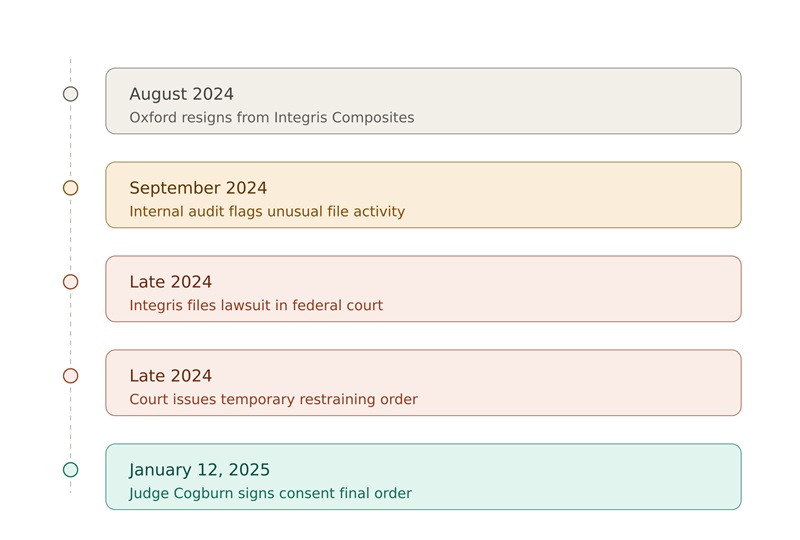
Visual Timeline of the Rowdy Oxford Lawsuit
To make the sequence of events easier to follow, here’s a visual timeline of the case’s key milestones:
Who Is Rowdy Lane Oxford?
Rowdy Lane Oxford is a U.S. defense industry executive with reported military experience including service as a Marine Scout Sniper and roles in the U.S. Army Reserve. He transitioned to corporate leadership and held the position of Vice President of Business Development at Integris Composites USA, Inc. before the events that led to this lawsuit.
His Role at Integris
- Strategic sales and business development
- Government contract relationships
- Military procurement networking
- Senior leadership access to proprietary information
Why His Departure Mattered
Defense industry executives operate in a highly regulated environment. Their roles typically involve:
- Access to confidential client lists
- Knowledge of armor system technology
- Government contract negotiation history
- Pricing strategies and supplier relationships
When a senior executive leaves a defense contractor, especially to join a competitor, the transition is closely monitored.
Who Is Integris Composites?
Integris Composites USA, Inc. is a defense contractor specializing in advanced composite armor systems for military and law enforcement applications. The company’s product focus includes:
- Lightweight ballistic armor
- Composite material technology
- Body armor for soldiers and officers
- Vehicle armor systems
The defense armor industry is a competitive niche with significant intellectual property — pricing, formulas, supplier networks, and contract strategies are tightly held.
What Integris Allegedly Discovered
According to publicly reported court filings, Integris’s allegations centered on actions taken in the period before and after Oxford’s resignation.
The Core Allegations
| Allegation | Details |
|---|---|
| Trade secret theft | Reportedly accessed and transferred thousands of proprietary files before resigning |
| Breach of contract | Alleged violations of confidentiality and non-compete clauses |
| Confidentiality violation | Retention of sensitive client and technical data after departure |
| Unfair competition | Alleged use of stolen information to lure clients to a competitor |
What Reportedly Triggered the Investigation
Integris reportedly conducted an internal forensic audit after Oxford’s departure, which allegedly revealed:
- Abnormal file download patterns in the weeks before resignation
- Access to confidential databases not required for standard duties
- Email and file transfers to external locations
- Total volume of files allegedly accessed: reportedly over 9,000
Important note: These allegations come from Integris’s filings. Oxford has denied wrongdoing, and the Consent Final Order does not include any admission of liability.
The Federal Lawsuit
The case was filed in the U.S. District Court for the Western District of North Carolina — a venue chosen because of Integris’s principal place of business and the alleged location of the wrongdoing.
Laws Cited in the Complaint
| Law | What It Covers |
|---|---|
| Defend Trade Secrets Act (DTSA) | Federal protection for proprietary business information |
| Uniform Trade Secrets Act (UTSA) | State-level trade secret protections (adopted in NC) |
| Breach of Contract | NDA and non-compete violations |
| Computer Fraud and Abuse Act (CFAA) | Possible application to unauthorized data access |
The Temporary Restraining Order
Shortly after filing, the court issued a Temporary Restraining Order (TRO) that:
- Prevented Oxford from continuing employment with Hesco Armor
- Prohibited use or disclosure of any allegedly retained Integris data
- Required preservation of digital records
The TRO is a strong court action — it suggests the judge found enough preliminary evidence to warrant immediate intervention.
The Consent Final Order: What It Actually Requires
On January 12, 2025, Judge Max Cogburn signed a Consent Final Order resolving the case without trial. This is a court-approved agreement between both parties.
Key Provisions of the Order
- Data destruction or return — Oxford must destroy or return all proprietary information obtained from Integris
- No employment with Hesco Armor — restriction on continuing his new position
- No competitor employment — prohibition on working for direct competitors for a specified period
- No solicitation — banned from pursuing Integris clients, vendors, or government contracts
- IP rights acknowledgment — formal acknowledgment of confidentiality obligations
- Independent digital audit — cooperation with forensic verification
What “Consent Order” Means
A Consent Final Order is not a guilty verdict. It’s a settlement where the defendant agrees to court-enforceable terms without admitting wrongdoing. Common reasons defendants accept consent orders include:
- Avoiding the cost and publicity of trial
- Eliminating risk of larger damages awards
- Resolving the matter quickly to move on
- Satisfying business or career concerns
Oxford’s acceptance of the order does carry legal weight — but it is not the same as a court ruling that he committed the alleged acts.
Oxford’s Defense Position
Through his legal team, Oxford has reportedly disputed every allegation. His public defense has reportedly included:
- He left Integris voluntarily and followed every offboarding protocol
- The documents he accessed were related to his ongoing responsibilities, not malicious
- Integris allegedly failed to clearly define what qualified as a trade secret
- The company allegedly launched the lawsuit to scare him from joining a competitor
- Personal communications were misinterpreted as suspicious activity
These represent his side of the dispute. The Consent Final Order ended the litigation before either side’s full case was tested at trial.
Why This Case Matters Beyond One Executive
The Rowdy Oxford lawsuit has become a reference point in defense industry compliance discussions for several reasons.
Trade Secrets in National Defense
Defense contractors handle:
- Government-classified or sensitive technology
- Proprietary armor and ballistic specs
- Supplier and pricing data
- Client relationships including federal and military buyers
Executives in this sector face stricter scrutiny because the information they touch can have national security implications, not just commercial value.
Internal Monitoring Trends
The case reflects a growing industry trend toward executive exit monitoring:
- Forensic audits at the time of resignation
- Email and file access reviews
- USB and external transfer logging
- Departure-window activity review (typically 30-90 days before resignation)
If you’re an executive at a sensitive industry company, expect this level of scrutiny on your way out.
NDA and Non-Compete Enforcement
The case demonstrates that non-compete and confidentiality clauses can be enforced, especially in:
- Defense and security industries
- Technology with proprietary trade secrets
- Client-relationship-heavy sectors
- Roles with government contract knowledge
Federal courts have consistently upheld reasonable non-compete agreements when properly drafted.
Why Information About This Case Is Sometimes Conflicting
When researching the Rowdy Oxford lawsuit online, you may encounter inconsistencies. Here’s why.
Multiple “Rowdy Oxford” References
Some sources confuse:
- The corporate case (Integris v. Oxford) — verifiable in federal court records
- A separate fraternity-related public nuisance discussion in Oxford, Mississippi — different matter entirely
- Symbolic or fictional usage of the term in some legal blogs
Source Quality Matters
For the most accurate information:
- Primary source: Court filings via PACER (Public Access to Court Electronic Records)
- Reliable secondary: Established legal news outlets and law firm summaries
- Use with caution: SEO-driven content sites that paraphrase each other
Always verify the docket through PACER or the Western District of North Carolina court website if precise details matter for your purposes.
Lessons for Executives
If you’re a senior executive or considering a job change, the Rowdy Oxford case offers actionable lessons.
Before Resigning
- Read your contract — review every non-compete, NDA, and confidentiality clause
- Know what counts as a trade secret — don’t assume “client information” is general knowledge
- Consult an employment lawyer — especially for senior roles or restricted industries
- Document everything in writing — including final tasks and access boundaries
During the Resignation
- Don’t download “your” work — files created in your role typically belong to the employer
- Don’t bulk-transfer emails to personal accounts — even your own correspondence
- Don’t access systems beyond normal duties in the final days
- Communicate exit details in writing
After Departure
- Comply fully with offboarding protocols
- Don’t contact former clients during restricted periods
- Keep careful records of any forensic requests
- Engage counsel immediately if concerns arise
Lessons for Companies
If you operate a company with proprietary information, the case suggests several best practices.
Prevention
- Crystal-clear NDAs and non-competes — vague clauses are harder to enforce
- Trade secret inventories — explicitly designate what is protected
- Monitoring infrastructure — forensic-ready logging of file access and transfers
- Tiered access controls — limit data exposure to job function
Response
- Standard exit forensic audits — for senior executives and high-access roles
- Immediate counsel consultation when irregularities appear
- Preservation of digital evidence — before deletion windows close
- Clear escalation protocols — internal investigation → legal → litigation
Federal vs. State Enforcement
A common question: which level of law applies to trade secret cases?
| Jurisdiction | Statute | Applies When |
|---|---|---|
| Federal | Defend Trade Secrets Act (DTSA, 2016) | Trade secrets used in interstate or international commerce |
| State | Uniform Trade Secrets Act (UTSA) | State-specific protections, varies by state |
| Federal | Computer Fraud and Abuse Act (CFAA) | Unauthorized computer access |
| Federal | Economic Espionage Act | Theft for foreign government benefit |
The Rowdy Oxford case reportedly invoked both federal and state protections — common in modern trade secret litigation.
FAQs
1. What is the Rowdy Oxford lawsuit about?
The Rowdy Oxford lawsuit is a federal civil case filed by Integris Composites USA, Inc. against its former Vice President of Business Development, Rowdy Lane Oxford. The company alleged trade secret theft, breach of contract, and confidentiality violations after Oxford resigned to join competitor Hesco Armor. The case was resolved by Consent Final Order in January 2025.
2. What did Rowdy Oxford allegedly do?
Integris Composites alleged that Oxford accessed and transferred thousands of proprietary files in the weeks before his resignation, retained confidential client and technical data, and violated non-compete agreements by joining a direct competitor. Oxford has denied these allegations and entered into a Consent Final Order without admitting guilt.
3. Did Rowdy Oxford lose the lawsuit?
The case was resolved by a Consent Final Order signed January 12, 2025 — not a court verdict. Oxford did not admit liability. However, the order imposes significant restrictions including data destruction, employment limitations with competitors, and restrictions on contacting former Integris clients.
4. What court handled the Rowdy Oxford case?
The case was filed in the U.S. District Court for the Western District of North Carolina. Judge Max Cogburn signed the Consent Final Order on January 12, 2025. The Western District handles federal civil cases including those involving the Defend Trade Secrets Act and the Uniform Trade Secrets Act for North Carolina-based companies.
5. What laws were cited in the case?
The lawsuit reportedly cited the Defend Trade Secrets Act (DTSA), the Uniform Trade Secrets Act (UTSA), breach of contract claims for NDA and non-compete violations, and unfair competition statutes. Trade secret cases often combine federal and state law claims to maximize protection and remedies available to the plaintiff company.
6. Can Rowdy Oxford work in the defense industry now?
Under the Consent Final Order, Oxford is restricted from working with Hesco Armor and other direct competitors for a specified period. He’s also prohibited from pursuing former Integris clients, vendors, or related government contracts. Once the restricted period ends and contractual obligations are satisfied, broader career options may resume.
7. Why is this case significant for the defense industry?
The case has become a reference point for executive exit monitoring, trade secret protection, and non-compete enforcement in defense contracting. It highlights how forensic audits can detect data movement before formal departure, and how courts will enforce well-drafted confidentiality agreements — particularly when national security interests overlap with corporate interests.
Key Takeaways
- The Rowdy Oxford lawsuit is a 2024 federal trade secrets case filed by Integris Composites against its former VP
- The case was resolved by Consent Final Order on January 12, 2025, signed by Judge Max Cogburn
- Oxford did not admit liability but agreed to data destruction, competitor restrictions, and client non-solicitation
- Allegations included trade secret theft, breach of NDA, and unfair competition
- Laws cited reportedly included the Defend Trade Secrets Act and Uniform Trade Secrets Act
- The case demonstrates the importance of executive exit forensics and clear NDA drafting
- Always verify case details through PACER rather than secondhand legal blogs
