
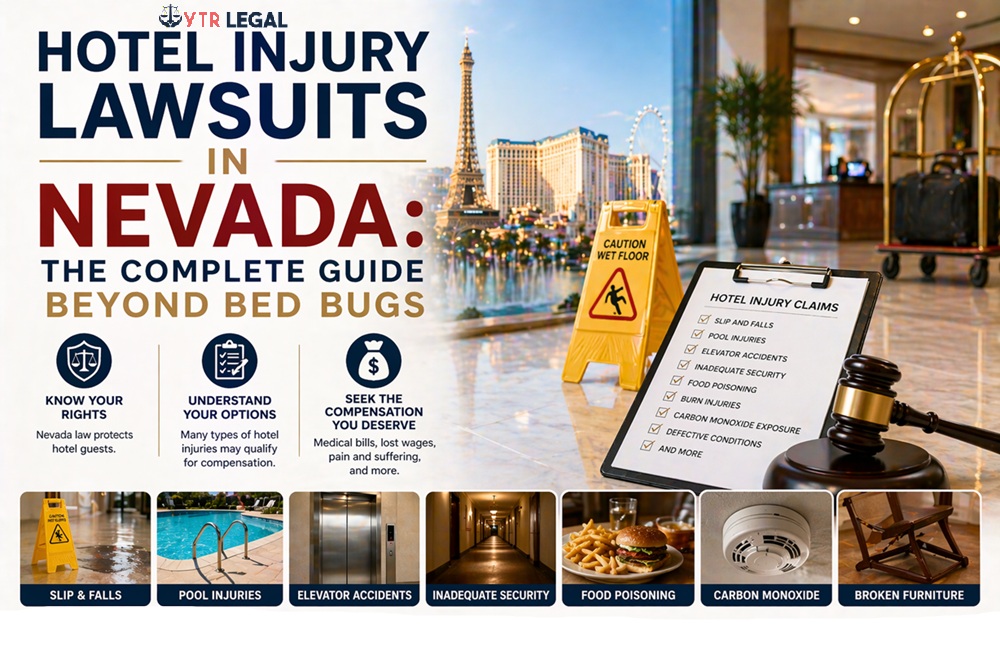

Hotel injury lawsuits in Nevada are premises liability claims filed when guests are harmed by unsafe conditions — slip-and-falls, elevator accidents, pool injuries, inadequate security, food poisoning, and more. Nevada law (NRS 11.190) imposes a two-year statute of limitations for personal injury, and hotels owe guests the highest duty of care as invitees.
Nevada hotel injury lawsuits cover far more than bed bugs. Guests can sue for slip-and-falls, broken furniture, swimming pool injuries, elevator malfunctions, inadequate security leading to assault, food poisoning, carbon monoxide exposure, and more. These cases rely on Nevada premises liability law, which treats hotel guests as invitees — the highest duty of care category. Compensation includes medical costs, lost wages, pain and suffering, and sometimes punitive damages. Nevada’s comparative negligence rule allows partial recovery even if the guest was partly at fault.
Las Vegas hotels host more than 40 million visitors a year — and injuries happen constantly, from slippery casino floors to malfunctioning pool equipment. What most guests don’t realize is that Nevada law gives injured hotel patrons significant rights and a defined path to compensation. This guide covers the full landscape of hotel injury lawsuits in Nevada: the types of cases, the laws that apply, the timelines, damages you can recover, how comparative negligence affects your claim, and what to do in the first 24 hours after an injury. Every legal citation here is from Nevada Revised Statutes and verified case law — no speculation.
What Is a Hotel Injury Lawsuit in Nevada?
A Nevada hotel injury lawsuit is a civil claim filed by a guest (or visitor) who suffered physical, emotional, or financial harm due to unsafe conditions or negligent acts on hotel property.
Who Can Sue
- Registered hotel guests
- Restaurant and bar patrons
- Spa and pool users
- Casino customers
- Convention attendees
- Visitors meeting registered guests
- Vendors and service providers on premises
What You Have to Prove
To win a hotel injury case, a plaintiff must establish four elements:
- Duty — the hotel owed you a duty of care
- Breach — the hotel breached that duty
- Causation — the breach caused your injury
- Damages — you suffered quantifiable harm
Key insight: Hotel guests in Nevada are classified as invitees — the highest protection category in premises liability law. This means hotels must proactively search for hazards, not just warn about ones they happen to know about.
Common Types of Nevada Hotel Injury Cases
Hotels face a wide range of injury claims beyond just bed bug cases. Here’s the full category landscape.
1. Slip-and-Fall Accidents
The most common hotel injury case in Nevada. Typical causes:
- Wet or slippery floors (buffets, pool decks, lobbies)
- Uneven carpet, torn runners, exposed cables
- Poorly lit stairways and walkways
- Freshly mopped floors without warning signs
- Spilled drinks or food in casinos and restaurants
Cases often cite Turner v. Mandalay Sports Entm’t, LLC (2008) and Asmussen v. New Golden Hotel Co. (1964) as foundational Nevada precedent.
2. Bed Bug and Sanitation Claims
Covered in depth in our companion article: Las Vegas Resorts Bed Bug Lawsuits: 2026 Facts, Cases & Rights — three lawsuits were filed in April 2025 against the Luxor and Treasure Island under Nevada sanitation statutes NRS 447.020 and NRS 447.040.
3. Swimming Pool and Hot Tub Injuries
- Drownings and near-drownings
- Chemical burns from improperly balanced water
- Slip-and-falls on wet pool decks
- Inadequate lifeguard staffing
- Broken tiles or handrails
- Hot tub overheating causing burns or medical episodes
4. Elevator and Escalator Accidents
- Sudden drops or stops
- Doors closing on guests
- Escalator step collapse
- Escalator entrapment injuries
- Malfunctioning emergency stops
5. Inadequate Security Claims
- Assaults in hotel hallways, parking structures, rooms
- Robberies and mugging in garages
- Sexual assaults with alleged security failures
- Insufficient surveillance or staffing
- Failure to restrict access to guest floors
The Humphries v. New York, New York case (2017) is frequently cited in security-failure claims.
6. Food Poisoning and Foodborne Illness
- Salmonella, E. coli, Listeria, Norovirus outbreaks
- Restaurant buffet contamination
- Improperly stored or prepared food
- Cross-contamination in food service
7. Broken or Defective Furniture
- Chairs that collapse at restaurants, bars, pool decks
- Bed frames breaking during normal use
- Balcony railings giving way
- Faulty exercise equipment in fitness centers
8. Carbon Monoxide and Air Quality
- CO leaks from heating or water heating systems
- Inadequate ventilation causing illness
- Mold exposure in guest rooms
- HVAC failures causing heatstroke in desert climate
9. Burn Injuries
- Hot beverages spilled by staff
- Scalding shower water due to faulty mixers
- Kitchen equipment accidents
- Fire-related injuries in guest rooms
10. Casino-Specific Injuries
- Collapsing gaming chairs
- Cord-related trips at slot machines
- Spilled drinks leading to falls
- Smoke inhalation in high-smoke environments
Nevada Laws That Govern Hotel Injury Claims
Several specific statutes form the backbone of hotel injury litigation in Nevada.
| Statute / Rule | What It Governs |
|---|---|
| NRS 11.190 | 2-year statute of limitations for most personal injury cases |
| NRS 41.141 | Nevada’s modified comparative negligence rule |
| NRS 447.020 | Requires clean bedding in hotels |
| NRS 447.040 | Requires clean, sanitary rooms |
| NRS 41.031 | General premises liability standards |
| NRS 42.005 | Punitive damages in personal injury cases |
The 50% Bar Rule (NRS 41.141)
Nevada follows a modified comparative negligence rule:
- You can still recover if you were partly at fault
- Recovery is reduced by your percentage of fault
- If you were more than 50% at fault, you cannot recover anything
- Example: $100,000 verdict, you’re 30% at fault → you receive $70,000
Duty of Care Hierarchy
Nevada recognizes three visitor categories:
| Visitor Type | Duty Owed |
|---|---|
| Invitee (hotel guests) | Highest duty — must inspect for and warn of hazards |
| Licensee (social guests) | Must warn of known hazards |
| Trespasser | Minimal duty — not willfully injure |
This classification matters. Hotel guests are always invitees, giving them the strongest legal position.
Nevada Statute of Limitations by Injury Type
Time is a critical factor. Miss the deadline and your case is dismissed regardless of merit.
| Case Type | Deadline | Source |
|---|---|---|
| Personal injury (general) | 2 years | NRS 11.190 |
| Slip-and-fall with property damage only | 3 years | NRS 11.190 |
| Wrongful death | 2 years | NRS 11.190 |
| Products liability | 4 years | NRS 11.190 |
| Medical malpractice | 2 years (3 with discovery rule) | NRS 41A.097 |
| Fraud | 3 years | NRS 11.190 |
| Asbestos exposure | 1 year | NRS 11.190 |
The Discovery Rule
Under Nevada’s discovery rule, the clock starts when you discovered or reasonably should have discovered your injury — not necessarily the date of the accident. This matters for:
- Internal injuries that appear days later
- Scarring that develops over weeks
- Psychological trauma with delayed onset
- Hearing or vision damage
Who Can Be Sued in a Nevada Hotel Injury Case
Identifying all potential defendants maximizes your recovery. Common parties include:
The Hotel Itself
The primary defendant — the corporate entity that owns or operates the property. Examples: MGM Resorts International, Caesars Entertainment, Wynn Resorts.
Property Owners vs. Operators
Many Strip hotels are leased or operated separately from the property owner. Both may be liable:
- Property owner (often a REIT like Vici Properties)
- Operator (the hotel brand managing daily operations)
Third-Party Vendors
- Cleaning and maintenance contractors
- Security companies
- Pool and spa maintenance companies
- Restaurant operators (when not hotel-owned)
- Pest control companies
- Elevator maintenance firms
Individual Employees
Under the doctrine of respondeat superior (vicarious liability), hotels are responsible for employee actions taken within the scope of employment. You can often sue both the employee and the hotel.
Manufacturers
For equipment-related injuries (collapsing chairs, defective safety systems), the manufacturer may share liability under product liability law.
Types of Damages You Can Recover
Nevada allows three main categories of damages in hotel injury cases.
Economic Damages
Measurable financial losses:
- Medical expenses — past and future
- Lost wages — time off work during recovery
- Reduced earning capacity — if you can’t return to your prior job
- Property damage — luggage, electronics, clothing
- Transportation costs — to medical appointments
- Home modifications — if your injury requires them
Non-Economic Damages
Harder to quantify but often the largest portion of a settlement:
- Pain and suffering
- Emotional distress and PTSD
- Loss of enjoyment of life
- Disfigurement and scarring
- Loss of consortium (spousal or family)
Punitive Damages
Under NRS 42.005, punitive damages may be awarded for:
- Knowingly renting a room with a known defect or infestation
- Gross negligence or recklessness
- Intentional misconduct or fraud
Nevada caps punitive damages at the greater of three times compensatory damages or $300,000 (varies by case type).
Real Nevada Hotel Injury Cases
Documented verdicts and settlements that shape current litigation.
Mandalay Bay Slip-and-Fall (2018)
A jury awarded a plaintiff $524,000 after the hotel reportedly offered only $2.5 million to settle. Although the verdict was below the offer, the case highlights the unpredictability of jury outcomes in Nevada hotel injury cases.
Luxor & Treasure Island Bed Bug Cases (April 2025)
Three separate lawsuits in Clark County District Court alleging bed bug bites, permanent scarring, and an emergency hospitalization from summer 2024 stays. Cases remain active.
Asmussen v. New Golden Hotel Co. (1964)
A foundational Nevada case still cited today, establishing that hotel operators must exercise reasonable care to keep premises safe for guests.
Turner v. Mandalay Sports Entm’t, LLC (2008)
Key Nevada Supreme Court decision defining the standards for premises liability in entertainment and hospitality contexts.
Humphries v. New York, New York (2017)
Nevada Supreme Court ruling affecting how hotels address third-party criminal acts and security obligations.
Step-by-Step: What to Do After a Hotel Injury
The first 24 hours determine your case’s strength.
- Get medical attention immediately — even if injuries seem minor
- Report the injury to hotel management in writing — request a formal incident report and keep your copy
- Document everything — photos and video of the scene, the hazard, your injuries, your surroundings
- Get witness contact information — names, phone numbers, emails
- Request surveillance footage — in writing, with a preservation demand
- Keep all physical evidence — torn clothing, broken equipment, damaged luggage
- Save receipts — medical, transportation, replacement items, prescriptions
- Follow medical recommendations exactly — gaps in treatment weaken your case
- Do NOT give recorded statements to the hotel’s insurer — without an attorney
- Do NOT sign a release or waiver — in exchange for a refund or free night
- Consult a Nevada personal injury attorney — most offer free consultations and contingency fees
Warning: Hotels commonly offer “comp’d stays,” refunds, or small cash amounts in exchange for liability waivers. Signing such a waiver can permanently bar future legal claims, even if injuries worsen. Never sign without legal advice.
Liability Waivers in Nevada Hotels
Many hotels require waivers before risky activities — zip lines, roller coasters, pool parties, adventure excursions.
What Waivers CAN Do
- Release the hotel from ordinary negligence claims
- Set forth assumed risks of specific activities
- Require arbitration instead of court trials (sometimes enforceable)
What Waivers CANNOT Do
- Release claims for gross negligence — reckless disregard for safety
- Waive intentional misconduct
- Waive statutory violations (like sanitation code breaches)
- Bind minors (parents cannot waive minor children’s rights in most cases)
Liability waivers are valid in Nevada but have clear limits. An attorney can assess whether any waiver you signed actually applies to your injury.
How Hotel Injury Lawsuits Typically Proceed
Standard timeline for Nevada hotel injury cases:
- Medical treatment and documentation (ongoing)
- Initial attorney consultation (free, within weeks of injury)
- Investigation and evidence gathering (1–3 months)
- Demand letter to the hotel’s insurer (3–6 months post-injury)
- Settlement negotiation phase (3–9 months)
- Lawsuit filing (if settlement fails)
- Discovery — depositions, interrogatories, expert witnesses (6–18 months)
- Mediation — often successful
- Trial (if needed)
Most hotel injury cases in Nevada resolve within 12–24 months. Complex cases with serious injuries can take 3+ years.
Hotel Injury Insurance and Why It Matters
Nearly every Nevada hotel carries substantial liability insurance — typically $1 million to $100+ million in coverage.
Types of Coverage
- General liability insurance — slip-and-falls, premises hazards
- Liquor liability insurance — alcohol-related injuries
- Employment practices liability — employee conduct
- Excess and umbrella coverage — for catastrophic claims
What This Means for You
- Most settlements are paid by insurance, not the hotel directly
- Hotels have strong financial incentives to settle rather than go to trial
- Insurance adjusters are trained to minimize payouts
- Never negotiate directly with an insurer without an attorney
Common Hotel Defenses
Hotels typically argue:
- No breach of duty — the hazard wasn’t foreseeable
- No notice of the hazard — the hotel didn’t know, couldn’t have known
- Open and obvious danger — you should have seen it
- Comparative negligence — you were mostly at fault
- Liability waiver — you signed away your rights
- Failure to mitigate — you didn’t seek prompt medical treatment
- Pre-existing condition — your injury wasn’t caused by the hotel
- Unforeseeable third-party act — in assault cases
Experienced attorneys know how to counter each defense with evidence.
Comparing Nevada to Other States
Nevada is moderately plaintiff-friendly compared to other major tourism states.
| State | Statute of Limitations | Comparative Negligence Rule |
|---|---|---|
| Nevada | 2 years | Modified (50% bar) |
| California | 2 years | Pure comparative |
| Florida | 2 years | Modified (51% bar) |
| New York | 3 years | Pure comparative |
| Arizona | 2 years | Pure comparative |
| Hawaii | 2 years | Modified (51% bar) |
Pure comparative states (CA, NY, AZ) are more plaintiff-friendly because you can recover even if 99% at fault — Nevada caps at 50%.
FAQs
1. How long do I have to sue a Nevada hotel for an injury?
Nevada’s statute of limitations for most personal injury claims is two years from the date of the injury or date of discovery (NRS 11.190). For property-damage-only cases, the deadline is three years. If you wait beyond these limits, the court will dismiss your case regardless of merit. Consult an attorney promptly.
2. Can I sue a Las Vegas hotel if I slipped on a wet floor?
Yes. Slip-and-fall is the most common type of Nevada hotel lawsuit. To win, you must prove the hotel owed you a duty of care, breached it by allowing the hazard, and that breach caused your injury. Photos of the hazard, lack of warning signs, and witness statements all strengthen your case.
3. What if I’m partly at fault for my hotel injury?
You can still recover under Nevada’s modified comparative negligence rule (NRS 41.141), as long as you were 50% or less at fault. Your award is reduced by your percentage of fault. For example, a $100,000 verdict where you’re 30% at fault results in $70,000. More than 50% at fault bars recovery entirely.
4. How much can I recover in a Nevada hotel injury lawsuit?
Recovery varies widely by severity. Minor injuries may settle for $5,000–$25,000. Serious injuries requiring surgery or long-term treatment often recover $100,000–$500,000. Catastrophic cases with permanent disability have resulted in multi-million-dollar verdicts. The Mandalay Bay 2018 slip-and-fall case resulted in a $524,000 jury verdict despite a higher settlement offer.
5. Does signing a hotel liability waiver prevent me from suing?
Not always. Waivers are valid for ordinary negligence in Nevada but cannot release claims for gross negligence, intentional misconduct, or statutory violations. They also cannot bind minor children in most cases. An attorney can evaluate whether a specific waiver applies to your particular injury and whether it’s enforceable.
6. Can I sue a hotel for food poisoning?
Yes. Food poisoning cases fall under premises liability and product liability. You must show the contaminated food came from the hotel, caused your illness, and resulted in documented harm. Medical records, lab tests confirming the pathogen, and receipts from the hotel’s restaurant are essential evidence.
7. Should I talk to the hotel’s insurance adjuster after an injury?
No — not without an attorney. Insurance adjusters are trained to extract statements that minimize the hotel’s liability. Anything you say can be used against you later. Politely decline to give recorded statements, and direct all communication to your attorney. Most personal injury attorneys offer free consultations.
Key Takeaways
- Nevada hotel injury lawsuits cover slip-and-falls, pool injuries, security failures, food poisoning, bed bugs, and more
- NRS 11.190 sets a 2-year statute of limitations for most personal injury claims
- Hotel guests are classified as invitees — the highest duty of care category
- Nevada’s 50% bar rule (NRS 41.141) allows partial recovery even if you were partly at fault
- Multiple defendants may apply: hotel, property owner, vendors, employees, manufacturers
- Recoverable damages include economic, non-economic, and punitive damages
- Never sign a waiver or give a recorded statement to the hotel’s insurer without an attorney
