

The Mary Ruth Organics lawsuit refers primarily to a 2021 voluntary recall of Liquid Probiotic for Infants over possible Pseudomonas aeruginosa contamination, plus a 2022 trademark dispute with Doctor Danielle LLC that was dismissed. As of late 2025, no certified consumer class action against Mary Ruth Organics appears on federal court dockets.
Mary Ruth Organics has been linked to two verified legal events: a 2021 voluntary FDA-listed recall of two lots of Liquid Probiotic for Infants over possible bacterial contamination, and a 2022 Lanham Act trademark/trade dress dispute with Doctor Danielle LLC that was dismissed with prejudice in August 2022. Despite widespread online articles suggesting an active class action exists, multiple credible sources confirm no certified class action against the company appears on federal court dockets through late 2025.
If you’ve searched “Mary Ruth Organics lawsuit” expecting to find an active class action with payouts, the reality is more complicated. Many websites describe the situation as if a lawsuit is currently underway — but verified court records tell a different story. This article separates real legal facts from SEO-driven rumors. You’ll learn exactly what happened with the 2021 infant probiotic recall, what the 2022 trademark case actually involved, why “potential class action” doesn’t mean “active class action,” and what your actual rights are if you used a recalled product. Every fact here is sourced from FDA notices, federal court dockets, and verified consumer reporting.
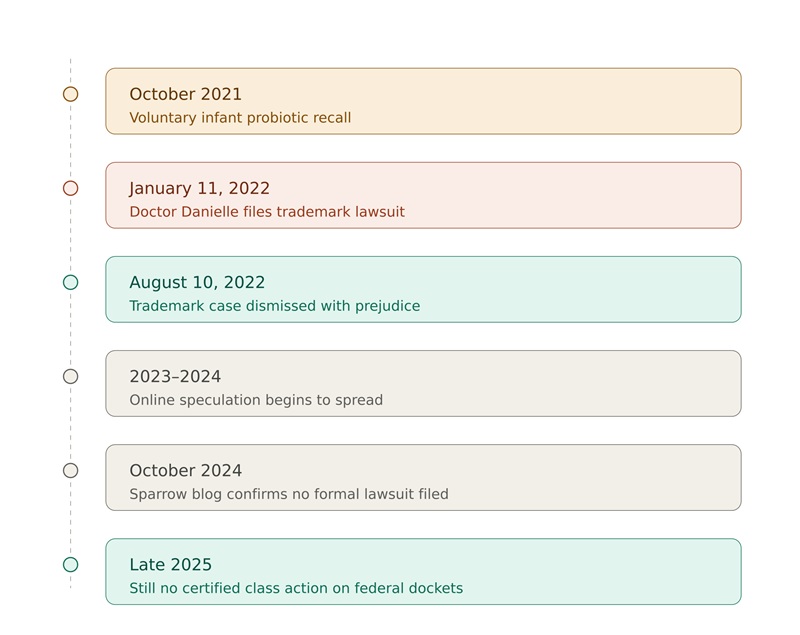
Visual Timeline of Mary Ruth Organics Legal Events
What Mary Ruth Organics Actually Is
Before diving into the legal timeline, here’s the brand context that matters.
Company Background
- Founder: MaryRuth Ghiyam
- Headquarters: Los Angeles, California
- Founded: 2014
- Ownership: MaryRuth Ghiyam and family (majority); private equity firm Butterfly (minority stake)
- Focus: Liquid vitamins, probiotics, prenatal formulas, kids’ drops, vegan supplements
- Distribution: Direct-to-consumer via website, Amazon, Target, and other major retailers
Why the Brand Matters Here
Mary Ruth Organics positioned itself as a “clean wellness” brand with strong social media presence — particularly on TikTok and Instagram. That combination of:
- Infant and child products
- Wellness branding
- Heavy social media exposure
…makes any safety alert spread quickly online. The 2021 recall continued circulating long after the FDA-listed recall ended, which contributed to the persistent online discussion of a “Mary Ruth Organics lawsuit.”
Verified Legal Event #1: The 2021 Infant Probiotic Recall
This is the most important real event in the Mary Ruth Organics legal story.
What Happened
In October 2021, Mary Ruth Organics voluntarily recalled two specific lots of its Liquid Probiotic for Infants after possible contamination with Pseudomonas aeruginosa — a bacterium that can cause serious infections in vulnerable populations.
Recall Specifics
| Detail | Information |
|---|---|
| Product | Liquid Probiotic for Infants |
| Size | 1 oz |
| Recalled lots | #100420218 and #100520218 |
| UPC | 856645008587 |
| Channels | Amazon, Target, MaryRuth’s website |
| Recall type | Voluntary, FDA-listed |
| Reported complaints | One minor case of temporary diarrhea, not confirmed as linked |
What Pseudomonas Aeruginosa Can Do
This bacterium can, in rare cases, cause:
- Serious infections in immunocompromised individuals
- Particularly dangerous bloodstream infections in infants
- Lung infections in vulnerable patients
- Wound infections
Important context: No confirmed serious illnesses or deaths were tied to the Mary Ruth Organics recall. The company described its action as “out of an abundance of caution.”
Why the Recall Happened
The contamination was identified through internal testing before significant adverse events occurred. The company:
- Initiated the voluntary recall
- Notified the FDA
- Issued public alerts to retailers
- Offered full refunds to affected customers
- Cooperated fully with the FDA’s recall program
Why No Class Action Materialized
A recall + contamination risk + national distribution often creates the fact pattern for class actions. But certain conditions weren’t met:
- Few or no documented serious injuries
- The recall caught the issue early
- Refunds were issued promptly
- The company cooperated with the FDA
Without injured plaintiffs willing to come forward with documented harm, no plaintiff law firm filed a certified class action.
Verified Legal Event #2: The 2022 Trademark Case
The other actual lawsuit involved trademark and trade dress — not product safety.
Case Details
| Detail | Information |
|---|---|
| Case | Doctor Danielle LLC v. MRO MaryRuth LLC (formerly MaryRuth Organics LLC) |
| Case number | 2:22-cv-00006-SAB |
| Court | U.S. District Court, Eastern District of Washington (Spokane) |
| Filed | January 11, 2022 |
| Dismissed | August 10, 2022 (with prejudice) |
| Type | Trademark / trade dress (Lanham Act) |
| Outcome | No fees or costs to either party |
What “Trade Dress” Means
Trade dress refers to the visual appearance of a product or its packaging — the look that consumers associate with a brand. The dispute centered on packaging design similarities between the two supplement brands.
Why It Was Dismissed
The case was dismissed with prejudice in August 2022, which typically means:
- The parties reached a private resolution
- The court could not refile the same claims
- Settlement terms were confidential
The dismissal was not a public verdict on either party’s claims.
What This Case Was NOT
This case was:
- Not a product safety lawsuit
- Not a consumer class action
- Not related to the 2021 recall
- Not about contamination or adverse events
- Just a business-to-business packaging dispute
What the Online “Class Action” Articles Get Wrong
Many websites describe an “active Mary Ruth Organics class action” — but this needs context.
The Pattern of SEO-Driven Speculation
A common pattern in legal-content websites:
- Real event happens (recall, regulatory action)
- Plaintiff law firms post investigation pages to gather potential plaintiffs
- SEO writers describe these investigation pages as “active lawsuits”
- Articles are republished and rewritten by other content sites
- Readers see “lawsuit” headlines without underlying court filings
What Multiple Credible Sources Confirmed
| Source | Date | Conclusion |
|---|---|---|
| Sparrow | October 22, 2024 | “No formal lawsuit had been filed at the time” |
| Green Matters | February 20, 2025 | No public certified class action |
| Injury Report USA | December 2025 | “No certified consumer class action tied to the 2021 infant-probiotic lots appears on federal dockets/mirrors” |
The Difference Between “Investigation” and “Lawsuit”
| Investigation | Active Lawsuit |
|---|---|
| Law firm collects consumer reports | Complaint filed in court |
| No court case number | Has case number and assigned judge |
| No certified class | Class certification motion filed |
| May or may not result in filing | Active litigation in progress |
If a website says “you may qualify for compensation,” check carefully — they may be describing a prospective investigation, not a filed lawsuit.
Why This Matters: Spotting Misleading Settlement Sites
The Mary Ruth Organics situation illustrates a broader problem in legal-content SEO.
Red Flags on Settlement Sites
Stop and reconsider if a site:
- Claims to offer “claim filing assistance” for a fee
- Cannot cite a specific case number or court
- Promises specific dollar amounts (“up to $1,000”)
- Uses urgency tactics (“file before deadline expires”)
- Asks for Social Security numbers or banking details
- Cannot be verified through ClassAction.org or PACER
- Contains generic legal language without case-specific facts
- Provides no settlement administrator name
How to Verify a Real Class Action
Always verify through these sources:
- PACER (pacer.gov) — Public Access to Court Electronic Records
- ClassAction.org — verified active and recent cases
- TopClassActions.com — official settlement notices
- Court-approved settlement administrators with court-issued domains
- Your state attorney general’s consumer protection division
Key principle: Real class actions never charge fees to participate. If anyone asks for payment to “file your claim,” it’s a scam.
What to Do If You Used a Recalled Mary Ruth Product
If your child consumed the recalled Liquid Probiotic for Infants, here’s the legitimate path forward.
Immediate Steps
- Check lot numbers — verify against #100420218 and #100520218
- Stop using the product — discontinue any recalled lots
- Save all packaging — photos and physical bottles
- Document any symptoms — with dates and medical records
- Consult your child’s pediatrician — for any concerning reactions
- Save all receipts — order confirmations, credit card statements
Reporting and Refund
- Request a refund from Mary Ruth Organics directly
- Report adverse events to the FDA’s MedWatch program at fda.gov/medwatch
- Contact the FDA Consumer Complaint Coordinator for your state
- File a Better Business Bureau complaint if refund is denied
If You Believe You Have a Legitimate Claim
If your child suffered documented harm allegedly linked to the recalled product:
- Consult a product liability attorney in your state
- Most offer free consultations and work on contingency
- Bring all documentation to your consultation
- Be aware of the statute of limitations in your state (typically 2–4 years)
Categories of Lawsuits Possible Against Supplement Brands
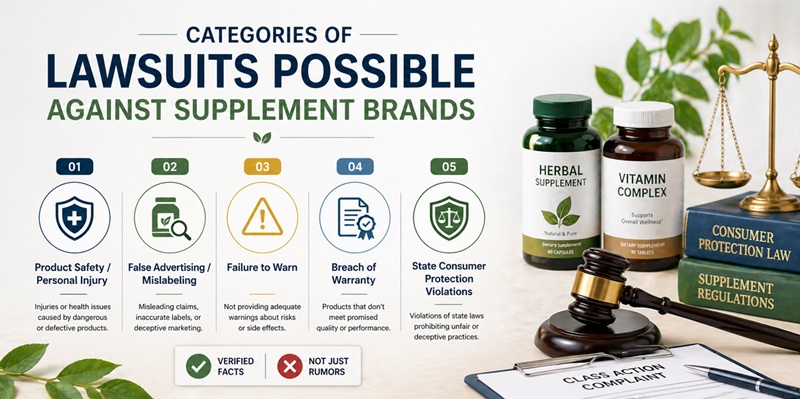
Even without an active Mary Ruth Organics class action, understanding common supplement lawsuit categories helps consumers know their rights.
1. Product Safety / Personal Injury
When a contaminated or defective supplement causes documented harm. Requires:
- Medical documentation of injury
- Causation evidence linking the product
- Timely filing within statute of limitations
2. False Advertising / Mislabeling
When marketing claims don’t match the product. Common targets:
- “Organic” claims with non-organic ingredients
- “100% natural” claims with synthetic content
- Health benefit claims unsupported by science
- Quantity or potency claims that don’t match testing
3. Failure to Warn
When known risks aren’t adequately disclosed:
- Side effects
- Drug interactions
- Population-specific risks (infants, pregnancy)
- Allergy concerns
4. Breach of Warranty
When products don’t meet promised standards:
- Express warranty violations (specific claims on labels)
- Implied warranty of merchantability
- Fitness for particular purpose claims
5. State Consumer Protection Violations
State-specific laws like:
- California’s Consumers Legal Remedies Act (CLRA)
- California’s Unfair Competition Law (UCL)
- New York General Business Law § 349 and § 350
How to Evaluate Any Supplement Brand Safely
The Mary Ruth Organics story offers practical lessons for evaluating any supplement.
Before You Buy
- Check FDA recall database at fda.gov/safety/recalls
- Look for third-party certifications — USP, NSF, ConsumerLab
- Read independent lab tests when available
- Check Better Business Bureau for complaint patterns
- Search PACER for any active litigation
- Consult your healthcare provider
Red Flags in Supplement Marketing
- “100% organic” without USDA certification
- Specific health claims (treats, cures, prevents)
- Celebrity endorsements as primary credibility
- “Doctor recommended” without specifying who
- Pressure to enroll in subscriptions
- Inability to find ingredient transparency
Smart Practices
- Patch test new products
- Start with single ingredient trials when possible
- Document any reactions photographically
- Save lot numbers for future reference
- Don’t share prescription medication interactions
FAQs
1. Is Mary Ruth Organics being sued in 2026?
As of late 2025, no certified consumer class action against Mary Ruth Organics appears on federal court dockets. The most-referenced legal events are the 2021 voluntary infant probiotic recall and the 2022 trademark dispute with Doctor Danielle LLC (dismissed). Online articles describing an “active class action” appear to refer to law firm investigations, not filed lawsuits.
2. What was the 2021 Mary Ruth Organics recall?
In October 2021, Mary Ruth Organics voluntarily recalled two lots of its Liquid Probiotic for Infants (lots #100420218 and #100520218) due to possible Pseudomonas aeruginosa contamination. The recall was FDA-listed and limited in scope. Only one minor adverse event (temporary diarrhea) was reported, and it was not confirmed as linked to the contamination.
3. Can I still get a refund for the recalled Mary Ruth Organics product?
Yes, depending on the company’s current policies. Contact Mary Ruth Organics customer service directly with your order details and proof of purchase. The original recall offered full refunds. Even years later, manufacturers often honor recall-related refund requests, particularly for documented purchases of specifically affected lot numbers.
4. Are Mary Ruth Organics products safe to use now?
The 2021 recall affected only specific lots of one product (Liquid Probiotic for Infants). Current Mary Ruth Organics products on the market today are not subject to that recall. The FDA has not issued safety warnings about current products. As with any supplement, consult your healthcare provider before use, particularly for infants or vulnerable populations.
5. What was the Doctor Danielle vs. Mary Ruth Organics case?
The Doctor Danielle LLC v. MRO MaryRuth LLC case (Case No. 2:22-cv-00006-SAB) was filed January 11, 2022 in the U.S. District Court, Eastern District of Washington. It was a trademark and trade dress dispute under the Lanham Act regarding allegedly similar packaging — not a product safety case. It was dismissed with prejudice on August 10, 2022.
6. How can I verify if a class action lawsuit really exists?
Check three official sources: PACER (pacer.gov) for federal court records, ClassAction.org for verified case lists, and your state’s court records system for state-level cases. Real class actions always have a case number, court, and named plaintiffs. If a website claims a lawsuit exists but cannot provide these details, the claim is likely speculative or misleading.
7. What should I do if my child got sick after a Mary Ruth Organics product?
If your child experienced an adverse reaction, consult their pediatrician immediately. Document symptoms, dates, and any treatment. Report the event to the FDA’s MedWatch program. Save all product packaging, especially the lot number. If significant harm occurred, consult a product liability attorney about individual legal options — even without an active class action.
Key Takeaways
- The 2021 voluntary recall of Liquid Probiotic for Infants is the most significant verified legal event for Mary Ruth Organics
- The 2022 trademark dispute with Doctor Danielle LLC was dismissed with prejudice in August 2022 — and was unrelated to product safety
- No certified consumer class action against Mary Ruth Organics appears on federal court dockets as of late 2025
- Many “Mary Ruth Organics lawsuit” articles describe law firm investigations rather than filed lawsuits
- Always verify legal claims through PACER, ClassAction.org, or court-approved settlement administrators
- Never pay fees to file class action claims — legitimate claims are always free
- Individual product liability claims remain possible if you have documented injury and meet your state’s statute of limitations
