
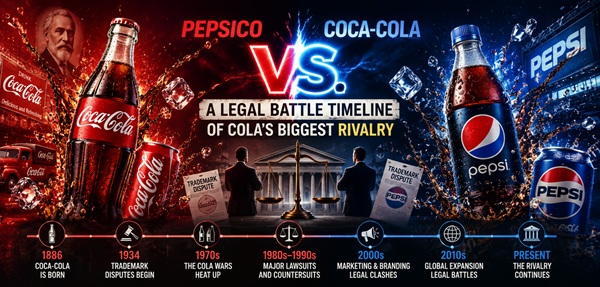

PepsiCo and Coca-Cola have battled in court for decades over trade secrets, trademarks, packaging, and unfair competition. Major cases include the 2006 Coca-Cola trade secrets theft trial (where one defendant got 8 years in prison), the 2011 Trop50/Simply Orange trademark settlement, and the 2014 Australia “Carolina Bottle” case Coke lost.
The PepsiCo vs. Coca-Cola legal rivalry spans over 40 years, from the 1982 Topaz Lodge “drink substitution” trademark case to the 2014 Australia Federal Court ruling dismissing Coke’s bottle-shape claims against Pepsi. The most dramatic case wasn’t even between them — in 2006, PepsiCo turned in three Coca-Cola employees who tried to sell trade secrets to Pepsi, leading to prison sentences. The companies also settled a 2011 Trop50/Simply Orange trademark suit privately, with terms undisclosed.
The Coke vs. Pepsi rivalry isn’t just marketing — it’s a four-decade legal battle that has shaped trademark law, trade secret protection, and corporate ethics in the consumer goods industry. Some cases involved direct litigation between the two giants. Others were tied to broader brand discontinuations, viral myths, or smaller cases that revealed how each company defends its empire. This article traces every major verified legal conflict between PepsiCo and Coca-Cola, plus the unverified myths people often confuse with real cases. Every fact comes from federal court records, federal indictments, or verified industry reporting — no speculation.
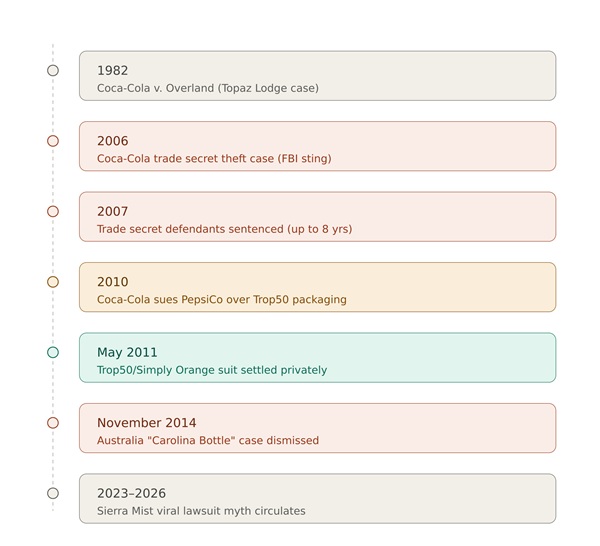
Visual Timeline of PepsiCo vs. Coca-Cola Legal Battles
The Cola Wars: Why So Much Litigation?
The PepsiCo and Coca-Cola legal rivalry runs deeper than marketing campaigns.
The Business Context
- Combined market value: Over $500 billion in 2026
- Global market share: ~70% combined for cola products
- Brand portfolios: Each owns dozens of beverage brands
- Trademark assets: Worth billions in valuation
- Trade secret value: Coca-Cola’s formula alone valued in the billions
What They Actually Fight Over
Most cola wars litigation isn’t about formula theft — it’s about:
- Packaging design (bottle shapes, color schemes)
- Marketing claims (taste tests, health benefits)
- Trademark protection (brand names, slogans)
- Restaurant substitution (serving one when customer ordered the other)
- Distribution agreements
- Trade secret protection
- Unfair competition
Major Verified Cases at a Glance
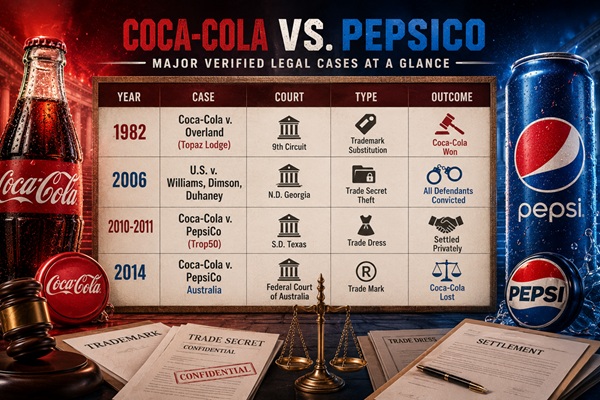
| Year | Case | Court | Type | Outcome |
|---|---|---|---|---|
| 1982 | Coca-Cola v. Overland (Topaz Lodge) | 9th Circuit | Trademark substitution | Coca-Cola won |
| 2006 | U.S. v. Williams, Dimson, Duhaney | N.D. Georgia | Trade secret theft | All defendants convicted |
| 2010-2011 | Coca-Cola v. PepsiCo (Trop50) | S.D. Texas | Trade dress | Settled privately |
| 2014 | Coca-Cola v. PepsiCo Australia | Federal Court of Australia | Trade mark | Coca-Cola lost |
The 2006 Trade Secrets Case: When PepsiCo Saved Coca-Cola
This is the most dramatic chapter in the cola wars, and it didn’t go the way most rivalry stories do.
The Setup
In May 2006, PepsiCo received a letter at its Purchase, New York headquarters. The envelope bore official Coca-Cola letterhead. Inside was an offer from someone claiming to be a “top-level Coca-Cola employee” with “extremely confidential” trade secrets to sell.
What PepsiCo Did
PepsiCo executives faced a choice. They could:
- Buy the secrets — gaining competitive intelligence
- Ignore the letter — staying out of the situation
- Alert Coca-Cola — turning in their biggest rival’s traitors
PepsiCo chose the third option. They contacted Coca-Cola, which then notified the FBI.
The FBI Sting
An FBI undercover agent posed as a PepsiCo executive named “Jerry” and began negotiating with the seller, who used the alias “Dirk.” The investigation lasted nearly two months.
Key moments:
- “Dirk” faxed 14 pages of confidential Coca-Cola documents
- A $5,000 wire transfer was sent to prove the buyer was “serious”
- A $30,000 payment was delivered in a Girl Scout cookie box at Atlanta airport
- Documents marked “highly confidential” and a sample of an unreleased Coca-Cola product changed hands
- The final $1.5 million payment was being prepared
The Arrests
On July 5, 2006, FBI agents arrested three people:
| Defendant | Role | Sentence |
|---|---|---|
| Joya Williams | Coca-Cola employee (inside source) | 8 years in prison |
| Ibrahim Dimson | “Dirk” — letter sender | 5 years in prison |
| Edmund Duhaney | Co-conspirator | 2 years in prison |
What Was Actually Stolen
Coca-Cola’s iconic Coke Classic formula was never at risk. The documents and sample related to:
- A new beverage product in development
- Marketing strategies
- Product launch plans
- Pricing information
The company stated definitively that its core formula was secure.
Why This Case Matters
The 2006 case demonstrates:
- Trade secret protection requires constant vigilance
- Even fierce rivals share legal ethics interests
- FBI sting operations work for corporate IP crimes
- Penalties for trade secret theft are serious
- Internal threats are often greater than external ones
The 2010-2011 Trop50 vs. Simply Orange Case
This was a direct PepsiCo vs. Coca-Cola trade dress dispute.
The Conflict
Coca-Cola introduced its Simply juice line in 2001, starting with Simply Orange. The packaging featured:
- Carafe-style bottle
- Oversized green cap
- Clear glass-like appearance
- Premium minimalist design
In August 2010, PepsiCo redesigned its Trop50 (stevia-sweetened orange juice from Tropicana) with a carafe-style bottle and large green cap.
The Lawsuit
Coca-Cola sued PepsiCo alleging:
- Trade dress infringement of the Simply line
- Consumer confusion between the brands
- Dilution of the Simply quality reputation
- Unfair competition through packaging mimicry
The case was filed in U.S. District Court, Southern District of Texas.
The Settlement
In May 2011, the parties reached a confidential settlement. U.S. District Judge Sim Lake signed an order dismissing the suit. Settlement terms were not disclosed publicly.
Why Trade Dress Matters
Trade dress is the visual appearance of a product or packaging — distinct from the brand name itself. Successful trade dress claims require:
- The design has acquired secondary meaning
- The design is non-functional
- There’s likelihood of consumer confusion
- The defendant’s design is substantially similar
The Trop50 case shows trade dress is real legal currency — strong enough to force a major settlement even between equally-resourced rivals.
The 2014 Australian “Carolina Bottle” Case
This is when Coca-Cola sued PepsiCo internationally — and lost.
The Background
Coca-Cola’s iconic Contour Bottle is one of the most recognized industrial designs ever created. The shape is registered as a trademark in most countries.
In 2007, PepsiCo Australia introduced a curved bottle design called the Carolina Bottle that Coca-Cola believed too closely resembled its Contour design.
The Lawsuit
Coca-Cola filed claims in the Federal Court of Australia alleging:
- Trade mark infringement of multiple Contour Bottle registrations
- Misleading and deceptive conduct
- False representation of association with Coca-Cola
- Passing off Pepsi’s products as Coca-Cola’s
The Defendants
- PepsiCo Inc.
- PepsiCo Australia Holdings Pty Ltd
- Schweppes Australia Pty Ltd (the manufacturer and distributor)
The Outcome
On November 28, 2014, the Federal Court of Australia dismissed all of Coca-Cola’s claims. The court found:
- The Carolina Bottle wasn’t sufficiently similar to the Contour
- Consumers weren’t likely to be confused
- No passing off had occurred
- Pepsi’s bottle had its own distinct identity
Why Coca-Cola Lost
The case highlighted several lessons:
- Even iconic trademarks have limits when other designs are sufficiently distinct
- Bottle shapes alone aren’t enough without other branding similarities
- Consumer recognition surveys play decisive roles in trade dress cases
- Different jurisdictions apply different standards
The 1982 Topaz Lodge Case
This earlier case shows the cola wars happening at the restaurant level.
The Setup
The Topaz Lodge and Casino in Nevada served customers who specifically ordered “Coca-Cola” or “Coke” with Pepsi-Cola instead — without telling them about the substitution.
Coca-Cola’s Response
Coca-Cola’s Trade Research employees conducted 29 separate test orders over three years. They documented:
- 23 instances where Pepsi was served in response to “Coca-Cola” orders
- No oral notification of the substitution
- Continued practice despite Coca-Cola’s protests
The Lawsuit
Coca-Cola filed under the Lanham Trade-Mark Act (15 U.S.C. § 1051), alleging:
- Trademark infringement
- Unfair competition
The Outcome
The U.S. District Court granted summary judgment for Coca-Cola. The case was appealed to the 9th Circuit Court of Appeals, which upheld the ruling in Coca-Cola Co. v. Overland, Inc. (1982).
The Broader Impact
This case established that:
- Restaurants can’t substitute without telling customers
- Trademark protection extends to point-of-sale practices
- Repeated documented violations strengthen infringement claims
- The Lanham Act applies to consumer-facing service businesses
- Specific brand orders create enforceable expectations
Why the Sierra Mist “Lawsuit” Doesn’t Belong on This List
Some online articles include the 2023 Sierra Mist discontinuation in cola wars timelines. It doesn’t belong here. For the complete breakdown of why the Sierra Mist v. Cierra Mistt story is a viral myth, see our detailed analysis: Sierra Mist Lawsuit: The Viral Myth vs. The Verified Truth.
Quick Verification Recap
- No court filings exist between PepsiCo and Cierra Mistt
- No USPTO trademark transfers occurred
- No legal action forced the rebrand to Starry
- PepsiCo still owns the Sierra Mist trademark
- Discontinuation was strategic — under 1% market share
The viral story is unsupported by any verifiable court records, unlike every case in this timeline.
Beyond Coke vs. Pepsi: Industry Context
The PepsiCo-Coca-Cola legal rivalry exists within a broader beverage industry legal landscape.
Other Major Soft Drink Legal Cases
| Year | Brand | Case Type | Outcome |
|---|---|---|---|
| 2009 | Vitaminwater | “Healthy” claims | Settled $1M+ |
| 2014 | Tropicana (PepsiCo) | “100% pure” claims | $35M settlement |
| 2013 | Naked Juice (PepsiCo) | “All natural” claims | $9M settlement |
| 2016 | Snapple | Sugar/calorie claims | Various outcomes |
| 2017 | Diet Coke | Aspartame claims | Multiple cases |
| 2023 | Sierra Mist | No verified lawsuit | N/A |
What Makes Coke vs. Pepsi Unique
The Coke-Pepsi conflicts stand apart because:
- Comparable corporate resources — neither party intimidated by litigation costs
- Decades of competition — long history of strategic legal moves
- Global market presence — international jurisdictional complexity
- High-profile public attention — every case becomes news
- Direct competitive impact — wins translate to market share
Trade Secret Protection: Lessons From Coca-Cola
The 2006 trade secrets case offers practical lessons for any business.
How Coca-Cola Protects Its Formula
- Limited access — only a handful of executives know complete formula
- Compartmentalization — different parts kept separate
- Physical security — formula vault at Coca-Cola headquarters
- Internal monitoring — surveillance, access logs, anomaly detection
- Employee training — clear policies on confidentiality
- Non-disclosure agreements — comprehensive contractual protection
- Vendor restrictions — limited supply chain access
What Companies Should Learn
- Identify true trade secrets vs. simply confidential information
- Implement layered security — physical, digital, procedural
- Train employees regularly on what constitutes a trade secret
- Monitor for unusual access patterns
- Have incident response plans ready before breaches occur
- Work with law enforcement when criminal violations occur
- Maintain civil and criminal options in your legal toolkit
Legal Framework
Trade secret protection in the U.S. is governed by:
- Defend Trade Secrets Act of 2016 (federal)
- Uniform Trade Secrets Act (state-level, adopted in 49 states)
- Economic Espionage Act of 1996 (federal criminal)
- Common law fiduciary duty principles
Trademark Protection in the Beverage Industry
Both PepsiCo and Coca-Cola spend millions annually protecting their trademarks.
Standard Trademark Maintenance
| Activity | Purpose |
|---|---|
| Trademark monitoring | Detect infringing uses globally |
| Cease-and-desist letters | Stop minor violations without litigation |
| Opposition proceedings | Prevent confusing new registrations |
| Renewal filings | Maintain registration validity |
| Use documentation | Preserve rights through continued use |
| Trade dress registration | Protect packaging designs |
| International filings | Maintain rights in foreign markets |
Why Cease-and-Desist Letters Matter
Both companies send thousands of cease-and-desist letters annually as routine business practice. These letters:
- Stop violations early without court filings
- Establish a paper trail for future litigation if needed
- Protect against trademark dilution claims
- Cost a tiny fraction of litigation expenses
Most cease-and-desist letters never lead to lawsuits — but the recipient gets a clear warning to change their behavior.
Famous Marks Doctrine
Both Coca-Cola and PepsiCo enjoy famous mark protection under the Lanham Act, which means:
- Protection extends beyond product categories
- Dilution claims available even without direct competition
- Higher damages possible for willful infringement
- Tarnishment claims for negative associations
What This Means for Consumers
The cola wars legal history affects consumers in subtle ways.
How Cola Litigation Shapes Your Shopping
- Restaurants must clearly disclose substitutions (Topaz Lodge legacy)
- Packaging similarities are limited (Trop50 settlement legacy)
- Bottle shapes have legal protection (Contour Bottle legacy)
- Product claims face heavy scrutiny (Tropicana, Naked Juice settlements)
- Discontinued brands rarely return (Sierra Mist trademark still active)
Your Rights as a Consumer
If a restaurant or store substitutes one brand for another:
- You have the right to know what you’re getting
- Federal law prohibits silent substitution under trademark law
- State consumer protection laws add additional rights
- Complaints to chains’ corporate offices can produce results
- Better Business Bureau complaints create public records
How to Verify Soft Drink Lawsuit Claims
Given how many viral myths circulate (like the Sierra Mist case), here’s how to verify any cola wars claim.
Three Free Verification Sources
- PACER (pacer.gov) — Federal court records
- CourtListener (courtlistener.com) — Free PACER alternative
- USPTO (uspto.gov) — Trademark records
What to Look For
A real cola wars lawsuit always has:
- Specific case name (PepsiCo Inc. v. Coca-Cola Co. format)
- Court of jurisdiction
- Case number
- Coverage in major legal publications (Law360, IPLaw, Reuters Legal)
- USPTO records if trademark-related
Red Flags for Fake Stories
Skip stories that:
- Lack specific case numbers
- Cite only TikTok or social media as sources
- Can’t be found in legal news databases
- Claim implausibly fast resolutions
- Describe trademark transfers without USPTO confirmation
FAQs
1. What is the most famous PepsiCo vs. Coca-Cola lawsuit?
The 2006 Coca-Cola trade secrets case is the most famous — though it wasn’t actually between the two companies. PepsiCo received a letter offering to sell stolen Coca-Cola trade secrets and immediately alerted Coca-Cola, who notified the FBI. Three defendants were arrested, convicted, and sentenced to 2-8 years in prison.
2. Did Coca-Cola really lose a lawsuit to PepsiCo?
Yes, in 2014 the Federal Court of Australia dismissed Coca-Cola’s trademark infringement claims against PepsiCo over the “Carolina Bottle” design. The court ruled Pepsi’s bottle wasn’t sufficiently similar to Coca-Cola’s iconic Contour Bottle and that consumers weren’t likely to be confused. Coca-Cola lost on all counts.
3. What was the 2011 Trop50 vs. Simply Orange case about?
Coca-Cola sued PepsiCo in 2010 over Trop50 (Tropicana stevia-sweetened orange juice) packaging, alleging the carafe-style bottle with green cap too closely resembled Coca-Cola’s Simply Orange juice line. The case was filed in the Southern District of Texas and settled privately in May 2011, with terms not disclosed.
4. Why didn’t PepsiCo just buy Coca-Cola’s stolen trade secrets in 2006?
PepsiCo turned in the would-be sellers because corporate ethics, federal trade secret laws, and the risk of criminal exposure made buying stolen IP a far worse option than reporting it. A statement from PepsiCo at the time noted they “only did what any responsible company would do.” The defendants received prison sentences.
5. Is the Sierra Mist lawsuit a real case?
No. Despite viral TikTok claims that influencer Cierra Mistt sued PepsiCo and won, no court records exist for any such case. PepsiCo still owns the Sierra Mist trademark per the USPTO database. Sierra Mist was discontinued in January 2023 due to poor sales performance — under 1% market share — not legal pressure.
6. Can Coca-Cola sue PepsiCo for using the color red?
This claim circulates online but doesn’t reflect actual successful litigation. While both companies have aggressively protected their trade dress (overall look and feel of packaging), no court has ruled that either company exclusively owns “red” or “blue” as a trademark. Color claims must be paired with other distinctive design elements.
7. What happens if a restaurant serves Pepsi when I ordered Coke?
Restaurants have a legal obligation to disclose brand substitutions under the Lanham Act (established in the 1982 Topaz Lodge case). If you specifically order “Coca-Cola” or “Coke” and the restaurant only serves Pepsi, they must verbally inform you before serving. Failure to disclose can constitute trademark infringement and unfair competition.
Key Takeaways
- The 2006 trade secrets case is the most dramatic cola wars chapter, ending in prison sentences of 2-8 years
- PepsiCo turned in Coca-Cola’s would-be traitors to the FBI
- The 2011 Trop50 vs. Simply Orange case ended in a confidential settlement
- Coca-Cola lost the 2014 Australia “Carolina Bottle” case against PepsiCo
- The 1982 Topaz Lodge case established that restaurants must disclose brand substitutions
- Most “Coke vs Pepsi” viral stories (like the Sierra Mist myth) lack any court records
- Trademark protection through cease-and-desist letters is routine — and almost never leads to actual lawsuits
