

The Meaningful Beauty lawsuit refers primarily to Competello v. Meaningful Beauty, LLC (Case No. 1:24-cv-00745), filed February 2024 in the Southern District of New York alleging unauthorized auto-renewal subscriptions. The case settled confidentially in May 2024. Parent company Guthy-Renker has paid over $23 million in related class action settlements since 2017.
The Meaningful Beauty lawsuit Competello v. Meaningful Beauty, LLC alleged that the Cindy Crawford-fronted skincare brand auto-enrolled customers in subscription programs without clear consent, violating California’s Automatic Renewal Law. Filed February 1, 2024 in the Southern District of New York and assigned to Judge Gregory H. Woods, the case was conditionally discontinued on May 3, 2024 following a confidential settlement. Parent company Guthy-Renker has faced similar lawsuits, paying $15 million in 2017 and $8.5 million in 2019 over comparable claims.
If you’ve searched “Meaningful Beauty lawsuit,” you’ve likely found articles describing an “active class action” — but the verified court record tells a different story. A real lawsuit existed, was filed in February 2024, and was settled and dismissed by May 2024. This article separates verified court facts from SEO speculation. You’ll learn the real Competello v. Meaningful Beauty case details, what the lawsuit alleged, the related Guthy-Renker settlement history, why subscription-based skincare brands keep facing similar lawsuits, what your refund options are now that the class action is closed, and how to protect yourself from auto-renewal traps in beauty subscriptions.
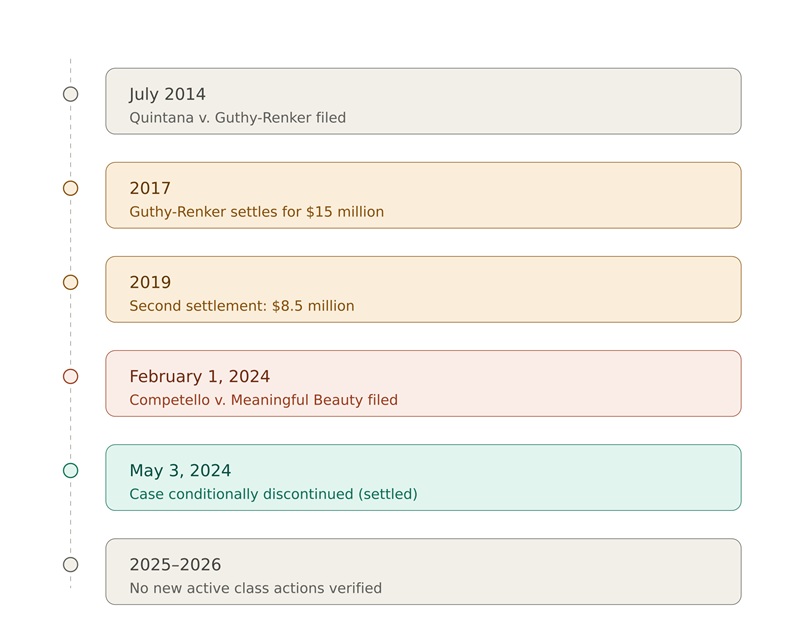
Visual Timeline of the Meaningful Beauty Lawsuit
What Meaningful Beauty Actually Is
Before evaluating the lawsuit, here’s the brand context.
Company Background
- Founded: 2005
- Co-creators: Cindy Crawford and Dr. Jean-Louis Sebagh
- Parent company: Guthy-Renker LLC
- Product type: Anti-aging skincare line
- Signature ingredient: Rare French melon (Cantaloupe melon) and orchid extracts
- Sales model: Direct-to-consumer with subscription auto-renewal
- Reported customer base: Over 5 million customers historically
How the Brand Markets Itself
Meaningful Beauty promotes products that claim to:
- Reduce fine lines and wrinkles
- Brighten complexion
- Improve skin texture
- Provide antioxidant protection
- Deliver “ageless” results based on Cindy Crawford’s appearance
The Business Model That Triggers Lawsuits
The brand’s revenue model is subscription-based:
- Customers order an “introductory kit” at a discounted price
- They’re automatically enrolled in a “continuity program”
- Products ship every 28-90 days depending on the kit
- Cancellation requires phone contact (not online cancellation)
- Auto-charges continue until customers actively cancel
This model is the heart of nearly every Meaningful Beauty lawsuit ever filed.
The Verified Meaningful Beauty Lawsuit: Competello v. Meaningful Beauty
This is the actual, verifiable Meaningful Beauty class action.
Case Details
| Detail | Information |
|---|---|
| Case name | Competello v. Meaningful Beauty, LLC |
| Case number | 1:24-cv-00745 |
| Court | U.S. District Court, Southern District of New York |
| Filed | February 1, 2024 |
| Judge | Gregory H. Woods |
| Plaintiff | Susan Competello |
| Plaintiff’s attorney | Bennitta Joseph |
| Resolution | Conditionally discontinued May 3, 2024 |
| Settlement | Confidential terms |
What the Lawsuit Alleged
The complaint focused on deceptive subscription practices, alleging:
- Automatic enrollment without clear consent in continuity programs
- Recurring charges customers were unaware of or had difficulty stopping
- Difficult cancellation procedures designed to retain unwilling customers
- Violations of California’s Automatic Renewal Law (ARL)
- Deceptive billing practices under federal consumer protection law
How It Was Resolved
The case progressed through:
- February 1, 2024 — Complaint filed
- February 14, 2024 — Defendant served
- March 2024 — Initial pleadings and procedural motions
- May 3, 2024 — Judge Gregory H. Woods issued order conditionally discontinuing the case without prejudice
What “conditionally discontinued” means:
- The parties reached a settlement
- Specific terms were not made public
- The court allowed 30 days for the parties to submit a final stipulation
- The case has not been actively litigated since May 2024
- If settlement terms were unmet, the case could have been restored
Why Settlement Terms Are Confidential
Most consumer class action settlements include non-disclosure provisions because:
- The company avoids public acknowledgment of wrongdoing
- Settlement amounts often disappoint plaintiffs’ bars and attract criticism
- Future litigation strategy is preserved
- Customer relations management benefits
This means individual customers cannot easily learn whether they qualified for any payment.
The Broader Guthy-Renker Lawsuit History
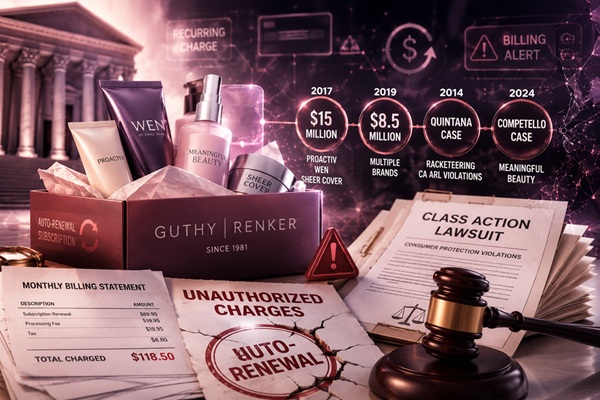
Meaningful Beauty’s parent company has a long pattern of similar lawsuits.
Major Guthy-Renker Settlements
| Year | Settlement Amount | Primary Products | Allegation |
|---|---|---|---|
| 2017 | $15 million | Proactiv, WEN, Sheer Cover | Auto-renewal violations |
| 2019 | $8.5 million | Various Guthy-Renker brands | Auto-renewal without consent |
| 2014 (Quintana) | Filed; later resolved | Multiple brands | Racketeering, CA ARL violations |
| 2024 (Competello) | Confidential | Meaningful Beauty | CA ARL, deceptive subscription |
Total disclosed settlements: Over $23.5 million in consumer class actions involving Guthy-Renker subscription practices.
The Quintana Case (2014)
The earliest and most detailed of these cases:
- Plaintiff: Nanci Quintana Gomez
- Filed: July 11, 2014
- Allegations: Racketeering, unfair competition, California Automatic Renewal Law violations
- Specific claim example: Customer charged $284.18 for unauthorized Proactiv products in a single year
- Specific claim example: Customer charged $347.68 for unordered Meaningful Beauty products
- Resolution: Eventually resolved (terms varied across consolidated cases)
The 2017 Settlement
According to Top Class Actions, Guthy-Renker settled a class action for $15 million in 2017 over auto-renewal complaints. This settlement primarily covered Proactiv and WEN brands but established the pattern for future settlements.
The 2019 Settlement
According to the Los Angeles Business Journal, Guthy-Renker settled another class action for $8.5 million in 2019 over claims of auto-renewal payments issued without consumer consent.
Why the Pattern Keeps Repeating
Despite settlements, the company continues to use subscription auto-renewal models. Reasons include:
- Settlement amounts are smaller than continued auto-renewal revenue
- Confidential settlements don’t require business model changes
- Different states have different ARL enforcement
- New customers continually enter the subscription pool
- Industry-wide acceptance of “negative option” billing
What California’s Automatic Renewal Law Says
The Competello and Quintana cases both invoked California’s Automatic Renewal Law (ARL). Understanding this law explains why these lawsuits keep succeeding.
Core ARL Requirements
Under California Business and Professions Code Section 17602, businesses must:
- Present subscription terms clearly before the consumer pays
- Obtain affirmative consent to the auto-renewal terms (not pre-checked boxes)
- Provide acknowledgment with the auto-renewal terms after enrollment
- Disclose the cancellation method clearly in writing
- Allow online cancellation for online enrollments (added 2018)
- Provide a reminder before renewals exceeding $200/year
Common ARL Violations in Beauty Subscriptions
- “Introductory price” offers that don’t clearly explain the recurring subscription
- Pre-checked subscription boxes during checkout
- Hidden auto-renewal terms in fine print
- Phone-only cancellation when enrollment was online
- Continued charges after cancellation requests
- Shipping products at frequencies different than disclosed (e.g., 28 days instead of 30)
Penalties for ARL Violations
California ARL violations can result in:
- Refund of all charges to affected consumers
- Restitution and damages
- Injunctive relief to change business practices
- Attorney’s fees for plaintiffs
- Civil penalties in state-prosecuted cases
What This Means If You Bought Meaningful Beauty
Here’s what your options actually are in 2026.
If You Were Charged Without Authorization
Since the class action settled and the claim period has passed, your options now include:
- Direct refund request — call Meaningful Beauty customer service
- Credit card chargeback — for recent charges (typically within 60-90 days)
- BBB complaint — creates public record and often prompts response
- State attorney general complaint — particularly in California, New York
- FTC complaint — at reportfraud.ftc.gov
- Individual lawsuit — for significant damages outside class action
Statute of Limitations Considerations
If you’re considering individual legal action:
- California ARL claims: typically 4 years
- Breach of contract: 4 years in California (written), 2 years (oral)
- Fraud: 3 years from discovery
- Unjust enrichment: 3-4 years
The clock typically starts when you discovered (or reasonably should have discovered) the alleged wrongdoing.
What Customer Service Says vs. What’s Documented
Many customer reviews report:
- Difficulty cancelling subscriptions by phone
- Charges continuing after cancellation
- Returns not credited despite documented proof
- Collection agency referrals for disputed amounts
- Multiple call requirements for single cancellation
These complaints fueled the lawsuits but are also useful documentation if you pursue individual claims.
Cindy Crawford’s Legal Role
Many people search specifically about Cindy Crawford’s involvement. Here’s the verified picture.
Crawford’s Position
- Co-creator with Dr. Jean-Louis Sebagh (2005)
- Spokesperson for over 15 years
- Brand ambassador appearing in all advertising
- Equity holder in the company (specific stake undisclosed)
Is Crawford Personally Named in Lawsuits?
In the Competello case and most other Meaningful Beauty lawsuits:
- Crawford was NOT named as an individual defendant
- Meaningful Beauty, LLC was the defendant
- Guthy-Renker has been named in related cases
Why Celebrities Are Sometimes Not Named
Plaintiff strategy generally focuses on:
- The corporate entity that controls business decisions
- The marketing company executing the alleged violations
- Parties with deeper pockets and insurance coverage
Adding celebrity defendants creates complications:
- First Amendment defenses for marketing statements
- Higher litigation costs
- Risk of mistrial from celebrity influence
- Smaller damage pools
FTC Endorsement Rules Apply Anyway
Regardless of being named in lawsuits, Cindy Crawford’s role implicates:
- FTC’s Endorsement Guides requiring disclosure of material connections
- Truthfulness standards for endorsement claims
- Substantiation requirements for product efficacy claims
- “Typical results” disclosure rules
Crawford has acknowledged using cosmetic procedures herself, which some critics argue complicates her endorsements of skincare’s anti-aging benefits.
How to Cancel a Meaningful Beauty Subscription
This is one of the most common reasons people search for the lawsuit.
Official Cancellation Methods
- Phone: Call Meaningful Beauty customer service
- Documented complaints suggest expecting hold times and retention pressure
- Account portal: Limited online cancellation availability
- Written notice: Mail to corporate address (slower but creates paper trail)
Step-by-Step Cancellation Best Practices
- Call from a phone that can record (with consent in two-party states)
- Note the date, time, and representative name
- Specifically state: “I am canceling my subscription effective immediately. Please confirm cancellation in writing.”
- Request a confirmation number
- Demand a confirmation email
- Check your account 24-48 hours later to verify
- Monitor your credit card statement for the next 60 days
- Save all documentation in case of disputes
If They Won’t Cancel
- Dispute the charge with your credit card company (chargeback)
- File a BBB complaint with documented evidence
- File a California Attorney General complaint even if you don’t live in California (the company operates there)
- Contact your state’s consumer protection division
- Consider a small claims action for amounts under your state’s limits
Comparison: Meaningful Beauty vs. Similar Subscription Beauty Brands
| Brand | Parent Company | Notable Lawsuits | Settlement Total |
|---|---|---|---|
| Meaningful Beauty | Guthy-Renker | Competello (2024) | Confidential |
| Proactiv | Guthy-Renker | Multiple | Part of $15M (2017) |
| WEN Hair Care | Guthy-Renker | Multiple | Part of $15M (2017); separate $26.25M |
| Sheer Cover | Guthy-Renker | Multiple | Part of $15M (2017) |
| Prose Hair | Persé Beauty | Under investigation | None filed |
| Function of Beauty | Independent | Limited | None major |
Pattern Recognition
Most major consumer class actions against beauty subscription brands share three elements:
- California Automatic Renewal Law violations
- Difficulty cancelling subscriptions
- Charges for unordered products
If you’ve experienced any of these with any beauty subscription brand, you may have potential individual legal claims.
Red Flags Before Buying Beauty Subscription Products
The Meaningful Beauty pattern offers practical lessons for any subscription beauty purchase.
Watch For These Warning Signs
- “Free trial” offers that auto-convert to paid subscriptions
- Pre-checked subscription boxes during checkout
- Fine-print continuity programs not clearly highlighted
- Phone-only cancellation for online enrollments
- Long cancellation hold times designed to discourage cancellation
- Shipping intervals shorter than the “monthly” or “90-day” promise
- Unrequested product additions to your shipment
- Difficulty obtaining refunds for returned products
- Aggressive “save the sale” scripts when you try to cancel
- Collection agency threats for disputed charges
Smart Practices
- Use a virtual credit card number that you can disable easily
- Set up bank account alerts for unexpected charges
- Document all enrollment terms with screenshots
- Keep records of cancellation attempts
- Cancel immediately if you’re unsure about the product
- Pay with credit cards, not debit cards (better chargeback protection)
- Read all terms before clicking “submit” — especially fine print
How to Verify a Class Action Lawsuit Status
If you encounter claims about active Meaningful Beauty lawsuits, verify before sharing personal information.
Three Free Verification Sources
- PACER (pacer.gov) — Federal court records (Competello case is here)
- CourtListener.com — Free PACER alternative through the RECAP archive
- State court records — For state-level cases
Five Markers of a Real Class Action
A legitimate class action always has:
- Specific case name (Plaintiff v. Defendant format)
- Court of jurisdiction (federal or state, with specific district)
- Case number in standardized format
- Named plaintiffs (real people, not anonymous claimants)
- Public docket entries accessible through court records
Why “Active Class Action” Articles Are Often Wrong
Many SEO-driven articles describe the Meaningful Beauty case as “active” when it’s been settled and closed since May 2024. The Competello docket on CourtListener confirms the conditional discontinuance order. Always verify lawsuit claims directly through court records.
What to Do About Past Unauthorized Charges
If you discovered you were charged without authorization, here are your action steps.
Immediate Steps (Within 90 Days)
- Credit card chargeback — call your card company immediately
- Document the timeline — when did charges start, when did you authorize, when did you try to stop
- Save all marketing materials you encountered
- Print or save email confirmations
- Request transaction history from the company
Within 1-2 Years
- File a BBB complaint at bbb.org
- File an FTC complaint at reportfraud.ftc.gov
- File a state attorney general complaint (CA, NY, TX especially active)
- Contact a consumer protection attorney for individual case evaluation
If Sent to Collections
- Demand validation in writing under the Fair Debt Collection Practices Act
- Dispute the debt with credit bureaus
- Document collection contacts
- Consult an attorney about FDCPA violations if collection practices are abusive
FAQs
1. Is there an active Meaningful Beauty lawsuit right now?
No. The most recent verified class action, Competello v. Meaningful Beauty, LLC (Case No. 1:24-cv-00745), was filed February 1, 2024 in the Southern District of New York and conditionally discontinued by court order on May 3, 2024 following a confidential settlement. No new certified class actions against Meaningful Beauty appear in federal court records as of 2026.
2. What did the Meaningful Beauty lawsuit allege?
The Competello case alleged that Meaningful Beauty automatically enrolled customers in subscription programs without clear consent, resulting in recurring charges customers were unaware of or had difficulty canceling. The claims focused on violations of California’s Automatic Renewal Law, deceptive marketing practices, and unauthorized credit card charges to consumers’ accounts.
3. How much was the Meaningful Beauty settlement?
The Competello v. Meaningful Beauty settlement amount was not made public. The case was confidentially settled and discontinued in May 2024. By comparison, parent company Guthy-Renker has paid over $23 million in similar class action settlements since 2017, including $15 million in 2017 and $8.5 million in 2019 over auto-renewal violations affecting Proactiv, WEN, and other brands.
4. Can I still get a refund from Meaningful Beauty?
Yes, though not through a class action. Options include calling customer service directly, requesting a credit card chargeback (within 60-90 days), filing BBB or state attorney general complaints, or pursuing individual legal action for significant damages. The California Automatic Renewal Law generally provides a 4-year statute of limitations for individual claims.
5. Is Cindy Crawford personally being sued?
No. Class actions against Meaningful Beauty typically name the corporate entity (Meaningful Beauty, LLC and parent company Guthy-Renker) — not Cindy Crawford individually. While her image and endorsements feature in the marketing at the heart of the cases, she has not been named as an individual defendant in the verified lawsuits like Competello (2024).
6. How do I cancel my Meaningful Beauty subscription?
Call Meaningful Beauty customer service directly. Be prepared for retention scripts and possible hold times. State clearly: “I am cancelling my subscription effective immediately. Please provide a confirmation number and email.” Document the call date, time, and representative name. Monitor your credit card statement for 60 days to confirm no further charges occur.
7. Why does Meaningful Beauty keep facing lawsuits?
The company’s subscription model relies on “negative option” billing — customers must actively cancel to avoid recurring charges. This model conflicts with state consumer protection laws like California’s Automatic Renewal Law that require clear disclosure and easy cancellation. Despite multiple settlements totaling over $23 million across parent company Guthy-Renker’s brands, the subscription model remains largely unchanged.
Key Takeaways
- The verified Meaningful Beauty lawsuit is Competello v. Meaningful Beauty, LLC (Case No. 1:24-cv-00745), filed February 2024 and settled in May 2024
- The case alleged auto-renewal violations under California’s Automatic Renewal Law
- Parent company Guthy-Renker has paid over $23 million in similar settlements since 2017
- Cindy Crawford was not personally named as a defendant
- The Competello settlement was confidential with no public payout structure
- Individual refund options remain available through chargebacks, BBB complaints, and state AG filings
- The subscription auto-renewal model continues to drive recurring lawsuits across Guthy-Renker brands
