

The Generational Equity lawsuit refers primarily to Linda Glass v. Generational Equity LLC (Case No. DC-23-20315), a Dallas County data breach class action over the February 2023 cyberattack that exposed personal data of about 2,200 people. The case settled for $275,000 in December 2024, with claim deadlines now closed.
Generational Equity, a Texas-based M&A advisory firm, faced a class action lawsuit after a February 2023 data breach exposed names, Social Security numbers, driver’s license numbers, and financial data of roughly 2,200 individuals. Plaintiff Linda Glass filed in Dallas County, Texas, alleging negligence and inadequate cybersecurity. The court approved a $275,000 settlement on December 6, 2024, offering up to $300 ordinary losses, $3,500 extraordinary losses, and two years of credit monitoring. The claim deadline (December 3, 2024) has passed.
If you’ve searched “Generational Equity lawsuit,” you’re likely either looking for information about the 2023 data breach class action settlement or trying to understand if there are broader legal concerns about the firm’s M&A advisory practices. This article breaks down both. You’ll learn the verified court details of the Glass v. Generational Equity case, what the $275,000 settlement actually covered, why the claim deadline has now passed, what individual fee complaints look like (separate from the class action), and what your options are if you’ve had a problem with the firm. Every fact comes from court records and primary settlement documents.
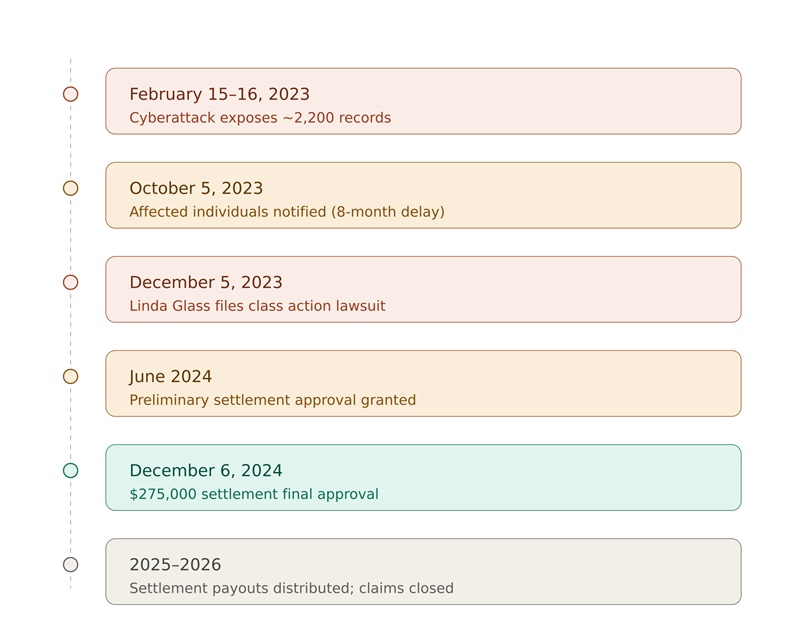
Visual Timeline of the Generational Equity Lawsuit
What Generational Equity Is
Before diving into the lawsuit, here’s the company context.
Company Background
- Founded: Late 1990s/early 2000s
- Headquarters: Richardson, Texas (Dallas-Fort Worth metro)
- Industry: Mergers and acquisitions (M&A) advisory
- Specialization: Privately-held middle-market businesses
- Reported deal volume: Over 1,800 M&A transactions
- Service model: Advisory and exit strategy services for business owners selling their companies
What Generational Equity Does
The firm helps business owners:
- Value their companies for sale
- Find qualified buyers (often through marketing campaigns)
- Negotiate transaction terms
- Manage due diligence during the sale process
- Close M&A deals
The firm targets owners of privately-held companies, typically in the $5 million to $150 million revenue range.
The Verified Class Action: Linda Glass v. Generational Equity
This is the actual, verifiable Generational Equity lawsuit — and it’s about a data breach, not advisory practices.
Case Details
| Detail | Information |
|---|---|
| Case name | Linda Glass v. Generational Equity LLC and Generational Equity Group Inc. |
| Case number | DC-23-20315 |
| Court | 298th Judicial District Court of Dallas County, Texas |
| Filed | December 5, 2023 |
| Settlement amount | $275,000 |
| Final approval | December 6, 2024 |
| Status as of 2026 | Payouts distributed; claim period closed |
What the Plaintiffs Alleged
The complaint was filed under multiple legal theories:
- Negligence — failure to implement adequate cybersecurity
- Negligence per se — violation of statutory data protection duties
- Breach of fiduciary duty — failure to protect entrusted information
- Breach of implied contract — unwritten promise of data security
- Unjust enrichment — company benefited while consumers bore breach risks
- Intrusion upon seclusion — invasion of privacy claim
Statutes Invoked
The case relied on multiple federal and state laws:
- Texas Identity Theft Enforcement and Protection Act
- FTC’s Safeguards Rule under the Gramm-Leach-Bliley Act
- Common law negligence and contract principles
What Was Allegedly Lacking
The complaint specifically pointed to missing industry-standard protections:
- Multi-factor authentication
- Regular security audits
- Intrusion detection systems
- Adequate encryption protocols
- Timely breach notification procedures
The 2023 Data Breach: What Happened
Understanding the breach is essential to understanding the lawsuit.
The Attack Window
- Dates: February 15–16, 2023
- Method: Unauthorized third-party access to Generational Equity’s systems
- Discovery: The company detected the breach quickly
- Notification: Affected individuals not notified until October 5, 2023 — nearly 8 months later
Who Was Affected
- Approximately 2,200 individuals (some court documents reference up to 2,790 potential class members)
- A mix of clients, employees, and business partners
- Primarily U.S. residents
What Data Was Exposed
The breach reportedly compromised:
- Full names
- Social Security numbers
- Driver’s license numbers
- Financial data including credit card details
- Other personally identifiable information (PII)
Why the 8-Month Delay Mattered
This delay became central to the lawsuit. Plaintiffs argued:
- Earlier notification could have prevented identity theft
- The delay violated reasonable notification standards
- It demonstrated a pattern of inadequate response
- It increased downstream financial harm to affected individuals
The $275,000 Settlement Breakdown
Here’s exactly what the settlement provided.
Compensation Tiers
| Type | Amount Available |
|---|---|
| Ordinary losses | Up to $300 per claimant |
| Extraordinary losses | Up to $3,500 per claimant |
| Lost time | Reimbursement included |
| Credit monitoring | 2 years of Experian (~$150 value per person) |
What Counted as “Ordinary Losses”
- Bank fees
- Communication charges (postage, phone calls)
- Notary or document fees
- Other minor out-of-pocket costs related to the breach
What Counted as “Extraordinary Losses”
- Documented identity theft damages
- Unreimbursed fraudulent charges
- Costs of correcting credit reports
- Fees for resolving identity issues
- Lost wages from time spent addressing the breach
Critical Deadlines (Now Passed)
- Claim submission: December 3, 2024 ✗ Closed
- Opt-out deadline: November 3, 2024 ✗ Closed
- Final approval hearing: December 6, 2024 ✗ Completed
- Settlement effective: Following final approval
Important: If you missed these deadlines, you can no longer file a claim under this specific class action settlement.
Key Settlement Detail
The settlement specifies that credit monitoring costs receive priority if total claims exceed the settlement amount. This means individual cash compensation may be reduced if many people file claims.
Settlement Administrator
The administrator handling the settlement was located at:
- Address: 1650 Arch Street, Suite 2210, Philadelphia, PA 19103
- Phone: 877-447-4017
This contact information is verified from primary settlement documents.
Generational Equity’s Position
Throughout the lawsuit, Generational Equity has maintained its position firmly.
Company Response
- Denies all liability for the data breach claims
- Denies any wrongdoing in cybersecurity practices
- Settled to avoid costs of continued litigation
- No admission of fault in the settlement agreement
Why Companies Settle Without Admitting Fault
This is standard in data breach class actions:
- Litigation costs often exceed settlement amounts
- Discovery process can expose internal vulnerabilities
- Reputational damage from prolonged trials
- Predictable resolution preferred over jury risk
The settlement therefore reflects risk management, not necessarily an acknowledgment that the allegations were correct.
Beyond the Data Breach: Other Concerns About Generational Equity
While the data breach lawsuit is the most prominent verified case, online complaints raise other concerns separately.
Common Fee Complaint Themes
Across BBB, Reddit, and review sites, recurring complaints include:
- High upfront retainer fees — reportedly $30,000 to $100,000+
- Non-refundable fee structures — even when sales fail to materialize
- Few or no buyer meetings despite substantial fee payments
- Pressure to extend contracts after initial periods
- Unclear marketing deliverables vs. actual results
The 2013 Pitt Chemical Case
A pre-existing fee dispute case involving Pitt Chemical challenged Generational Equity over alleged unfulfilled advisory services. This earlier case is sometimes referenced in industry coverage as evidence of long-standing concerns about the firm’s contract practices.
Why These Aren’t (Currently) Class Actions
The fee complaints, despite being widespread, haven’t reached certified class action status because:
- Individual variation — each business owner’s situation differs significantly
- Mandatory arbitration clauses in many contracts
- Difficulty proving systemic deception vs. individual disappointment
- Complex damages calculation for failed M&A engagements
What Some Sites Get Wrong
Some online articles describe an “active class action over fees” against Generational Equity in 2026. Verified court records do not confirm this. If you encounter such claims, check PACER or state court records for actual case filings.
What to Do If You Have an Individual Fee Complaint
If you signed a Generational Equity contract and feel you didn’t get what was promised, here are your options.
Document Everything
- Original contract with all addenda
- Marketing materials that influenced your decision
- Communications (emails, texts, voicemails)
- Meeting notes with dates and participants
- Buyer outreach records (or lack thereof)
- Receipts and proof of fees paid
- Timeline of events from signing to dispute
Possible Action Paths
| Action | Best For |
|---|---|
| BBB complaint | Creating public record |
| State AG complaint | Consumer protection enforcement |
| Texas Securities Board | If investment advisory issues |
| FINRA complaint | If broker-dealer practices implicated |
| Individual lawsuit | If significant damages and contract allows |
| Arbitration | If mandatory clause in contract |
| Mediation | Often required before litigation |
Key Considerations
- Check arbitration clauses in your contract first
- Calculate statute of limitations (typically 4 years for breach of contract in Texas)
- Calculate financial harm — both direct and indirect
- Consult an attorney before formal action — many offer free consultations
How M&A Advisory Cases Are Typically Resolved
Understanding the broader landscape helps set realistic expectations.
Common Resolution Paths
- Private negotiation — most fee disputes resolve quietly
- Arbitration — required by most M&A advisory contracts
- Mediation — voluntary structured negotiation
- Individual lawsuit — for significant damages outside arbitration
- Regulatory complaint — state agency enforcement
- Class action — rare but possible for systemic issues
Why Class Actions Are Difficult in M&A Disputes
Each M&A engagement is highly fact-specific:
- Different industries and business sizes
- Varying market conditions during engagement
- Individual contract terms and amendments
- Specific buyer outreach efforts (or lack thereof)
- Different agreed-upon deliverables
This individual variation makes class certification harder than in data breach cases, where everyone shares a common breach event.
Comparison: Data Breach vs. M&A Fee Lawsuits
| Factor | Data Breach Class Action | M&A Fee Disputes |
|---|---|---|
| Common harm event | Single breach affects all | Each engagement unique |
| Class certification | Easier to achieve | Difficult to certify |
| Settlement amounts | Smaller per person | Higher per individual case |
| Resolution speed | Faster (1-2 years typical) | Slower (varies widely) |
| Generational Equity status | ✅ Settled ($275K) | ✗ Individual disputes only |
Lessons for Business Owners Considering M&A Advisors
The Generational Equity situation offers practical lessons regardless of which firm you choose.
Before Signing Any M&A Advisory Contract
- Read every clause carefully — especially fee, arbitration, and termination terms
- Understand the success fee structure — typically 1-10% of deal value
- Question the upfront retainer — what specifically does it pay for?
- Ask about typical buyer outreach — how many qualified buyers contacted?
- Verify deal completion rates — what percentage of clients actually sell?
- Get references from completed transactions in your industry
- Compare multiple firms — never sign with the first option
- Have your attorney review before signing
Red Flags to Watch For
- Six-figure non-refundable retainers
- Pressure to sign immediately
- Vague performance promises
- Mandatory arbitration with limited damages
- Contracts with automatic renewal clauses
- Inability to terminate without penalty
What Reasonable Contracts Look Like
- Clear fee structure with milestones
- Defined deliverables (specific buyer counts, marketing materials)
- Reasonable termination provisions
- Limited or refundable retainer
- Performance benchmarks tied to fees
- Reasonable contract length with extension only by mutual agreement
How to Verify Any Class Action Lawsuit
If you encounter claims about lawsuits against Generational Equity or any company, verify before sharing personal information.
Three Free Verification Sources
- PACER (pacer.gov) — Public Access to Court Electronic Records
- CourtListener (courtlistener.com) — free PACER alternative via RECAP archive
- State court records — most states have free online access
Five Markers of a Real Class Action
A legitimate class action always has:
- Specific case name (Plaintiff v. Defendant)
- Court of jurisdiction (federal or state, with specific district)
- Case number in standardized format
- Named plaintiffs (real people, not anonymous)
- Public docket entries accessible through court records
Red Flags for Fake Settlement Claim Sites
- Asks for upfront fees (real claims are always free)
- Requests Social Security numbers before basic verification
- Promises specific dollar amounts
- Uses urgency tactics (“file before deadline expires”)
- Cannot be cross-referenced through PACER or ClassAction.org
Cybersecurity Lessons From the Breach
The Generational Equity breach offers cybersecurity lessons applicable to any business.
What Should Have Been in Place
Industry standards typically require:
- Multi-factor authentication (MFA) on all administrative accounts
- Regular security audits by independent third parties
- Intrusion detection systems monitoring for unauthorized access
- Encryption of sensitive data at rest and in transit
- Incident response plans with clear notification protocols
- Employee security training to prevent phishing
- Network segmentation to limit breach scope
Notification Best Practices
The 8-month notification delay was central to the lawsuit. Best practice involves:
- Initial breach assessment within 72 hours
- Affected individual notification within 30-60 days when feasible
- Cooperation with regulators during investigation
- Free credit monitoring offered to affected parties
- Clear communication about what data was exposed
- Specific guidance on protective steps
Comparable Cases
The Generational Equity case parallels patterns in:
- Equifax (2017) — $425 million settlement
- Capital One (2019) — $190 million settlement
- T-Mobile (2021) — $350 million settlement
These cases established legal standards for breach response that lower-profile cases like Generational Equity now follow.
What’s Next for Generational Equity
The data breach lawsuit is resolved, but the broader landscape continues evolving.
Likely Future Developments
- Increased cybersecurity scrutiny in financial services
- Stricter notification requirements under state laws
- Possible federal data privacy legislation
- Continued individual fee disputes through private channels
- Industry-wide changes in M&A advisory contracts
What Affected Individuals Should Continue Doing
Even if you received a settlement payment:
- Monitor your credit through Experian’s continued monitoring period
- Watch for identity theft indicators — credit, banking, tax filings
- Place fraud alerts on credit files (free for 1 year)
- Consider credit freezes for stronger protection
- Save all settlement documentation for tax and reference purposes
FAQs
1. Can I still file a claim in the Generational Equity class action settlement?
No. The claim deadline was December 3, 2024, and that period has passed. The court granted final approval on December 6, 2024, and settlement payouts have been distributed throughout 2025. If you missed the deadline, you cannot now file a claim under this specific settlement, though individual legal action may still be possible if you suffered specific documented harm.
2. How much did Generational Equity actually pay?
Generational Equity agreed to a $275,000 settlement fund. Individual class members received compensation based on their tier: up to $300 for ordinary losses (bank fees, communication costs) or up to $3,500 for extraordinary losses (identity theft damages, unreimbursed fraud). All class members also received approximately two years of Experian credit monitoring services valued at over $150 per person.
3. What was the data breach about?
In February 2023, unauthorized actors accessed Generational Equity’s systems between February 15-16, exposing personal information of approximately 2,200 individuals — primarily clients, employees, and business partners. Compromised data included names, Social Security numbers, driver’s license numbers, and financial details. The company waited until October 5, 2023 — nearly eight months later — to notify affected individuals.
4. Are there other lawsuits against Generational Equity?
The data breach class action is the primary verified lawsuit. Some online articles describe “active fee disputes” or “M&A class actions” but no certified class actions of that type appear in current court records. Individual fee disputes do exist, including the 2013 Pitt Chemical case, but these are isolated rather than systemic. Always verify lawsuit claims through PACER or state court records.
5. What if I have a fee dispute with Generational Equity?
You may have individual legal options. Document everything — your contract, communications, marketing materials, and timeline. Check your contract for mandatory arbitration clauses. File a BBB complaint, contact the Texas Attorney General’s consumer protection division, or consult a Texas business attorney. Most attorneys offer free initial consultations to evaluate whether you have a viable claim.
6. Is Generational Equity still in business?
Yes. The firm continues to operate as an M&A advisory company headquartered in Richardson, Texas. The data breach settlement did not require Generational Equity to cease operations, and the company continues to take on new clients. The settlement resolved specific data breach claims without affecting the firm’s broader advisory business.
7. How can I protect myself if my data was exposed?
Even if you received settlement compensation, ongoing protection is wise. Place free fraud alerts on your credit files (Equifax, Experian, TransUnion). Consider a credit freeze for stronger protection. Monitor bank statements monthly for unauthorized activity. File taxes early to prevent fraudulent returns. Use identity theft monitoring services beyond the included two years if possible.
Key Takeaways
- The verified Generational Equity lawsuit is Linda Glass v. Generational Equity LLC, Case No. DC-23-20315, in Dallas County District Court
- The case settled for $275,000 with final approval on December 6, 2024
- The lawsuit involved a February 2023 data breach exposing data of about 2,200 individuals
- Claim deadlines have passed — December 3, 2024 was the final submission date
- Class members received up to $300 ordinary losses or $3,500 extraordinary losses plus credit monitoring
- Generational Equity denied all wrongdoing and settled to avoid continued litigation
- Individual fee disputes exist but no broader certified class action over advisory practices
