

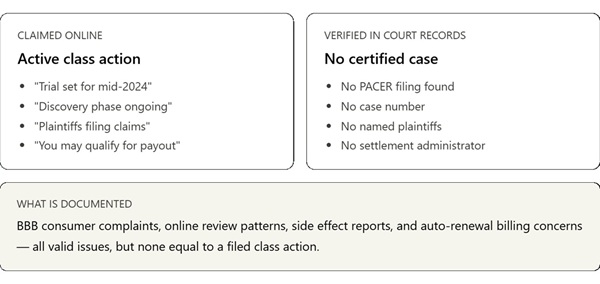
As of 2026, no verified class action lawsuit against Peptiva appears in federal court records (PACER). While numerous online articles describe a “Peptiva class action,” none cite a specific case number, plaintiff, or court. Real consumer complaints exist about false advertising, auto-renewal billing, and side effects — but no certified class action has been filed.
The “Peptiva lawsuit” widely discussed online cannot be verified through federal court databases. Multiple SEO-driven content sites describe an “active class action,” but none provide a case number, plaintiff name, court, or PACER docket. What is verifiable: real BBB complaints about Peptiva’s auto-renewal subscriptions, side effects including digestive discomfort and sleep disturbances, and pricing concerns. Consumers do have individual legal options under state consumer protection laws and California’s Automatic Renewal Law — even without a certified class action.
Introduction
If you’ve searched “Peptiva lawsuit” expecting to find an active class action with payouts, the verified picture is very different from what most online articles describe. While numerous content sites discuss a “Peptiva class action lawsuit,” extensive searches of federal court records reveal no certified case, named plaintiff, or specific case number. This article separates verified facts from SEO speculation. You’ll learn what Peptiva actually is, the real consumer complaints driving online concern, your actual legal options under U.S. consumer protection law, and how to spot misleading settlement claim sites. Every claim here is sourced from official records, consumer protection agencies, and verified BBB data.
What Peptiva Actually Is
Before evaluating any lawsuit claims, understanding the product matters.
Brand Background
- Product type: Dietary supplement (probiotic + sleep aid)
- Main marketing claims: Improves gut health, supports better sleep, reduces bloating
- Key ingredients: Probiotic strains, digestive enzymes, melatonin
- Sales model: Direct-to-consumer with subscription auto-renewal
- Pricing: Approximately $64.99-$70.63 per monthly subscription
- Distribution: Online direct sales, some retail availability
How Peptiva Is Marketed
The brand has been promoted with several recurring claims:
- “Nighttime probiotic that works while you sleep”
- Premium formulation for digestive health
- Free trial offers leading to recurring subscriptions
- Combined gut health and sleep benefits
- “Clinically studied” probiotic strains
The price point, subscription model, and aggressive marketing are at the center of most consumer complaints — but consumer complaints are not the same as a filed lawsuit.
The Verified Truth About a “Peptiva Lawsuit”
This is the most important section of this article.
What Court Records Actually Show
A thorough search of:
- PACER (Public Access to Court Electronic Records)
- CourtListener.com (free PACER alternative)
- State court databases
- FTC enforcement actions
- FDA recall database
- Major consumer class action trackers (ClassAction.org, TopClassActions.com)
reveals no verified certified class action against Peptiva as of early 2026.
Why Online Articles Describe a “Class Action” That Isn’t There
Multiple SEO-driven content sites publish articles describing a “Peptiva lawsuit” but share key warning signs:
| Red Flag | What It Means |
|---|---|
| No case number | No actual court filing referenced |
| No plaintiff name | No real party has been identified |
| No court of jurisdiction | Cannot be verified in any database |
| Vague timelines | “Began in early 2023” / “Trial set for mid-2024” without specifics |
| Generic legal language | Could apply to almost any product |
| No settlement administrator | No court-approved claim portal exists |
| No FDA recall | No regulatory action documented |
What This Doesn’t Mean
The absence of a certified class action does not mean:
- Peptiva is endorsed by regulators
- Consumer complaints are invalid
- The product is necessarily effective
- Marketing practices are above scrutiny
It simply means that, as of the latest court records, no formal certified class action has been filed.
Visual: Real vs. Rumored Peptiva Legal Status
Real Consumer Complaints About Peptiva
While no certified class action exists, real consumer complaints are well-documented across BBB, Reddit, Trustpilot, and major review platforms.
Common Marketing Complaints
- Health claims allegedly not supported by independent clinical trials at advertised dosages
- “Free trial” offers converting to paid subscriptions with confusing terms
- Premium pricing ($64.99-$70.63/month) compared to similar probiotics
- Vague claims about ingredient effectiveness
- Aggressive online and TV marketing
- Difficulty matching real-world results to advertised benefits
Common Subscription Complaints
- Auto-renewal enrollment without clear consent
- Two-week cancellation window allegedly hidden in fine print
- Difficulty canceling subscriptions by phone
- Unexpected charges after free trial conversion
- Continuing shipments after cancellation attempts
- Limited refund options
Common Side Effect Reports
Users have reported various reactions, though individual responses vary significantly:
- Digestive issues: bloating, stomach cramps, diarrhea
- Sleep disturbances: vivid dreams, restless nights
- Headaches and foggy thinking
- Allergic reactions to specific probiotic strains or inactive ingredients
- Continued symptoms after stopping the product
Important: These are user-reported experiences, not court findings. Individual responses to probiotics and melatonin vary widely based on existing health conditions, microbiome differences, and concurrent medications.
Your Actual Legal Options
Even without a certified class action, real legal remedies exist.
Federal Consumer Protection Tools
| Agency | Role |
|---|---|
| FTC | Federal Trade Commission enforces against deceptive advertising |
| FDA | Monitors dietary supplement safety and adverse events |
| CFPB | Consumer Financial Protection Bureau for billing disputes |
Key Laws That May Apply
- FTC Act Section 5 — prohibits deceptive marketing
- Federal Food, Drug, and Cosmetic Act — governs supplement labeling
- California Automatic Renewal Law (ARL) — requires clear subscription disclosure
- State consumer protection statutes — vary by state
- State warranty laws — implied warranty of merchantability
- ROSCA (Restore Online Shoppers’ Confidence Act) — federal subscription law
California Automatic Renewal Law Specifically
Under California Business and Professions Code Section 17602, supplement companies must:
- Present subscription terms clearly before payment
- Obtain affirmative consent to auto-renewal (no pre-checked boxes)
- Provide written acknowledgment after enrollment
- Disclose cancellation methods clearly
- Allow online cancellation for online enrollments
- Provide renewal reminders for subscriptions over $200/year
California ARL violations can result in full refunds, restitution, and attorney’s fees — even for individual cases.
Step-by-Step: What to Do If You Have a Peptiva Complaint
If you’ve had a negative experience with Peptiva, here are your real options.
- Document everything — receipts, marketing materials you saw, communication records
- Save all email confirmations from sign-up through current status
- Take screenshots of pre-purchase pages, terms, and cancellation policies
- Photograph product packaging and labels
- Note side effects with dates if applicable
- Consult a healthcare provider for any medical concerns
- Request a refund directly from Peptiva customer service
- Dispute charges with your credit card company (chargeback within 60-90 days)
- File a BBB complaint at bbb.org
- File an FTC complaint at reportfraud.ftc.gov
- File with your state attorney general — particularly active in California, New York, Texas
- Consult a consumer protection attorney for individual claim evaluation
Warning: Never pay fees to claim “settlement” compensation for a class action that hasn’t actually been filed. Real class actions never charge fees to participate.
How to Cancel a Peptiva Subscription
Among the most common reasons people search for the “Peptiva lawsuit” is cancellation difficulty.
Recommended Cancellation Steps
- Call Peptiva customer service directly
- Document the call — date, time, representative name
- State clearly: “I am canceling my subscription effective immediately. Please confirm in writing.”
- Request a confirmation number
- Demand email confirmation
- Check your account 24-48 hours later
- Monitor your credit card for 60 days
- Save all documentation
If Cancellation Fails
- Dispute charges with your credit card company
- File a BBB complaint with documented evidence
- File state attorney general complaint
- Contact your state’s consumer protection division
- Consider small claims court for amounts under your state’s limit
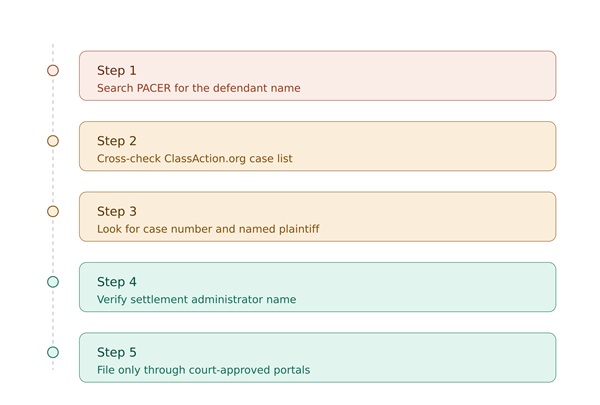
Visual: How to Verify Any Lawsuit Claim
Peptiva Lawsuit: Verified Facts vs. Online Claims (2026) — Continued
Comparison: Peptiva Complaint Categories
| Complaint Type | Verified Pattern | Best Legal Path |
|---|---|---|
| Auto-renewal billing | Well-documented across BBB | California ARL / state consumer law |
| Misleading marketing | Common reviewer concern | FTC complaint / state AG |
| Side effects | User-reported, variable | Healthcare consult + FDA MedWatch |
| Refund denials | Documented BBB issue | Credit card chargeback / BBB |
| Subscription cancellation | Frequent complaint | State AG / individual lawsuit |
Similar Supplement Brand Patterns
The Peptiva situation parallels several other supplement brands where viral “lawsuit” articles outpace verified court records.
Comparable Supplement “Phantom Lawsuit” Cases
| Brand | Online Claim | Verified Status |
|---|---|---|
| Mary Ruth Organics | “Active class action” | Only 2021 recall + 2022 trademark case |
| Peptiva | “Active class action” | No verified court filing |
| Various probiotic brands | “Class action lawsuits” | Many are speculation, not certified cases |
What Real Supplement Class Actions Look Like
Real supplement class actions that have actually been filed include:
- Bayer One A Day — settled false advertising claims ($3.3M, 2014)
- GNC — multiple settled cases over labeling
- Centrum — settled false advertising suit
- Airborne — $30M FTC settlement (2008)
These cases share what’s missing from the “Peptiva lawsuit” narrative: documented case numbers, named plaintiffs, court orders, and settlement administrators.
Red Flags Before Buying Any Supplement Subscription
The Peptiva situation offers practical lessons for any subscription supplement purchase.
Watch For These Warning Signs
- “Free trial” offers that auto-convert to paid subscriptions
- Pre-checked subscription boxes during checkout
- Hidden continuity programs in fine print
- Phone-only cancellation for online enrollments
- Long hold times designed to discourage cancellation
- Shipping intervals shorter than promised
- “Limited-time” pressure tactics
- Vague clinical claims without specific studies
- Difficulty obtaining refunds
- Collection agency threats for disputed charges
Smart Practices
- Use a virtual credit card that can be disabled easily
- Set bank account alerts for unexpected charges
- Screenshot all enrollment terms
- Pay with credit cards, not debit cards (better chargeback protection)
- Read all terms before clicking “submit”
- Cancel immediately if uncertain
- Save email confirmations from sign-up
FAQs
1. Is there a real Peptiva lawsuit?
As of 2026, no verified class action lawsuit against Peptiva appears in federal court records (PACER) or state court databases. While many online articles describe a “Peptiva class action,” none cite a specific case number, plaintiff name, or court of jurisdiction. Real BBB consumer complaints exist, but these are different from a certified class action.
2. Why do so many websites describe a Peptiva lawsuit?
Many SEO-driven content sites describe speculative lawsuits to capture search traffic. These articles often describe “what could happen if a lawsuit were filed” rather than verified court records. Without specific case numbers, named plaintiffs, or court documentation, these claims cannot be independently verified through PACER or other official legal databases.
3. Can I still get a refund from Peptiva without a class action?
Yes. Several options exist regardless of class action status: contact Peptiva customer service directly, file a credit card chargeback (typically within 60-90 days), submit a BBB complaint, contact your state attorney general’s consumer protection division, file with the FTC, or pursue individual legal action under your state’s consumer protection laws.
4. What are common Peptiva side effects?
User-reported side effects include digestive issues (bloating, stomach cramps, diarrhea), sleep disturbances (vivid dreams, restless nights), headaches, foggy thinking, and allergic reactions to probiotic strains or inactive ingredients. Individual responses vary significantly. Consult a healthcare provider for any concerning reactions and report serious adverse events to the FDA’s MedWatch program.
5. How do I cancel my Peptiva subscription?
Call Peptiva customer service directly. State clearly: “I am canceling my subscription effective immediately. Please provide a confirmation number and email.” Document the call date, time, and representative name. Monitor your credit card statement for 60 days. If charges continue, dispute them with your credit card company and file a BBB complaint.
6. Is Peptiva FDA approved?
No. Like all dietary supplements in the U.S., Peptiva is not FDA approved. The FDA does not pre-approve supplements before they reach the market. Manufacturers are responsible for ensuring their products are safe and labeling is accurate. The FDA can take action against unsafe supplements after they enter commerce, but no enforcement action against Peptiva has been documented.
7. How can I verify if a class action against any company exists?
Search PACER (pacer.gov) for federal cases, use CourtListener.com as a free alternative, or check ClassAction.org’s verified case list. A real class action always has a case number, named court, named plaintiffs, and (if settled) a court-approved settlement administrator. If a website claims a class action exists but cannot provide these details, treat the claim skeptically.
Key Takeaways
- No verified class action against Peptiva appears in federal court records as of 2026
- Online articles describing an “active Peptiva lawsuit” lack case numbers, plaintiffs, and court documentation
- Real consumer complaints exist — BBB filings, side effect reports, auto-renewal issues — but these are separate from filed lawsuits
- Common complaints include hidden auto-renewals, premium pricing ($64.99-$70.63/month), and difficulty canceling subscriptions
- California Automatic Renewal Law and FTC rules provide individual legal options even without a class action
- Verify any class action through PACER or court-approved settlement administrators before submitting personal information
- Never pay fees to file a class action claim — legitimate claims are always free
