


The 72 Sold lawsuit refers to a federal RICO racketeering case filed by former Keller Williams CEO John Davis in U.S. District Court (Western District of Texas), where 72 Sold is named as a co-defendant due to Gary Keller’s 49% ownership stake. No certified consumer class action against 72 Sold currently exists.
The verified 72 Sold lawsuit is a corporate RICO case (Davis v. Keller Williams et al.) — not a consumer class action. Originally filed August 2023, amended November 2023 and January 2025, the case names 72 Sold as one of several Keller Williams-affiliated entities allegedly involved in financial misconduct. The amended complaint describes 72 Sold’s marketing as “misleading national advertising.” Keller Williams calls the claims “baseless.” Despite widespread online speculation, no certified consumer class action against 72 Sold appears in court records.
When you search “72 Sold lawsuit,” you’ll find dozens of articles describing a “consumer class action” — but verified court records tell a different story. A real, ongoing federal lawsuit does name 72 Sold as a defendant, but it’s a corporate RICO case filed by former Keller Williams CEO John Davis, not a homeowner class action. This article separates verified court records from online speculation. You’ll learn what the real lawsuit involves, who 72 Sold actually is, what the company’s business model looks like, what homeowners can do if they feel misled, and how to protect yourself when using fast-sale real estate programs. Every fact here is sourced from federal court filings and major real estate industry publications.
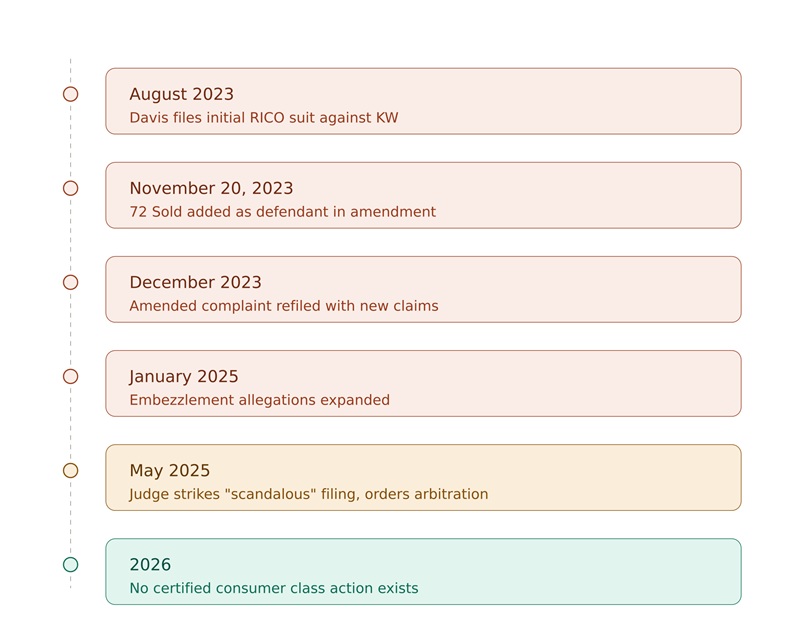
Visual Timeline of the 72 Sold Lawsuit
What 72 Sold Actually Is
Most online articles skip this part. Understanding what 72 Sold actually does is essential before evaluating the lawsuit.
Company Background
- Founded: 2018 in Scottsdale, Arizona
- Founder: Greg Hague, an attorney and entrepreneur
- Business model: Marketing-driven real estate program (NOT an iBuyer)
- Partner network: Licensed real estate agents, largely through Keller Williams
- Ownership: Gary Keller (Keller Williams co-founder) owns approximately 49%
What 72 Sold Is NOT
This matters because the model is often misunderstood:
- Not an iBuyer like Opendoor or Offerpad
- Not a direct home buyer
- Not a traditional brokerage
- Not a discount listing service
How the Model Works
72 Sold operates as a marketing and lead generation system for partner real estate agents. The pitch:
- Limited showings create competitive urgency
- Tight timeline (originally marketed as “72 hours”)
- Multiple offers from interested buyers within the window
- Higher prices through artificial scarcity
- Faster transactions for sellers wanting speed
The original tagline focused on selling “in 72 hours.” After legal scrutiny, the company has reportedly shifted language to describe the process as an “accelerated sale system” — a notable adjustment that reflects evolving advertising compliance concerns.
The Verified 72 Sold Lawsuit: John Davis v. Keller Williams
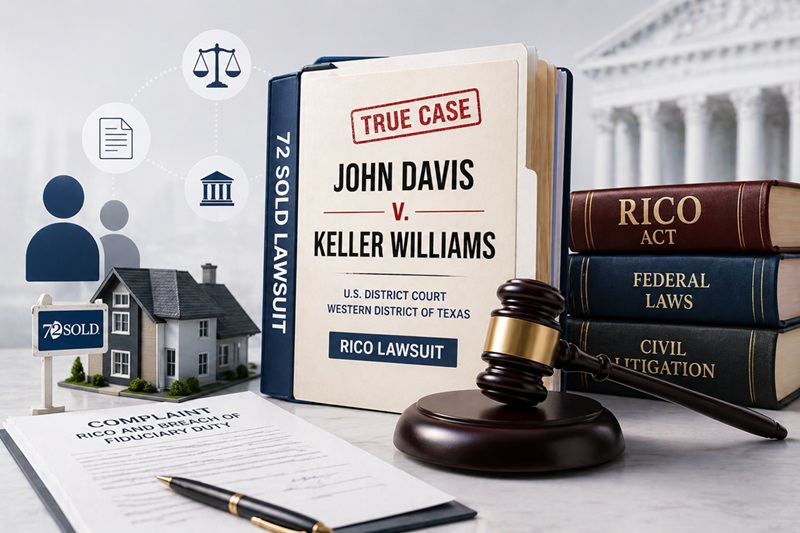
This is the actual federal lawsuit that names 72 Sold as a defendant.
Case Details
| Detail | Information |
|---|---|
| Plaintiff | John Davis (former Keller Williams CEO) |
| Co-plaintiff | Jesse Herfel (former KW Market Center owner) |
| Court | U.S. District Court, Western District of Texas |
| Original filing | August 2023 |
| Refiled | December 2023 |
| Amended | November 20, 2023 and January 2025 |
| Type | RICO racketeering and breach of fiduciary duty |
| Co-defendants include | Gary Keller, John Keller, Josh Team, Business MAPS, KWx, Livian, 72Sold, KW Southwest Region |
What 72 Sold Is Accused Of (in This Lawsuit)
The amended complaint specifically targets 72 Sold with these allegations:
- Mischaracterization — described as a “leads and marketing platform” but allegedly conducts “misleading national advertising”
- Coercion of franchisees — Keller Williams franchisees allegedly pressured to use 72 Sold
- Self-dealing — Gary Keller’s 49% ownership creating conflicts of interest
- Cyclical revenue scheme — fees from KW franchisees allegedly directed to 72 Sold and other Keller-owned entities
What This Lawsuit Is NOT
Critical distinction:
- Not a consumer class action — homeowners are not plaintiffs
- Not about specific homeowner damages — focused on franchisee/corporate harm
- Not about individual seller experiences — focused on alleged systemic patterns
- Not a settled case — actively contested and partly in arbitration
What This Lawsuit IS
- A corporate RICO case under federal racketeering law
- Active in federal court as of 2026
- Names 72 Sold as a co-defendant alongside Keller Williams
- Includes embezzlement allegations against Gary Keller
The Defendants’ Response
Keller Williams and its affiliated companies — including 72 Sold by association — have firmly denied all allegations.
Keller Williams’ Position
In multiple statements through spokesperson Darryl Frost, Keller Williams has called the claims:
- “Baseless allegations”
- A “public smear campaign” by Davis
- An “attempt to generate attention for false claims”
- “Untrue personal attacks”
The Arbitration Order
In May 2025, Magistrate Judge Hal R. Ray Jr. issued a notable ruling:
- Struck Davis’s “Demand for Arbitration” filing as “redundant, immaterial, impertinent, and scandalous”
- Did not hold Davis in contempt despite the defendants’ request
- Compelled parts of the dispute into arbitration twice
- The judge described certain Davis filings as containing “scandalous allegations”
This ruling weakens but does not end Davis’s case. The substantive RICO claims continue to move through court.
What the Filings Mean for 72 Sold
72 Sold itself has not been individually convicted or found liable. Its inclusion as a co-defendant reflects the business relationship with Keller Williams and Gary Keller’s ownership stake — not a direct judicial finding against the company’s consumer practices.
Why People Search “72 Sold Lawsuit” — and What They’re Actually Finding
The search volume around “72 Sold lawsuit” has multiple sources of confusion.
What Online Articles Often Claim
Many SEO-driven content sites describe:
- “Active consumer class actions” (no such certified case exists)
- “Multiple homeowner lawsuits” (most are individual disputes or arbitration cases)
- “Settlement payouts coming soon” (no settlement has been announced)
- “Hidden fee class actions” (these are speculative or unverified)
What Actually Exists
| Type | Verified Status |
|---|---|
| Davis v. Keller Williams RICO case | ✅ Active federal lawsuit, 72 Sold as co-defendant |
| Individual homeowner disputes | ✅ Some exist, but mostly through arbitration or private settlement |
| State AG actions | ❌ No major actions confirmed |
| FTC enforcement actions | ❌ No formal actions confirmed |
| Certified consumer class action | ❌ Does not exist as of 2026 |
How to Verify Yourself
Check official sources:
- PACER (pacer.gov) — search for “72 Sold” or “72Sold”
- CourtListener (courtlistener.com) — free PACER alternative
- ClassAction.org — verified class action list
- State court records in your jurisdiction
Common Homeowner Complaints
While no certified class action exists, homeowner complaints documented across BBB, online reviews, and industry coverage reveal recurring themes.
Most Frequent Complaints
- Sale timeline — homes not selling within advertised “72 hour” or “8 day” windows
- Below-expectation pricing — final sale prices lower than promised
- Marketing fees — averaging around $2,500 reportedly not always disclosed clearly
- Pressure tactics — sellers feeling pushed to accept early lowball offers
- Contract complexity — fine print clauses not clearly explained
- Commission structure — total costs sometimes comparable to traditional listings despite “savings” marketing
Real-World Complaint Examples
Documented in industry coverage:
- Phoenix, Arizona: A homeowner reported signing up expecting quick sale, then being asked to slash the price after several weeks with no serious offers
- Texas: A couple reported believing the program charged a flat fee, only to discover layered commission costs
- California: A seller reported receiving a low offer within days and feeling pressured to accept it to maintain the “72-hour” timeline
These examples illustrate the type of dispute that drives lawsuit-related searches — even though no certified class action has emerged.
Comparison: 72 Sold vs. Alternative Selling Methods

| Method | Speed | Cost Structure | Risks |
|---|---|---|---|
| 72 Sold | Marketing-driven urgency | Marketing fees + agent commission | Pricing pressure, timeline mismatch |
| Traditional Agent | 30–90 days typical | 5–6% commission | Slower, but more market exposure |
| iBuyer (Opendoor, Offerpad) | 7–14 days | Service fee + below-market offer | Lower price, faster cash |
| Real Estate Auction | Defined date | Auction fee + buyer premium | Reserve risk, market timing |
| For Sale by Owner | Variable | No commission, but more work | Pricing risk, marketing limits |
Setting Realistic Expectations
The choice depends on your priorities:
- Speed first? → iBuyers may match 72 Sold but with clearer pricing
- Maximum sale price? → Traditional agent likely better
- Avoiding pressure tactics? → For Sale by Owner or seasoned traditional agent
- Specific local market dynamics? → Consult an independent real estate attorney before signing
What to Do If You Believe You Were Misled
If you used 72 Sold and feel the marketing didn’t match reality, you have multiple paths forward.
Step-by-Step Action Plan
- Gather all documentation — contract, marketing materials, emails, texts
- Save promotional screenshots — ad copy, website claims at time of signup
- Review your contract carefully — look for arbitration clauses
- Document financial harm — fees, lost equity, time costs
- Calculate your statute of limitations — typically 2–6 years depending on state and claim type
- File a BBB complaint — creates public record
- File with state real estate commission — agent licensing concerns
- File with state attorney general — consumer protection issues
- Consult a real estate attorney — for individual claim evaluation
- Avoid signing settlement waivers without legal review
Watch for Arbitration Clauses
Many real estate marketing program contracts include mandatory arbitration clauses. These can:
- Prevent you from joining future class actions
- Force private dispute resolution
- Limit damages available
- Restrict your legal venue
If you’re considering signing with 72 Sold or any similar program, read the arbitration clause carefully before signing.
Individual vs. Class Action Path
| Factor | Individual Claim | Class Action |
|---|---|---|
| Speed | Faster (months) | Slower (years) |
| Recovery potential | Higher per person | Lower per person |
| Cost to pursue | Higher per person | Spread across class |
| Legal complexity | Personal counsel needed | Class counsel handles |
| Best for | Significant individual harm | Shared, smaller harm |
For homeowners with significant financial damages, an individual lawsuit is often more practical than waiting for a class action that may never be certified.
Red Flags When Considering Any Fast-Sale Program
The 72 Sold situation offers practical lessons for any homeowner evaluating accelerated selling programs.
Critical Red Flags
- Unrealistic guarantees — “We’ll sell your home in [X] days at [Y] price”
- Vague fee structures — total costs not clearly itemized upfront
- High-pressure sales — being pushed to sign immediately
- Mandatory arbitration — buried in contract fine print
- Performance claims without verification — promises with no independent backing
- Contracts difficult to exit — penalty clauses for backing out
- Limited window for review — “Sign today only” tactics
What to Verify Before Signing
- Total fees in writing — including all marketing, commission, and service charges
- Realistic timeline expectations — not just marketing claims
- Independent reviews — beyond company testimonials
- Local agent reputation — research who you’re actually working with
- Comparable sales data — what similar homes recently sold for in your market
- Cancellation terms — how to exit if it’s not working
- Attorney review — for high-value transactions, well worth $200–$500
How to Protect Yourself in Real Estate Transactions
Beyond the 72 Sold-specific concerns, these principles apply universally.
Best Practices
- Get everything in writing — verbal promises don’t count in court
- Compare at least 3 selling options — never accept the first pitch
- Read all contracts before signing — including all fine print
- Understand your local market — research recent comparable sales
- Ask about commission structures — get itemized breakdowns
- Document the agent’s promises — emails preferred over phone calls
- Know your rights — your state’s Department of Real Estate has resources
- Don’t sign under pressure — any legitimate program will give you time
Resources for Verification
- Your State Real Estate Commission — agent licensing and complaints
- Better Business Bureau — company complaint history
- State Attorney General — consumer protection
- Truth in Advertising (TINA.org) — investigates misleading marketing claims
How This Connects to the Broader Real Estate Industry
The 72 Sold lawsuit context fits a pattern of recent real estate legal activity.
Similar Industry Cases
- NAR Commission Settlement (2024) — National Association of Realtors paid $418 million to settle commission practices
- iBuyer Lawsuits — Opendoor faced FTC enforcement over marketing claims
- DOJ Investigations — Continuing scrutiny of real estate commission structures
Implications for Sellers
These cases collectively suggest:
- Increased transparency requirements likely coming
- Marketing claims facing more legal scrutiny
- Commission structures continuing to evolve
- Consumer protection emerging as a major industry theme
For homeowners, this means more options and more disclosure are coming — but also that any “guarantee” should be evaluated skeptically.
FAQs
1. Is there a real lawsuit against 72 Sold?
Yes — but it’s a corporate RICO case, not a consumer class action. Former Keller Williams CEO John Davis filed a federal racketeering lawsuit naming 72 Sold as a co-defendant due to Gary Keller’s 49% ownership stake. The case is active in U.S. District Court, Western District of Texas. No certified consumer class action exists.
2. Why does 72 Sold appear in the Davis lawsuit?
The amended complaint accuses 72 Sold of conducting “misleading national advertising” and being part of a Keller-controlled corporate scheme. Gary Keller owns approximately 49% of 72 Sold. The lawsuit alleges Keller pressured Keller Williams franchisees to use 72 Sold, creating self-dealing and conflicts of interest. 72 Sold is named as part of broader allegations against Keller Williams.
3. Can homeowners sue 72 Sold individually?
Yes, but only if you can demonstrate specific harm — like breach of contract, misrepresentation, or fraud. Statutes of limitations vary by state (typically 2-6 years). Many 72 Sold contracts include mandatory arbitration clauses that may prevent court lawsuits. Consult a real estate attorney to evaluate your individual situation. Document everything before pursuing legal action.
4. Is 72 Sold an iBuyer?
No. 72 Sold is a marketing and lead generation program for licensed real estate agents — not a direct home buyer like Opendoor or Offerpad. Sellers still go through traditional closing processes with partner agents (mostly Keller Williams). The “72 Sold” branding refers to the urgency-based sales method, not how the homes are purchased.
5. What does the “72 hours” claim mean?
Originally, 72 Sold marketed itself as selling homes “in 72 hours.” After legal scrutiny, the company has reportedly described the process as an “accelerated sale system.” The 72-hour window typically refers to the showings and offer period — not the full transaction. Actual closing still takes weeks. Marketing language has reportedly been adjusted for compliance.
6. How can I verify a class action lawsuit exists?
Search PACER (pacer.gov) for federal court cases — registration is free and most users pay no fees. Cross-reference at ClassAction.org for verified certified cases. Use CourtListener.com for free PACER alternative access. Real class actions always have a specific case number, named court, and named plaintiffs. If a website claims a class action exists but cannot provide these details, treat the claim with skepticism.
7. Should I avoid 72 Sold because of the lawsuit?
That’s a personal decision based on your circumstances. The lawsuit doesn’t prevent the company from operating, and many homeowners report positive experiences. Risks include marketing claims potentially not matching results, hidden fees, and pressure tactics. Verify all claims, get fees in writing, read all contract clauses (especially arbitration), and consider getting attorney review before signing.
Key Takeaways
- The verified 72 Sold lawsuit is a corporate RICO case (Davis v. Keller Williams) — not a consumer class action
- 72 Sold is named as a co-defendant due to Gary Keller’s 49% ownership stake
- The amended complaint accuses 72 Sold of “misleading national advertising”
- Keller Williams calls all allegations “baseless” and contests the case
- No certified consumer class action against 72 Sold exists in court records
- Individual homeowners can pursue separate legal claims if they can prove specific harm
- Many 72 Sold contracts include mandatory arbitration clauses worth reviewing carefully
