

Multiple Credit One Bank lawsuits exist alleging TCPA robocall violations and credit reporting issues — but the widely circulated “$14 million class action settlement” with “$1,000 per person” payouts has not been verified by court records as of late 2025. Always check official settlement administrator websites before filing any claim.
Credit One Bank faces multiple class action lawsuits alleging TCPA violations, harassing phone calls, and credit reporting errors. The viral “$14 million settlement” reported by numerous outlets in 2025 was flagged by The National Law Review as potentially a “phantom settlement” — possibly confused with an unrelated case. Verified active cases include Jefferson v. Credit One Bank (Northern District of Illinois) and Snyder v. Credit One Bank (Southern District of Florida, filed December 2025). No official claim portal currently exists for the rumored $14M settlement.
If you’ve seen viral headlines about a “$14 million Credit One Bank settlement” with “$1,000 payouts per person,” you’re not alone — and you should be cautious. While Credit One Bank does face multiple legitimate lawsuits, the most-shared settlement story of 2025 was flagged by leading legal publications as unverified. This article gives you the truth: which Credit One Bank lawsuits are real, which settlements have actually been confirmed in court, how to spot scam claim sites, and what your rights actually are under the Telephone Consumer Protection Act (TCPA). Every fact here is sourced from court filings, federal statutes, and verified legal news.
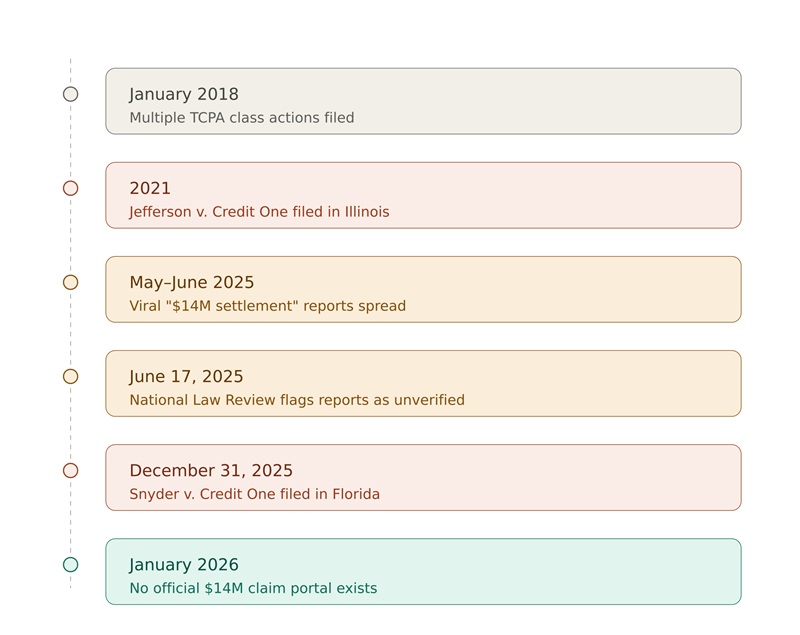
Visual Timeline of Credit One Bank Litigation
The “$14 Million Settlement” Story — What’s Actually Verified
This is the single most important section of this article. If you’ve heard about a “$14 million Credit One Bank settlement” promising “$1,000 payouts,” read this carefully before doing anything.
What the Viral Reports Claim
Multiple outlets — including FX Street, MSN, Hindustan Times, Times Now News, and various smaller content sites — published articles in May and June 2025 claiming:
- Credit One Bank settled a TCPA class action for $14 million
- Eligible class members would receive up to $1,000 each
- The class period covers 2014–2019 robocalls
- A claim portal would soon open
What the National Law Review Said
On June 17, 2025, attorney Eric J. Troutman published an analysis at The National Law Review titled: “PHANTOM TCPA SETTLEMENT?: Numerous Outlets Are Reporting Credit One Has Settled a TCPA Class Action for $14MM– But Has It?”
The analysis concluded:
- The viral articles appeared to confuse a different settlement unrelated to TCPA
- Sources cited back to a Reddit article rather than verified court records
- No matching court-approved $14M Credit One TCPA settlement could be confirmed
What This Means for You
If you submitted information to a claim form for this settlement, you should:
- Stop sharing personal information unless you can verify the source
- Check official settlement administrators like ClassAction.org’s verified case list
- Search PACER (Public Access to Court Electronic Records) directly
- Be alert for scam recovery sites that ask for fees to “process” claims
Critical: No legitimate class action settlement requires you to pay a fee to file a claim. If anyone asks for payment, it’s a scam.
Verified Credit One Bank Lawsuits
Several Credit One Bank lawsuits are confirmed in federal court records.
Jefferson v. Credit One Bank (2021)
- Case: Adriane Jefferson v. Credit One Bank, NA
- Case number: 1:21-cv-00532
- Court: U.S. District Court, Northern District of Illinois
- Allegation: Repeated unsolicited prerecorded marketing calls in violation of the TCPA
The plaintiff alleged Credit One Bank called her cell phone repeatedly with prerecorded messages even after she requested they stop. The case sought class certification on behalf of similarly affected consumers.
Snyder v. Credit One Bank (December 2025)
- Case: Joseph Nicos Snyder v. Credit One Bank, N.A.
- Case number: 1:25-cv-26172
- Court: U.S. District Court, Southern District of Florida
- Filed: December 31, 2025
- Plaintiff’s attorney: Simeon Genadiev (The G Law Group P.A.)
Key allegations:
- Unsolicited telemarketing calls without prior express written consent
- Calls made through automatic telephone dialing systems (ATDS)
- Continued calls after explicit opt-out requests
- Failure to maintain an internal do-not-call list
- Calls made to numbers on the National Do Not Call Registry
Damages sought:
- $500 per negligent TCPA violation
- $1,500 per willful TCPA violation
- Class certification, injunctive relief, fees, and a jury trial
2018 TCPA Class Actions
Multiple proposed class actions were filed in January 2018 alleging TCPA violations and improper debt collection practices. These cases established the pattern of TCPA-based claims that continues today.
What Is the TCPA and How Does It Apply?
Most Credit One Bank lawsuits invoke the Telephone Consumer Protection Act (TCPA) — a federal law that’s the foundation of consumer phone protection.
Core TCPA Rules
The TCPA prohibits:
- Robocalls to cell phones without prior express written consent
- Prerecorded marketing calls to landlines without consent
- Calls to numbers on the National Do Not Call Registry
- Use of automatic telephone dialing systems (ATDS) without consent
- Failure to honor opt-out requests promptly
- Failure to maintain internal do-not-call lists
TCPA Damages
The TCPA provides specific statutory damages:
| Violation Type | Damages Per Call |
|---|---|
| Negligent violation | $500 |
| Willful or knowing violation | Up to $1,500 |
These damages stack per call — meaning 10 unwanted robocalls could mean $5,000–$15,000 in statutory damages.
Recent FCC Update
The FCC pushed back the TCPA Consent Revocation Rule to a new effective date of January 31, 2027. This means companies still have time to adjust their consent revocation procedures, but consumers’ core TCPA rights remain unchanged.
Three Categories of Credit One Bank Class Actions
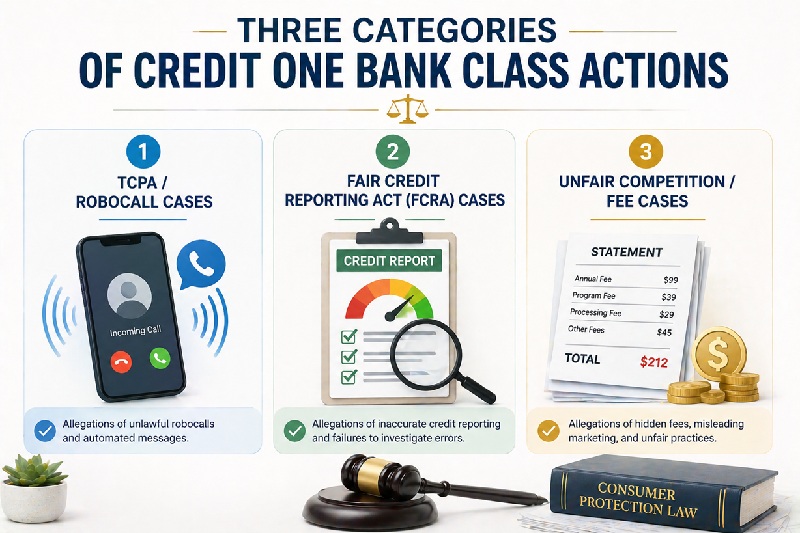
Most Credit One Bank lawsuits fall into one of three legal categories.
1. TCPA / Robocall Cases
The largest category of Credit One Bank litigation. Allegations include:
- Use of automatic dialing systems
- Prerecorded voice messages
- Calls without prior consent
- Continued calls after opt-out requests
These cases rely on the Telephone Consumer Protection Act and offer statutory damages of $500–$1,500 per violation.
2. Fair Credit Reporting Act (FCRA) Cases
Some lawsuits allege Credit One Bank reported inaccurate information to credit bureaus (Experian, Equifax, TransUnion) and failed to:
- Investigate consumer disputes properly
- Correct demonstrably wrong data
- Update information after disputes were upheld
The FCRA imposes specific obligations on data furnishers — and violations create grounds for individual or class action lawsuits.
3. Unfair Competition / Fee Cases
These cases challenge:
- Annual fees and processing fees that reduce initial credit limits
- Late fees and over-limit fees allegedly excessive or non-compliant with state laws
- Add-on product charges (like credit protection insurance) without proper consent
- Express payment fees allegedly improperly disclosed
A previous class action alleged Credit One earned more than $5 million through express payment fees.
Comparing Credit One Bank Lawsuits
| Case | Year | Court | Type | Status |
|---|---|---|---|---|
| Jefferson v. Credit One | 2021 | N.D. Illinois | TCPA robocalls | Active |
| Snyder v. Credit One | Dec 2025 | S.D. Florida | TCPA telemarketing | Active (recently filed) |
| 2018 TCPA actions | 2018 | Various | TCPA + debt collection | Various outcomes |
| Express Payment Fees case | Earlier | — | Hidden fee claims | Settled / resolved |
| “$14M Settlement” reports | 2025 | — | TCPA (alleged) | Unverified |
How to Spot a Scam Settlement Claim Site
The phantom $14M settlement story shows why caution matters. Use these red flags to identify scam claim sites.
Major Red Flags
- Requests for upfront fees — legitimate settlements never charge to file claims
- Asks for Social Security numbers before claim processing officially begins
- Promises specific large payouts — actual TCPA settlements rarely exceed $300–$900 per person after class division
- Urgency tactics — “Only X spots left” or “Apply in next 24 hours”
- No court case number listed
- No settlement administrator name
- Cannot be verified at ClassAction.org or PACER
- Generic email contact only — no phone or physical address
How to Verify a Real Settlement
Always check these official sources:
- ClassAction.org — maintains a verified case list
- TopClassActions.com — official settlement notices
- PACER (pacer.gov) — direct federal court records
- Settlement administrator websites ending in court-approved domains
- Your state attorney general’s office
Pro tip: A real class action settlement always has a court case number and an independent settlement administrator — usually firms like JND Legal Administration, Epiq, or Angeion Group.
Step-by-Step: What to Do If You Received Robocalls from Credit One
If you’ve experienced unwanted Credit One Bank calls and believe your TCPA rights were violated, here’s the legitimate process.
Building Your Documentation
- Save call records — phone bills, screenshots of caller ID
- Save voicemails — both robocalled messages and human follow-ups
- Document opt-out requests — date, time, what you said, employee name
- Keep copies of any letters sent to Credit One requesting calls stop
- Save written records of any Do Not Call list registration
- Note dates and times of every unwanted call
Verifying Settlement Eligibility
- Search ClassAction.org for active Credit One Bank cases
- Check PACER directly for case status
- Look up your specific state’s consumer protection office
- Watch for official notice mail or email from court-approved administrators
If No Active Class Settlement Applies
You can still pursue individual TCPA claims:
- File complaints with the FCC (fcc.gov/consumers/guides/stop-unwanted-robocalls)
- File complaints with the FTC (donotcall.gov)
- Consult a TCPA attorney — most work on contingency
- Small claims court for individual TCPA damages ($500–$1,500 per call)
Using a Consumer Protection Attorney
TCPA attorneys typically:
- Offer free consultations
- Work on contingency (no upfront fees)
- Take cases for 20+ documented unwanted calls
- Settle individual cases for $500–$1,500 per provable violation
The Capital One Connection: What’s Actually Happening
Some of the confusion around the “$14M Credit One settlement” may stem from confusion with Capital One — a separate, larger bank.
Capital One 360 Savings Account Interest Rate Litigation
This is a different and unrelated case:
- The Capital One 360 case had a final approval hearing scheduled for November 6, 2025
- It involves alleged interest rate practices, not robocalls
- It is not a Credit One Bank case
Why This Matters
Some content websites may have conflated the two banks when reporting on settlement timelines, contributing to the misinformation around Credit One.
Don’t confuse them: Credit One Bank, N.A. (Las Vegas-based, focused on subprime credit cards) is completely separate from Capital One Financial Corporation (one of the largest US banks).
Common Credit One Bank Complaints
Beyond formal lawsuits, common consumer complaints about Credit One Bank include:
- Aggressive marketing calls to current and former customers
- High annual fees on subprime cards
- Membership fees that reduce initial credit limits
- Express payment fees charged for fast payment processing
- Difficulty closing accounts
- Repeated robocalls even after opt-out requests
- Credit reporting errors that take time to resolve
These complaints can serve as the basis for individual claims, even outside of class actions.
Your Rights Under the TCPA: A Quick Reference
| Right | Source | Damage |
|---|---|---|
| Free from robocalls without consent | TCPA § 227(b) | $500–$1,500 per call |
| Free from telemarketing if registered on DNC | TCPA § 227(c) | $500–$1,500 per call |
| Right to revoke consent at any time | TCPA + FCC rules | $500–$1,500 per post-revocation call |
| Right to sue in state or federal court | Private right of action | Statutory + actual damages |
What’s Next for Credit One Bank Litigation
Several developments will shape the legal landscape through 2026.
Active Cases to Watch
- Snyder v. Credit One Bank (Southern District of Florida, filed Dec 2025) — newest TCPA class action
- Jefferson v. Credit One Bank (Northern District of Illinois) — earlier TCPA case still active
- Other TCPA class actions filed in various federal courts
Potential Industry Impact
- FCC Consent Revocation Rule takes effect January 31, 2027
- More TCPA enforcement expected as robocall complaints continue
- AI-driven calls create new legal questions
- Subprime credit card industry continues to face scrutiny
FAQs
1. Is the Credit One Bank $14 million settlement real?
The widely circulated reports of a $14 million Credit One Bank TCPA settlement were flagged by The National Law Review in June 2025 as a potential “phantom settlement” — meaning it could not be verified in court records. Many outlets cited a Reddit post rather than primary sources. As of late 2025, no official claim portal exists.
2. How can I verify a real Credit One Bank class action?
Check ClassAction.org for verified active cases, search PACER (pacer.gov) for federal court records by case name and number, and only file claims through court-approved settlement administrators. Real settlements never charge fees and always have a documented case number from a federal or state court.
3. Can I still sue Credit One Bank for robocalls?
Yes. The Telephone Consumer Protection Act (TCPA) provides individual rights to sue for $500–$1,500 per unauthorized robocall. You don’t need a class action to file a TCPA claim. Document all calls carefully, save voicemails, record opt-out requests, and consult a TCPA attorney for free consultation.
4. How much can I win in a TCPA lawsuit against Credit One?
Statutory damages range from $500 per negligent violation to $1,500 per willful violation. If you received 20 unauthorized robocalls, potential damages could range from $10,000 to $30,000. Most cases settle for less than the maximum, but well-documented TCPA cases routinely settle for several thousand dollars.
5. Is Credit One Bank the same as Capital One?
No. Credit One Bank, N.A. is a Las Vegas-based bank focused on subprime credit cards. Capital One Financial Corporation is one of the largest US banks with diverse consumer products. They are completely separate companies. Confusion between the two has contributed to misinformation about settlements affecting one but not the other.
6. What should I do if Credit One Bank keeps calling me?
Send a written cease-and-desist letter via certified mail demanding all calls stop. Document every subsequent call with date, time, and content. Register your number with the National Do Not Call Registry at donotcall.gov. File complaints with the FCC and FTC. After 5+ continued calls, consult a TCPA attorney for potential individual claims.
7. Are Credit One Bank fees subject to lawsuits?
Yes. Multiple class actions have challenged Credit One Bank’s annual fees, processing fees, late fees, and add-on product charges. A previous case alleged the bank earned over $5 million through express payment fees. Fee-based lawsuits typically rely on state consumer protection laws and require documentation of disclosure failures.
Key Takeaways
- The viral “$14 million Credit One Bank TCPA settlement” was flagged by The National Law Review as potentially unverified — no official claim portal exists
- Multiple legitimate Credit One Bank lawsuits do exist, including Snyder v. Credit One (filed December 2025) and Jefferson v. Credit One (2021)
- TCPA violations carry statutory damages of $500 per negligent call and up to $1,500 per willful call
- Always verify settlements through ClassAction.org, PACER, or court-approved settlement administrators
- Never pay fees to file a class action claim — legitimate claims are always free
- Consumers can pursue individual TCPA claims even without a class action settlement
- Credit One Bank and Capital One are different companies — don’t confuse settlement news between them
