
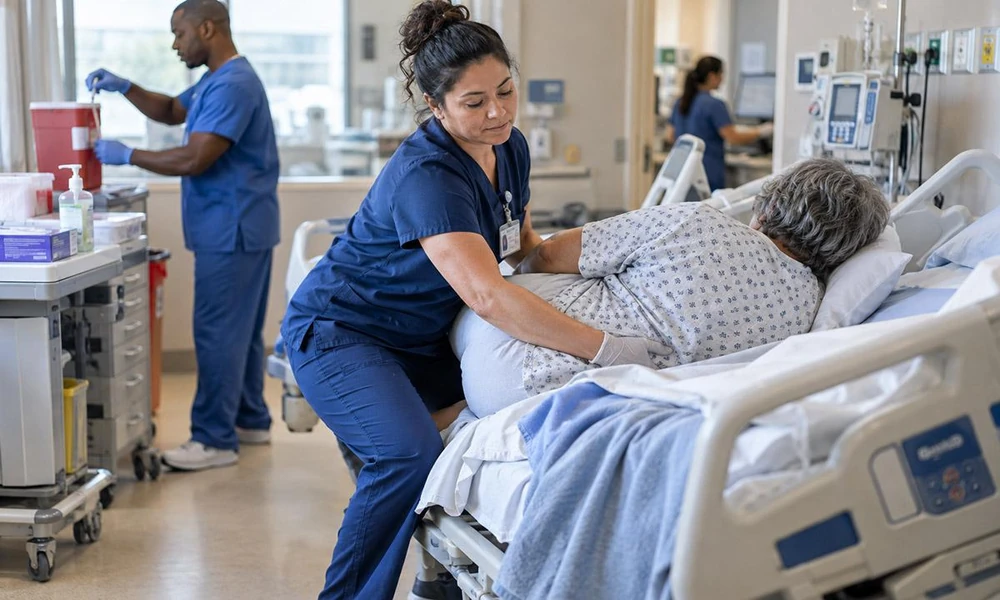

Healthcare workers, especially nursing assistants, get hurt at some of the highest rates of any job. Most injuries come from lifting and moving patients, plus needlesticks and violence. In California, these are workers’ comp injuries no matter who was at fault. Report your injury to your employer right away (the legal outer limit is 30 days) and ask for the DWC-1 claim form. Firing or punishing you for filing a claim is illegal.
The patient starts to slide during a transfer. You catch them, and something in your lower back pulls hard. Many healthcare worker injuries happen exactly like this, in one fast second, and then you finish the shift because the unit is short-staffed.
Now it is the next morning, and you can barely bend down to put on your shoes. Or maybe it was a needle that slipped during disposal. Maybe a confused patient hit you in the face.
You are trained to put patients first. You may worry that reporting this will put your job at risk. Here is the truth: your injury matters too, and California law takes it seriously.
This guide covers the most common injuries in hospitals, nursing facilities, and home care. It explains the safety rules that protect you, the workers’ comp deadlines you cannot miss, and how the law protects your job when you file.
Why Healthcare Worker Injuries Are So Common
Quick take: Healthcare is one of the most physically risky fields in the country. Nursing assistants have one of the highest injury and illness rates of any job, and moving patients is a big reason why.
According to the U.S. Bureau of Labor Statistics, nursing assistants and orderlies have one of the highest injury and illness rates of all occupations. OSHA reports that in 2020, musculoskeletal disorders (injuries to muscles, joints, tendons, and nerves) made up 52% of nursing assistants’ cases that required days away from work. Our guide to the most common workers’ comp injuries covers other fields.
Registered nurses face similar risks. BLS data for 2021-22 shows nurses in private industry had 220.9 days-away-from-work cases per 10,000 full-time equivalent workers, about double the all-occupation rate of 112.9. Their rate of injuries from violence was 16.6, compared with 4.3 for all workers.
Common injuries include:
- Back and shoulder strains from transferring or repositioning patients
- Needlesticks and cuts from sharps
- Assaults by patients or visitors
- Slips on wet floors and exposure to infectious disease
Lifting and Patient-Handling Injuries: Your Rights Under California Law
Quick take: A lifting injury is a workers’ comp injury, even if you think you “lifted wrong.” In a California general acute care hospital, your employer must also follow safe patient handling rules.
Workers’ comp is a no-fault system. You do not have to prove your employer did anything wrong, and your own mistake does not cancel your claim. You only need to show the injury came from your work.
California also has specific lifting rules. Labor Code 6403.5 took effect on January 1, 2012, and the regulation that carries it out took effect on October 1, 2014. According to Cal/OSHA, these rules apply to general acute care hospitals, not nursing facilities, clinics, or home health (though workers there are still covered by workers’ comp).
What the Safe Patient Handling Rules Require
Under Title 8, Section 5120, hospitals that are covered must:
- Have lift teams or other trained workers available on each unit
- Give refresher training at least every 12 months
- Respect your right to refuse a lift because of safety concerns
- Investigate patient-handling injuries
A violation of these rules does not create a separate lawsuit against your employer. But the facts can be strong evidence that your injury came from work.
Documenting a Lifting Injury
- Write down the transfer, the time, and the unit
- Note whether lift equipment or a lift team was available
- List coworkers who were present
- See a doctor and describe exactly how it happened
Our guide on proving you hurt your back at work goes deeper. What you write down today becomes your evidence.
“Catching a falling patient is part of the job. Paying for that injury yourself is not.”
Needlesticks and Blood Exposure: What to Do in the First Hours
Quick take: Report a needlestick or blood exposure right away. Your employer must offer a confidential medical evaluation and follow-up at no cost to you.
California’s Bloodborne Pathogens standard requires employers to make a free, confidential post-exposure evaluation available immediately. The employer must also record the incident in its Sharps Injury Log within 14 working days after it is reported. That is the employer’s deadline, not yours, and a claim filed now protects you if an infection is diagnosed later.
The CDC says the risk of getting HIV from a needlestick is less than 1%. If post-exposure prophylaxis (PEP, medicine that can prevent HIV infection) is needed, it must start within 72 hours, and sooner is better.
Your first-hours checklist:
- Wash the site with soap and water
- Tell your supervisor or charge nurse right away
- Go to employee health or the emergency room and ask about PEP
- Write down the device type and the procedure
- Request the DWC-1 claim form
Workplace Violence Against Nurses and Aides
Quick take: An assault by a patient or visitor is a workplace injury. California has a specific workplace violence standard for healthcare settings, and covered employers must log violent incidents.
Title 8, Section 3342 covers health facilities, home health care and hospice, emergency medical services, and drug treatment programs, among other settings. Covered employers must keep a violent incident log. Certain hospitals must report some incidents to Cal/OSHA within 24 hours (for example, an injury or a weapon) or within 72 hours.
Many medical offices fall outside that rule. Since July 1, 2024, Labor Code 6401.9 has required most other California employers to have a workplace violence prevention plan.
After an assault:
- Report every incident, even ones that seem minor
- Get medical care and photograph bruises, bites, or scratches
- Tell your doctor about anxiety, sleep problems, or fear of returning to work
- Keep incident numbers and security reports
Claims for psychiatric injury (mental or emotional harm) have extra legal requirements in California. Get advice before you count on that part of your claim.
“Getting hit by a patient is not part of the job. It is a workplace injury.”
How to File a Workers’ Comp Claim as a Healthcare Worker (Deadlines That Matter)
Quick take: Tell your employer in writing as soon as possible, and no later than 30 days. Your employer must give you a DWC-1 claim form within one working day of learning about the injury.
A fast, written record makes it harder for an insurance adjuster to question whether your injury really happened on the job. Our workers’ compensation attorney page explains the full process.
Key deadlines:
- Report to your employer: within 30 days (Labor Code 5400)
- Employer gives you the claim form: within one working day (Labor Code 5401)
- Employer authorizes treatment: within one working day after you file, up to $10,000 while the claim is pending (DWC)
- Decision: if not denied within 90 days, the claim is presumed covered (Labor Code 5402)
- Outer filing limit: generally one year from the injury or last benefit (Labor Code 5405)
Documents to gather:
- Your DWC-1 with a date stamp, or a certified mail receipt
- Incident report and log entry numbers
- Employee health records and your shift schedule
- Witness names and photos of your injuries
Per Diem, Travel Nurses, and Home Health Aides: Special Situations
Quick take: You are still covered if you work through a staffing agency or in a patient’s home. But a different company may handle your claim, so confirm your employer of record first.
Travel and Per Diem Nurses From Staffing Agencies
The staffing agency usually carries your workers’ comp insurance. Labor Code 3602 allows the agency and the facility to arrange coverage between them. Report the injury to both your agency and your facility supervisor.
Home Health Aides and IHSS Providers in Orange County
Workers’ comp covers In-Home Supportive Services (IHSS) providers. The Orange County IHSS Public Authority says benefits are handled through Intercare and asks providers to report an injury within 24 hours through the recipient’s IHSS social worker. That is a program instruction, and the legal notice deadline is still 30 days. Healthcare is among the common claim industries in Orange County, as our Orange County workers’ compensation attorney page explains.
Aides who work for a private home health agency submit claims through that agency’s insurance carrier. Either way, take these steps:
- Get the name of the insurance carrier or claims administrator
- Keep your assignment contracts
- Report to every supervisor involved
Retaliation and Third-Party Claims: Protecting Your Job and Your Full Recovery
Quick take: Your employer cannot legally fire, threaten, or punish you for filing a workers’ comp claim. If someone other than your employer caused the injury, you may also have a separate personal injury claim.
Retaliation Protection (Labor Code 132a)
Labor Code 132a bans discrimination against a worker for filing, or planning to file, a claim. Remedies can include a 50% increase in compensation (capped at $10,000), costs up to $250, reinstatement, and lost wages. A petition generally must be filed with the Workers’ Compensation Appeals Board within one year of the discriminatory act.
When a Third Party Is Responsible (Labor Code 3852)
Workers’ comp is usually your only remedy against your employer. But Labor Code 3852 keeps your right to pursue someone else who caused the harm. Our guide to workers’ comp vs. personal injury in California shows how the two claims fit together. Examples include:
- The maker of a defective bed, lift, or sharps device
- A visitor or another company’s worker who injured you
- A driver who hit you between home health visits
Key Takeaways
- Lifting injuries, needlesticks, and patient assaults are workers’ comp injuries in California, no matter who was at fault.
- Report your injury in writing right away, because the legal outer limit for notice is 30 days.
- After a needlestick, get evaluated immediately, because HIV PEP must start within 72 hours.
- Firing or punishing you for filing a claim violates Labor Code 132a.
- A defective device or a person outside your workplace may support a separate personal injury claim.
This article is for general information only and is not legal or medical advice. Every case depends on its specific facts, and past results do not guarantee future outcomes.
Healthcare Worker Injuries Deserve the Same Care You Give Patients
You spent your shift taking care of everyone else. Now it is your turn. Report your injury early, keep copies of everything, and remember that the law protects your job when you file a claim.
Oracle Law Firm represents injured workers across Orange County and Los Angeles, including nurses, CNAs, techs, and home health aides, and our Spanish-speaking team is ready to help. Been in an accident or hurt on the job? You don’t have to navigate insurance companies alone. Oracle Law Firm fights to get you the compensation, control, and clarity you deserve.
Get a Free Consultation or call 888.597.4099.
Frequently Asked Questions
Can a nurse get workers’ comp for a back injury from lifting a patient?
Yes. California workers’ comp is a no-fault system, so you do not have to prove anyone did something wrong. Report the injury in writing within 30 days and file the DWC-1 claim form.
What should I do right after a needlestick at work in California?
Wash the site and report it to your supervisor immediately. Your employer must provide a free, confidential medical evaluation. If HIV PEP is recommended, it must start within 72 hours, so get seen right away and file the DWC-1 claim form.
Can my hospital fire me for filing a workers’ comp claim?
No. Labor Code 132a makes it illegal to fire, threaten, or punish you for filing or planning to file a claim. Remedies can include reinstatement and lost wages.
I’m a travel nurse. Who pays my workers’ comp in California?
Usually the staffing agency’s insurance carrier handles your claim, but the agency and the facility can arrange coverage between them. Report your injury to both, and ask who the claims administrator is.
Can I sue if a patient or visitor assaulted me at work?
Workers’ comp covers your injury, and suing your employer is generally not allowed. A separate claim against a third party, such as a visitor, may be possible depending on the facts. Whether it makes sense often depends on whether that person has insurance or assets to pay.
